
Angi reports a 2026 US estimate of about $271 to $1,726 per visit for a sewer camera inspection. Another consumer cost guide reports a broad range of about $200 to $1,300 or more for camera inspection associated with a main-line service. Treat those as planning observations, not a standardized price list. The cost depends on access, line length, cleaning, recording, locating, urgency, and how much interpretation the provider supplies.
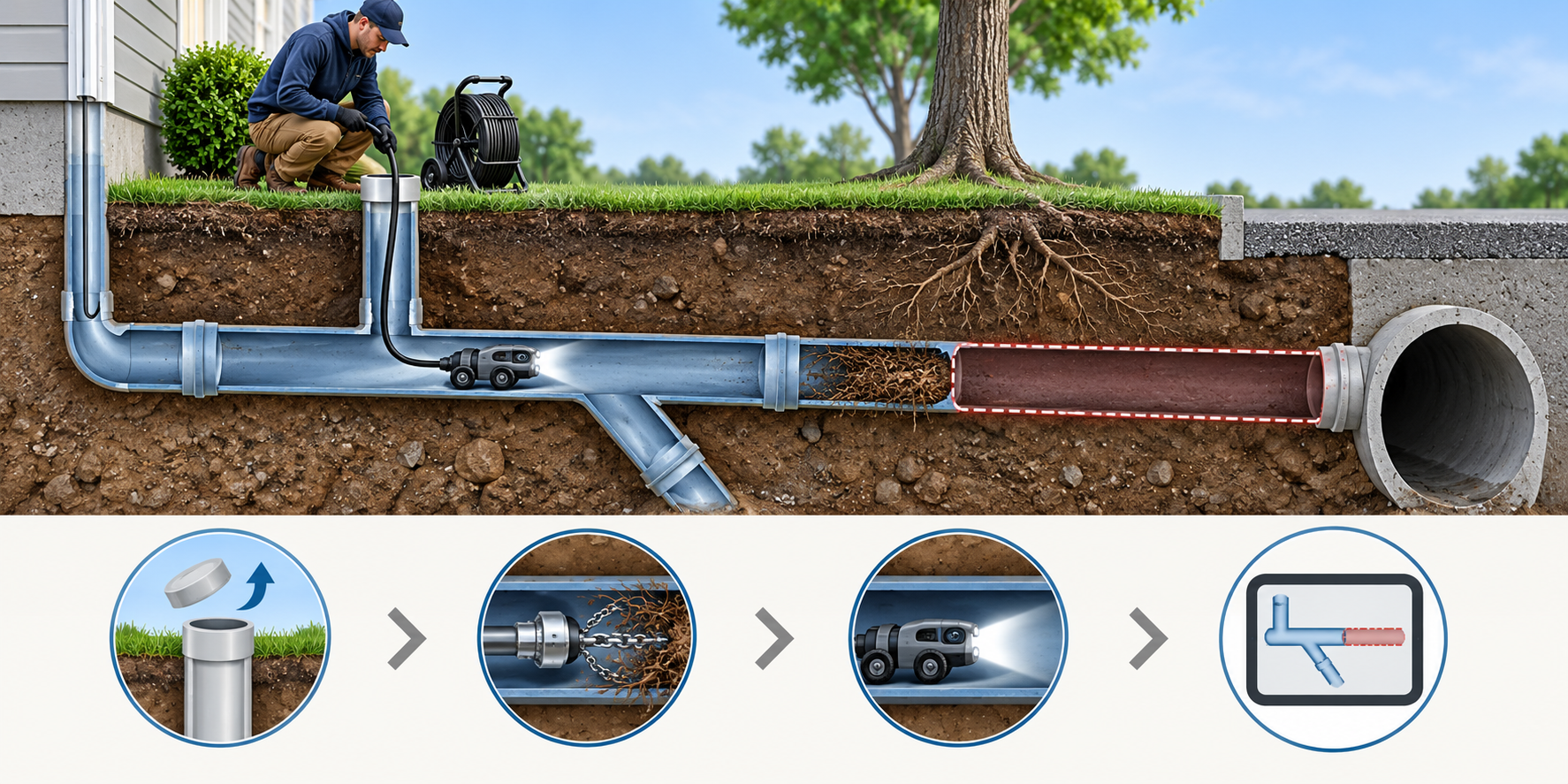
What a useful inspection includes
A camera service should identify the pipe segment inspected, the access point, the direction of travel, and the portion that could not be viewed. Useful deliverables may include a video, timestamps or distance markings, photographs, a written report, a marked route or depth estimate, and a clear statement of findings and limitations.
Inspection direction is not universal. NASSCO describes building-sewer and drain inspections as typically proceeding from the building side toward the main, while a lateral inspection program may proceed from the main toward the building without entering it. Ask how the contractor will access the line and what that means for the segment you need to understand.
Price layers to separate
| Cost layer | Why it may appear |
|---|---|
| Access and setup | Existing cleanout is buried, missing, damaged, or difficult to use |
| Cleaning | Blockage or buildup prevents the camera from seeing the line |
| Camera inspection | Camera, operator time, and travel or service minimum |
| Recording/report | Video editing, written findings, distance markers, or formal deliverable |
| Electronic locate | Route or approximate depth is needed for excavation or responsibility questions |
| Emergency timing | Inspection is requested during an active backup or after-hours event |
| Follow-up assessment | A specialist is asked to interpret a complex condition |
Do not assume the lowest camera quote includes every layer. Conversely, a premium does not prove that the report is better. Ask what you receive and whether the contractor can distinguish visible observation from a structural conclusion.
Local official charges are not a camera-market price
A municipal schedule may price an inspection service differently from a private contractor’s camera visit. Wesleyville, Pennsylvania’s 2026 fee schedule lists $200 for a full lateral inspection that includes camera work and certification, but its $100 partial inspection is described as certification only. Those are Borough charges for defined local services, not a general camera price. Oro Loma’s sale program separately lists a $450 compliance-certificate charge and requires CCTV plus an air or water test; contractor inspection, testing, and repair prices sit outside that fee. A video alone may therefore be both more and less than a local compliance package requires. If the inspection is part of a sale trigger, use the transaction compliance guide and confirm the authority’s exact deliverables.
When inspection is worth paying for
Inspection has high decision value when a blockage recurs, a home has an older or undocumented line, roots are suspected, a repair quote is large, or a buyer needs to understand buried-line risk before closing. It can also be useful before major landscaping, remodeling, or excavation if the route is unknown. King County recommends knowing a side sewer’s route, age, and condition and obtaining an inspection before buying a home in its jurisdiction.
If the line is actively blocked, clearing may come first because retained water or debris can limit visibility. Seattle Public Utilities says camera inspection is generally more useful after a blockage has been cleared. That sequence is not a universal rule, but it explains why a quote for “clean and scope” may be more useful than a camera-only promise during an active obstruction.
What a camera can reveal
A camera may show roots, cracks, breaks, offsets, deposits, deformation, standing water, or a collapse visible from the camera’s path. It may show where the pipe changes direction or where a connection enters. The EPA condition-assessment guidance treats CCTV as one input among inspection, operating information, and other assessment methods; it identifies access, analysis, reporting, restoration, and service disruption as possible assessment costs.
The output is evidence about the observed view, not a universal repair prescription. A visible crack may be minor or severe depending on extent and effect on function. A belly or standing-water section may require more context about grade and flow. A camera cannot necessarily evaluate every concealed condition, the full structural capacity of the line, responsibility under local law, or the cost of opening the ground.
Three inspection scenarios
Pre-purchase scope: Ask for the full route inspected, a recording you can retain, location of findings, access limitations, and whether the report identifies the public/private transition. A camera result should inform repair budgeting; it should not be converted automatically into a repair price without a method and access assessment.
Recurring blockage: Clear the line enough to see, then ask whether the obstruction is isolated or part of a larger condition. Keep previous videos and invoices so the next contractor can compare changes rather than repeat a generic diagnosis.
Pre-repair assessment: Require the proposal to identify the defect, location, affected length, and expected repair boundary. If a contractor recommends lining, bursting, spot repair, or open cut, ask which observed conditions make that method feasible and what remains uncertain.
Scope and responsibility questions
“Sewer camera inspection” can cover an interior building drain, an exterior private lateral, or a connection toward the public main. The difference matters for cost, access, and who may own or maintain the segment. Private-lateral responsibility varies by jurisdiction, so a camera location does not by itself determine who pays.
If a defect is near the street or appears to extend across a right-of-way, ask whether a utility investigation, permit, traffic plan, or separate locate is required. A useful report records enough route information to support that conversation. It does not create legal proof in every jurisdiction.
Questions before approving the service
- What exact segment and approximate length will be inspected?
- Is cleaning included, required, or separately priced?
- Will I receive the complete video and a written report?
- Are findings marked by distance from the access point?
- Is electronic locating or depth estimation included?
- What portions may remain unseen because of blockage, water, access, or camera limits?
- Is the provider offering observation only or a repair recommendation too?
- Are tax, travel, emergency timing, and a second access point excluded?
The inspection earns its cost when it reduces a larger uncertainty: whether to keep cleaning, request a localized repair, compare rehabilitation with replacement, or call the municipality before paying. Buy the deliverable that answers that decision, not merely a camera visit with an attractive headline price.
Judge the inspection quality, not just the video
A video is more useful when it identifies the access point, direction, distance, visible condition, and limits of the view. Ask whether the camera reached the public connection, passed every branch relevant to the decision, and recorded areas obscured by water or debris. If the report uses a severity term, ask what observation supports it and whether the term is a local or program-specific classification.
For a repair quote, request the contractor’s proposed repair length over the camera evidence. If the length is materially larger, ask what additional condition supports it. If the proposed method is trenchless, ask what host-pipe and alignment assumptions make it feasible. These questions turn inspection spending into comparable decision evidence.
Separate the inspection stages
An inspection can have several stages with different costs: finding or opening access, clearing enough material to see, running the camera, locating a finding on the surface, interpreting the recording, and producing a written deliverable. One quote may include a simple video but exclude an electronic locate or written report. Another may charge for cleaning because the camera cannot pass the blockage. Ask which stage is fixed and which is conditional before approving a bundle.
The route matters as much as the camera. A scope from an interior drain may stop before the exterior lateral; a scope from a cleanout may not reach every branch or the public connection. The contractor should say which segment is intended, what access point is used, whether the camera can pass bends or standing water, and how incomplete portions will be marked in the report. A brief view is not equivalent to a full-route condition record.
Decide what the report must let you do
For a recurring clog, the useful result may be a location and a distinction between removable material and a structural defect. For a home purchase, the buyer may need a complete video, segment coverage, inaccessible areas, and a written note on what remains unknown. Before a repair, the decision may require a measured length, approximate surface location, method feasibility, or a utility boundary inquiry. These are different deliverables and should not all be hidden under “camera inspection.”
If two contractors interpret the same video differently, request the observation supporting each conclusion: visible crack, measured offset, root location, water level, camera stop point, or inability to see beyond a blockage. A second inspection may help when the first recording is incomplete or poor quality, but repeating a clear inspection without a new question may add little. Keep the original file so later bidders can compare evidence and price the same segment.
Put a limit on diagnostic spending
Inspection is most valuable when its result could change a larger decision. Set the next step before ordering: if the camera shows a clear obstruction, stop after the report; if it shows a bounded defect, request a localized repair estimate; if it cannot reach the suspected area, price another access or cleaning stage. A defined decision tree prevents diagnosis from becoming an open-ended series of service charges.
Ask who interprets the video and whether the written report is included; recording alone may leave important repair questions unanswered.
The report should also identify the portions that were not visible.
Before the visit, share the specific decision the inspection must support and ask the provider to state whether it can reach that segment from the available access. If not, ask what cleaning or alternate access would add and whether the first visit can stop before that charge. This avoids paying for a video that does not answer the intended repair question.