
“Sewer repair” can mean anything from a localized excavation to lining a long private lateral. Consumer cost guides frequently combine repair, rehabilitation, and replacement, so there is no single reliable national number for every project. Angi reports illustrative US trenchless project pricing of roughly $1,900 to $6,000 and broader per-foot observations, but those figures differ by method and included work. Use them as market context, not as a quote or Canadian price.
What counts as repair
For this guide, repair means correcting a defined damaged section without automatically replacing the entire lateral. It may involve a spot repair, a limited section replacement, or a rehabilitation method such as CIPP lining. Cleaning a blockage is a service event; it may be the right first step, but it is not structural repair.
The quote should identify the defect, affected length, access, method, connections, permits, and restoration. If those boundaries are missing, the total cannot be compared with another contractor’s “repair” price.
Cost bands rather than a false average
| Project case | Main cost layers |
|---|---|
| Accessible localized defect | Diagnosis, limited pipe work, connection, small restoration |
| Defect beneath hardscape or deep soil | Locating, excavation, protection, backfill, surface restoration |
| Longer or multiple defects | More pipe work, access, reconnections, possible replacement comparison |
| Trenchless rehabilitation | Cleaning, camera preparation, lining equipment, access, connection treatment, permits |
| Emergency failure | Urgent clearing or stabilization first; permanent repair later |
The lower end is more plausible when the defect and access are known. The higher end is driven less by the pipe alone than by excavation, restoration, public right-of-way coordination, and uncertainty.
Local provider observations
Two 2026 contractor pages illustrate possible repair scopes but do not establish a Canadian market range. OCM Excavation’s Greater Toronto Area table gives CAD $3,500–$7,500 for a one-pit spot repair at one joint or cracked section, CAD $9,000–$18,000 for CIPP lining with no taps along the run, and CAD $11,000–$24,000 for pipe bursting on a straight run with launch and receiving pits. HYDROPRO’s Vancouver guide displays $2,000–$6,000 for a spot repair, $4,000–$12,000 for CIPP depending on length, and $5,000–$15,000 for bursting depending on length and depth; it does not state the currency code.
These are separate provider observations with different scope descriptions and no disclosed, auditable quote samples. Do not average them or treat the Vancouver dollar figures as CAD. They are useful prompts for asking whether a quote is for one localized opening, a prepared liner, or a replacement method with pits; current written scope and currency matter more than the label.
Method families
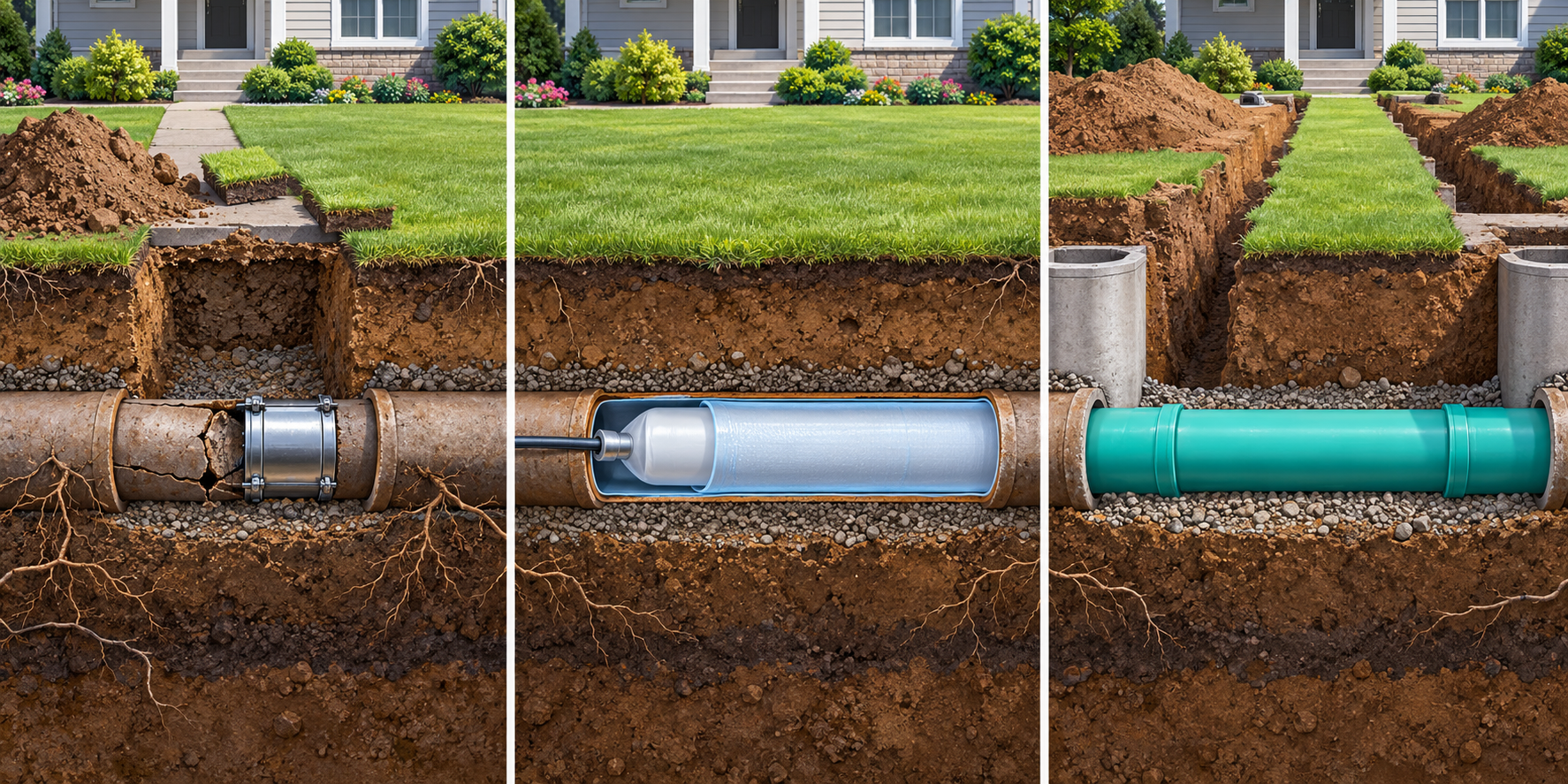
Seattle Public Utilities describes four distinct families: spot repair for a localized defect, open cut for a longer or multiple-defect section, pipe bursting through access pits with a replacement pipe, and CIPP lining using a resin-soaked tube cured inside the existing pipe. They are not interchangeable.
Spot repair preserves more of the existing line but may leave other weak sections. Lining can reduce surface disruption but requires a suitable host pipe and does not correct every geometry problem. Bursting replaces the pipe with limited surface excavation but needs suitable alignment, access, and utility conditions. Open cut exposes the route and may be necessary where collapse, slope, connections, or access make trenchless methods unsuitable.
What moves the price
Defect evidence: A clear, localized finding makes a bounded quote possible. An incomplete camera view creates an allowance or investigative phase.
Length and depth: More pipe, deeper excavation, and more difficult handling increase labor and restoration exposure.
Access: Driveways, patios, landscaping, buildings, fences, narrow side yards, and public streets can make surface work more expensive or influence method selection.
Connections and public interface: Service connections, cleanouts, the public main, permits, inspection, traffic control, and right-of-way work may be separate.
Timing: Active backups can require immediate stabilization, while scheduled work may permit better method comparison and coordination.
Three decision scenarios
One camera-defined break in an accessible yard: Spot repair may be the smallest coherent scope. Ask whether the camera shows healthy pipe on both sides and whether the repair includes a follow-up inspection.
Several roots and cracks under a driveway: Repeated cleaning and surface restoration make a broader comparison worthwhile. Lining, bursting, and open cut should be compared by complete project scope, not unit rate alone.
A near-collapse section with uncertain downstream condition: Emergency flow restoration may be separate from structural work. Request a method and access assessment after the line is visible enough to evaluate; do not treat the clearing price as the permanent budget.
Repair versus replacement boundary
Repair makes economic sense when the failure is localized, the retained pipe is serviceable, access is manageable, and the repair does not create repeated mobilization. Replacement or broader rehabilitation becomes more credible when deterioration is distributed, the same access would be repeated, a method cannot address the geometry, or repeat-work risk is high.
No age, dollar, or percentage threshold applies to every property. Compare today’s repair with the likely cost of future access, emergency exposure, remaining uncertainty, and the portion of the system left untouched.
Quote checklist
- pipe segment, length, and defect location;
- camera, locate, and access assumptions;
- cleaning and preparation;
- proposed method and rejected alternatives;
- excavation, access pits, permits, inspection, and traffic requirements;
- service connections and public/private boundary;
- backfill, pavement, landscaping, and finish restoration;
- warranty, testing, and follow-up documentation;
- contingencies with an approval threshold.
The cheapest repair quote is not always the smallest total cost. A narrow price may omit the access needed to reach the defect or the restoration needed to close the project. A defensible repair budget makes the plumbing scope and the uncertainty visible separately.
Model the unknowns explicitly
Use a low case when the defect, route, access, and retained pipe are documented. Use an expected case when cleaning, locating, connection work, or ordinary restoration remains. Use a difficult case only for identified risks such as a deeper-than-expected line, an inaccessible connection, public-right-of-way work, or a camera that cannot pass the defect. Tie each case to an approval step.
This approach is especially useful where repair, rehabilitation, and replacement are all being proposed. A repair price may be lower because it treats one location; a lining price may include preparation but not all connections; a replacement price may include excavation but not surfaces. Normalize those scopes before deciding that one method is expensive or another is a bargain.
If the repair leaves older pipe outside the work, record its location and observed condition. Future service may still be needed there. The best proposal states what risk it reduces and what risk it deliberately retains.
Budget diagnosis separately from correction
When the defect is not fully defined, ask for the smallest first-stage scope that can establish location and extent: clearing enough for inspection, a camera report, an electronic locate, or an exposed inspection point where professionally appropriate. Request a price and stopping point for that stage before authorizing a repair. The cost of a camera or locate can be worthwhile if it prevents a quote from assuming the wrong length or surface.
The repair proposal should then distinguish fixed work from allowances. Pipe length, connection treatment, and access may be known; depth, soil, hidden utilities, public inspection, or restoration may remain uncertain. An allowance should say what condition triggers extra work, how the price will be calculated, and when the homeowner must approve it. An undefined contingency makes two repair totals impossible to compare.
Understand what the method leaves behind
A spot repair may leave other pipe and access points in service. Lining may rehabilitate a longer host section but leave some connection or geometry problems unresolved. Bursting replaces a route through pits but may follow an existing alignment; open excavation can expose more of the pipe while disturbing more surface. Ask each bidder to mark the work limits and describe the retained section’s known condition.
After the work, request a post-repair inspection or other appropriate close-out record, photographs of connections before cover, permit/inspection sign-off where applicable, restoration details, and warranty boundaries. The documentation should show what was completed rather than promise that every future clog or defect has been eliminated. This makes the next maintenance or replacement decision less dependent on an invoice description.
For a reasonable comparison, ask the bidder to separate the cost to restore flow from the cost to correct the structure, then identify whether inspection, locating, preparation, and final restoration are included. A defined price for each stage makes it easier to stop when new evidence changes the method.
Where quotes vary widely, ask each contractor to price one shared base scope and list alternatives separately. The difference may come from a different assumed repair length, access, connection, or restoration rather than labor rate alone.
If the bid remains difficult to compare, ask for separate totals for access, pipe work, and reinstatement.
When an estimate includes a per-foot amount, ask which setup, access, connection, and restoration charges remain outside it. Compare the installed total for the defined defect rather than multiplying a unit rate by guessed length. If a bidder cannot price the full scope yet, ask for a bounded investigation stage and a revised written total before structural work proceeds.