
A camera report is a set of observations about the portion of pipe the camera could see. It is not automatically a repair specification. Cost and urgency depend on the finding’s severity, length, location, recurrence, effect on flow, access, and the condition of the surrounding line. Seattle Public Utilities presents minor, moderate, and severe cracks or fractures as different decision states, which is a useful reminder that the same label can lead to different actions.
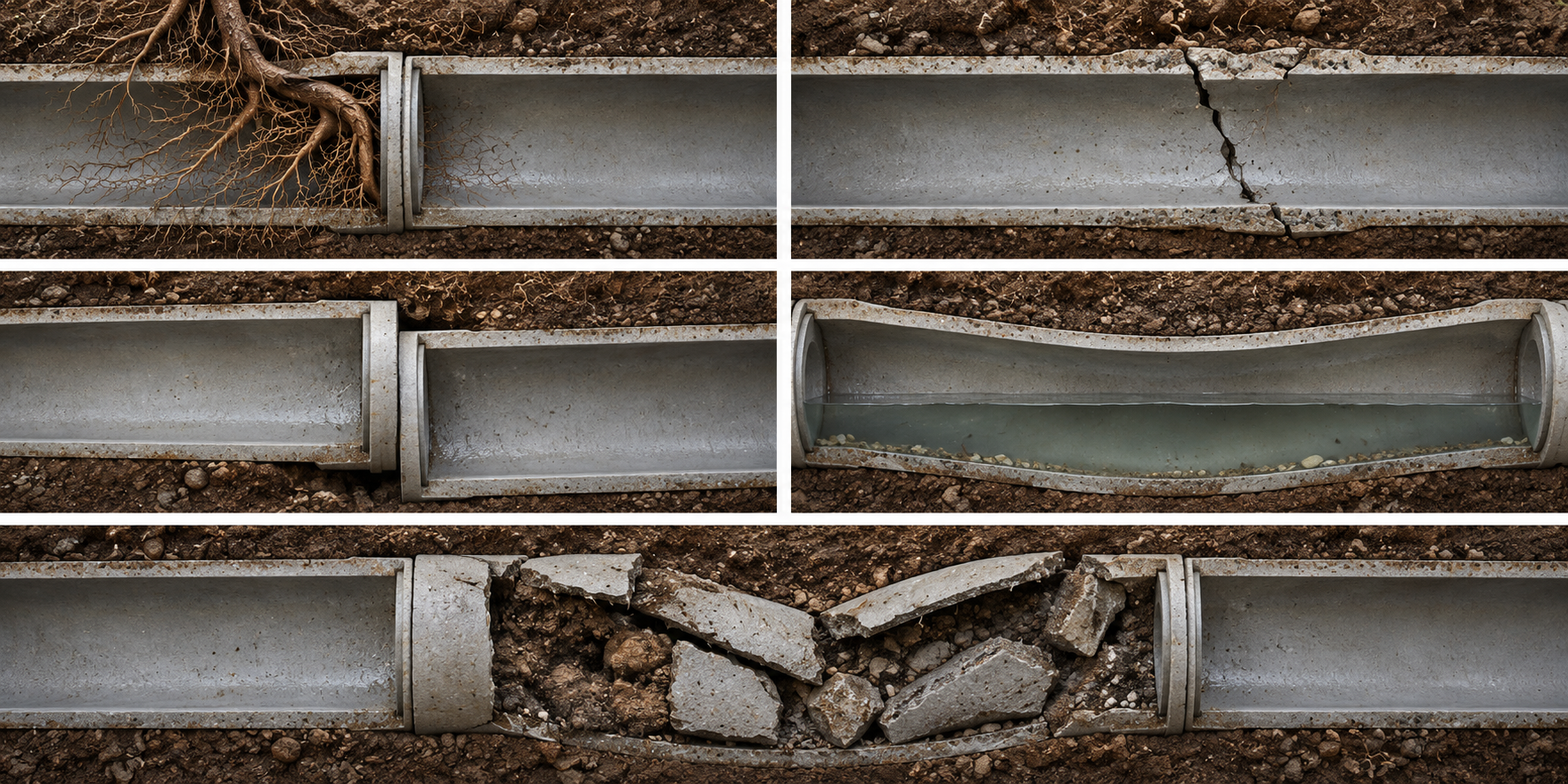
Read every finding with four questions
- Where is it? Distance from the access point is not the same as a surface location. A locate may be needed before excavation or a responsibility conversation.
- How extensive is it? One joint is different from deterioration along the route.
- Does it affect function? A visible defect may be stable, intermittently obstructive, or near collapse; a report should state what was observed rather than imply more.
- What remains unseen? Blockage, water, poor access, camera direction, and line length can limit the inspection.
Roots
Roots can obstruct a line and may indicate an entry path at a joint, crack, break, or connection. The immediate intervention may be cleaning or root cutting. The longer-term question is whether the entry defect can be corrected and whether other weak sections remain.
Ask whether the video was taken after clearing, whether the root location is measured, and whether the proposed price is for cleaning, spot repair, lining, or replacement. Repeated root removal is not proof of distributed failure, but recurrence makes inspection and a structural comparison more valuable.
Cracks and breaks
A crack is a structural observation whose importance depends on size, extent, location, and effect on the line. A break or collapse can create a more immediate functional problem, but a short image does not by itself establish the full repair boundary. Seattle’s local guidance distinguishes minor findings that may be monitored from severe defects that may require repair; its suggested reassessment timing is not a universal maintenance schedule.
Request the report’s location, length, photos or video, and explanation of what is known versus inferred. Ask whether the repair would be a localized excavation, lining, replacement, or another method and what condition makes that method appropriate.
Offset joints
An offset means the pipe sections are no longer aligned at a joint. The economic importance depends on how much the alignment has changed, whether it restricts flow or catches debris, whether the joint is leaking, and whether more offsets appear along the route. A localized offset may produce a spot-repair conversation; repeated offsets may point toward a broader alignment or replacement issue.
Do not convert the word “offset” directly into a per-foot price. Ask whether the camera can pass the joint, whether the route is stable, and whether access or excavation is required to correct it.
Bellies or standing water
A “belly” generally describes a section where the pipe does not maintain a consistent fall and water remains after flow. A camera can show standing water, but the report may need more context about grade, length, flow, and whether the observation represents a persistent defect rather than temporary conditions. The correction may involve localized work, replacement of a section, or a larger route problem; suitability is property-specific.
Ask how the finding was identified, whether the full section was viewed, and what effect it has on use. If a contractor recommends a method that does not correct the underlying alignment, ask what recurrence risk remains.
Collapse or severe obstruction
A collapsed or nearly collapsed section can limit camera travel and flow. Clearing may be necessary to restore service, but cleaning does not reconstruct the pipe. A repair or replacement proposal should identify the accessible evidence, the estimated boundary, emergency stabilization, access, and what remains unknown beyond the blocked view.
This is also where public/private responsibility can change the economic decision. A defect near a public main or right-of-way should be discussed with the utility before a homeowner assumes the entire repair bill.
Deposits, scale, and deterioration
Deposits, corrosion, or scale can reduce the opening and encourage recurring clogs. Cleaning may restore capacity for a time, but a widespread deteriorated surface can create a different maintenance and replacement decision. Material, age, and prior repairs are context rather than a universal remaining-life formula.
Ask whether the camera report distinguishes an obstruction that can be removed from a pipe wall or joint that is itself failing. If cleaning is proposed, ask what observation would prompt a structural evaluation.
How findings map to project choices
| Finding pattern | Possible next decision |
|---|---|
| Isolated obstruction, sound surrounding pipe | Cleaning and monitoring |
| Recurring roots at a defined defect | Cleaning plus inspection; spot repair or rehabilitation comparison |
| Localized crack or offset | Confirm location and compare spot repair with broader options |
| Multiple defects or distributed deterioration | Rehabilitation or replacement assessment |
| Collapse, severe restriction, or inaccessible section | Urgent professional repair assessment; scope may need opening |
| Finding near public/shared boundary | Utility, title, easement, or local-rule verification before payment |
The table shows possible paths, not automatic prescriptions. The EPA describes condition assessment as using CCTV and other information to inform maintenance, rehabilitation, or replacement. A homeowner camera report is one decision input within that broader logic.
When a second opinion helps
Get another assessment when a large replacement is proposed from a short or incomplete video, the report lacks location and length, two contractors recommend materially different methods, or the proposed repair does not address the described finding. A second opinion should not be used to delay an active dangerous backup, but it can prevent an unsupported expansion from a small defect to an entire system.
Questions to ask before approving work
- Can I retain the complete video and written report?
- What section was inspected and what could not be viewed?
- Where is the finding relative to the access point and surface?
- Is it an obstruction, a structural defect, an alignment issue, or more than one?
- Is the defect isolated or distributed?
- Why is the proposed method suitable, and what methods are not?
- Does the price include cleaning, locating, access, permits, excavation, and restoration?
The useful interpretation is not “this word means replacement.” It is “this observation changes which evidence and quote scope I need next.”
Turn a finding into a bounded next step
Start with the least-cost action that can resolve the uncertainty without delaying an urgent response. If roots are visible but the line still functions, ask whether a post-cleaning video can locate the entry point before pricing repair. If a crack is visible at a measured distance, request a locate and a quote for that segment, with the condition of pipe on both sides documented. If the camera stops at a collapse, a contractor may need to restore flow or open a defined point before the downstream condition can be assessed. The blocked view is a scope limit, not proof that the unseen route has the same defect.
If the report uses a severity score, ask what classification system it follows and whether the score is based on a complete view. Do not compare scores from different inspection programs as though the labels were universal. Request the actual observation—size, length, opening, alignment, water retention, or camera travel—along with the score. A descriptive video lets another contractor assess the same evidence.
Separate urgent work from a capital proposal
An active backup may require clearing or temporary stabilization before a full repair comparison is possible. Keep that immediate charge separate from the proposed permanent work. Once the line is usable, obtain the estimated repair boundary, access method, restoration, permits, connections, and retained pipe. If the recommended scope expands well beyond the visible finding, ask for the additional evidence and price an investigation stage before approving the larger project.
For multiple findings, make a simple route map and list each location in order from the access point. Ask whether the proposed repair corrects one defect or a pattern, and whether defects between repaired points remain. A bundle price for “whole line repair” can conceal a narrow treatment or an undefined replacement boundary. Reconcile the quote to the video so the homeowner can identify what condition is being purchased and what uncertainty remains.
Decide when another opinion is worth its cost
A second opinion has greater value when a large replacement is based on a short video, two reports disagree about severity, the camera did not reach the critical segment, or a trenchless method is proposed without discussing alignment and host condition. Share the same recording and report with each reviewer and ask them to answer the same question. If the evidence is already complete and recommendations differ only in price, compare the work boundary and restoration before paying for another inspection.
Ask reviewers to identify what new evidence could change their recommendation.
Ask each reviewer to distinguish direct observation from inference in writing. That small distinction often determines whether you need a second inspection, a locate, or a repair bid.