
If a sewer lateral has failed and the project is already known, the next question may be how to pay for the work. A city, utility, or state program can sometimes reduce an eligible bill, pay a contractor directly, reimburse an owner later, or spread repayment over time. The terms differ sharply: a grant is not a loan, an assessment still has to be repaid, and an existing municipal repair fund may not be open to voluntary enrollment after a failure.
Start with the property’s responsibility boundary and a complete project scope. Then ask the relevant utility or municipality whether a current program applies to this address and this type of work. These examples are local illustrations, not a national entitlement, program directory, or promise that an applicant will qualify.
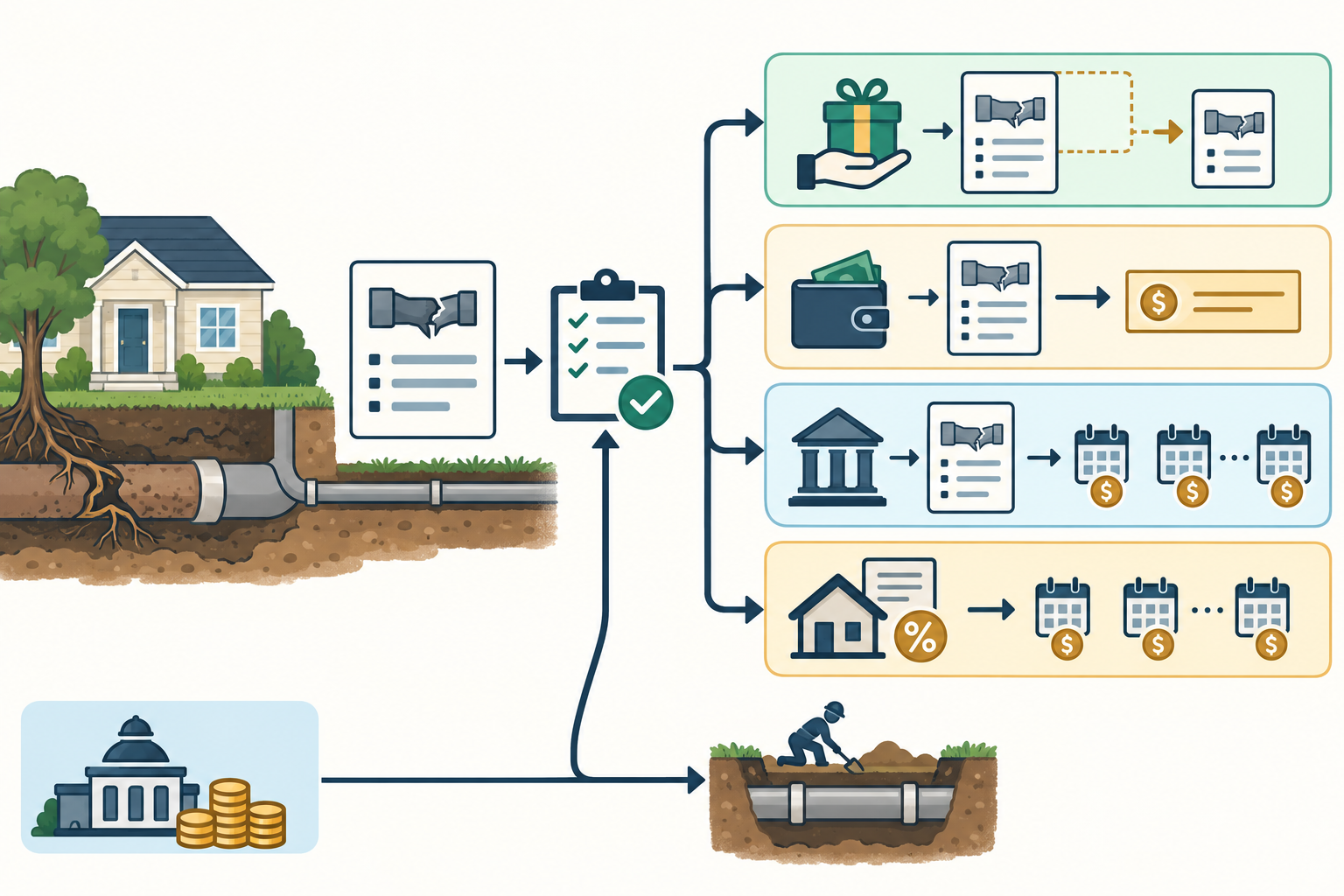
Establish the work and gross amount first
Get a written condition report and identify the affected segment before searching for money. Confirm whether the project is cleaning, camera inspection, locating, spot repair, lining, full replacement, or a first connection to municipal sewer. A program that helps with a full lateral replacement may exclude an inspection, an isolated repair, private-side cleaning, a public-side segment, extra paving, or work already completed.
Ask the municipality who owns or must maintain each segment, whether a public or shared portion is involved, and which party may authorize work. An assistance program does not prove that the owner is responsible, and eligibility for aid does not establish the repair method. The responsibility guide and repair cost guide address those separate decisions.
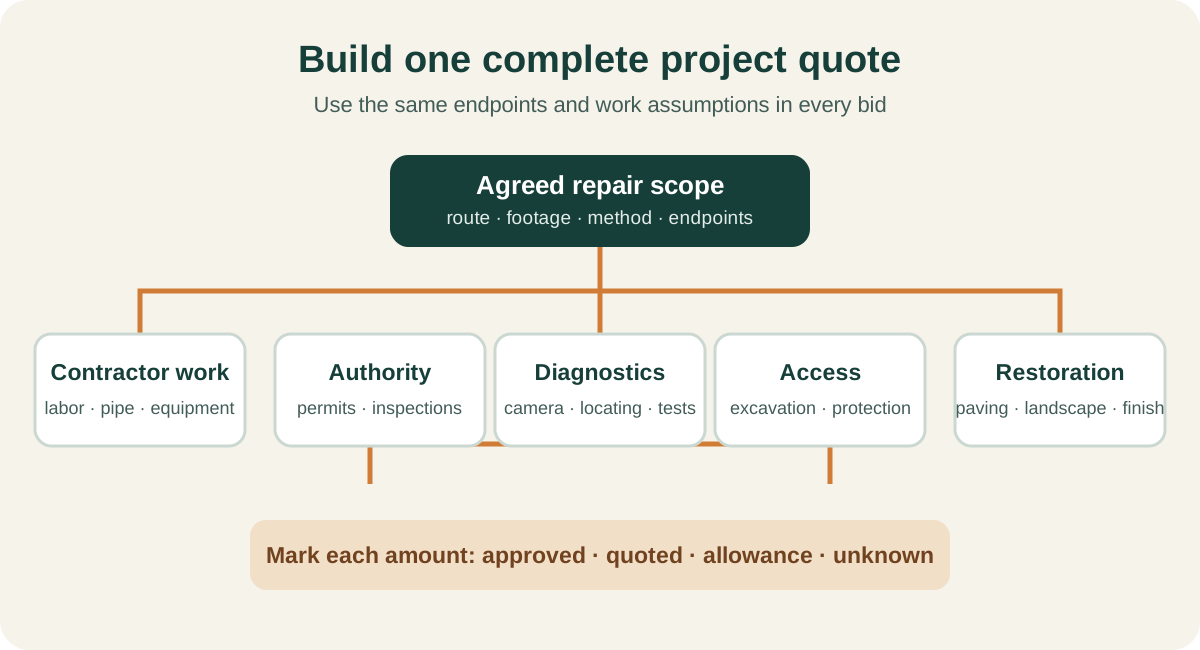
Request one itemized gross quote with the same route, endpoints, footage, method, access, connections, permit, testing, restoration, taxes, and exclusions. Separate the contractor amount from authority fees, diagnostic services, and restoration that another provider will perform. Mark each amount as approved, quoted, an allowance, or not yet known. A funding cap cannot be used as a substitute for the project price.
Identify which kind of payment route is available
| Route | What it can do | Cash-flow question |
|---|---|---|
| Grant or cost share | Pay part of an eligible scope, often up to a cap | Must work be approved first, and is payment made before or after the owner pays? |
| Reimbursement | Return part of an eligible cost after specified work and records | Can the owner carry the full invoice while waiting for review and payment? |
| Utility or state loan | Provide repayable funds for listed sewer work | What rate, term, fees, lien, approval, and contractor rules apply now? |
| Property-tax assessment | Spread an approved repair cost through tax bills | When does the assessment begin, what interest and fee apply, and how is early payoff handled? |
| Existing municipal repair fund | Cover specified failures for eligible properties under an established program | Is the property already covered, which segment is included, and what deductible or exclusions remain? |
A private service contract or insurance endorsement is a separate future-risk decision. It may not accept a known defect or reimburse work started before approval. For a possible future failure, see the insurance and protection-plan guide; do not treat it as a way to finance a repair already underway.
Local examples show why the sequence matters
San Mateo, California: cost-share reimbursement. The City’s current FY 2026/27 page says it is accepting applications while funds remain. It describes reimbursement of 50% of the lowest approved bid, up to $2,500, for a full lateral replacement. The owner must be accepted into the program before work, then submit the required licensed-contractor quotes for City approval. The program page excludes CCTV, spot or partial repairs, pothole repairs, and additional street resurfacing. Permits and a paid final invoice are part of the reimbursement packet; the City says a check is mailed within three to four months after it receives and approves a complete packet. This is delayed reimbursement, so an eligible owner still needs a plan for the gross invoice and any excluded work.
Minneapolis, Minnesota: repayment through a property-tax assessment. The City requires its Target Market Program contractor and at least three bids with the application. Eligible vendors are paid directly by the City; the repair cost can then be assessed to the property and paid through property taxes. The City says the program year runs July through June and the assessment normally appears in November, with taxes the following year. An administrative fee applies to assessed work. Its published 2026 interest examples range from 3.80% for five years to 4.70% for twenty years; available terms depend on the repair-cost band and rates are set annually. Ask about current terms, payoff timing, and any hardship deferment directly with the City.
Halifax Water, Nova Scotia: utility loan. Halifax Water describes a loan for eligible registered property owners who accept a lien on the property. The published rate is Prime plus 2% and can change; the longest listed repayment term is five years. The utility requires a quote and approval before work, an inspection, correction of deficiencies, and a final invoice. It pays the contractor after acceptance, then the owner makes monthly loan payments separate from the water bill. The page says not all applicants are approved. Confirm current eligibility, amount, rate, and sequence with the utility; do not assume another Canadian utility has the same offer.
Philadelphia, Pennsylvania: HELP loan for a narrow sewer-connection condition. Philadelphia Water Department says HELP may cover an eligible private sewer connection repair when the drainage direction must be reversed to connect to a public sewer; it is not a general offer for every lateral repair. The owner applies, receives a City inspection and cost estimate, and must consent to a lien. The City describes the loan as interest-free when payments are timely; its July 1, 2026 regulations set 60 equal monthly payments. Qualifying owners enrolled in the income-based water program or senior discount may choose 60, 120, or 180 months, with no prepayment penalty. PWD sets the principal from work cost and the lien fee; no fixed cap is stated. Missing two consecutive timely payments triggers default: the balance becomes due, and arrearage-rate penalties plus a 5% fee are added to the balance and lien. Those penalties continue through the remaining term even if missed payments are later made. Confirm eligibility and agreement terms with PWD before relying on the loan.
Mishawaka, Indiana: existing utility-bill-funded repair program. The City describes a monthly sewer fee on qualifying residential utility bills and a deductible when a covered lateral fails. Its page says the fund pays covered repair or replacement costs above the deductible from the foundation wall to the street main, including listed street, curb, and sidewalk work; routine cleaning remains the homeowner’s responsibility. This is an existing local municipal arrangement, not a general grant application or a private insurance policy. Check whether the property and failure qualify before treating the program as available money.
These examples illustrate different payment mechanics, not equivalent awards. Their interest, funding, property rules, eligible work, and administration can change. Pennsylvania’s Homeowner Sewage Program, for example, lists repair, replacement, and first-connection loan uses, but its displayed interest rate is dated January 1, 2024. Treat that as a prompt to contact a participating lender for current terms, not a present loan quote.
Confirm approval order before authorizing work
Write down the required steps in order. A program may require an application before obtaining bids, bids with the initial application, an approved contractor, City acceptance of quotes, a permit, and written approval before excavation. Another may let the owner request bids only after application acceptance. Calling the program after signing a contract or paying an invoice can make the project ineligible.
Ask the administrator to confirm in writing:
- whether the parcel, owner, dwelling type, and sewer segment qualify;
- whether the known failure and proposed method are eligible;
- whether cleaning, inspection, locating, spot repairs, lining, replacement, permits, connections, and restoration count;
- how many bids are required and from which contractors;
- whether the quote, change orders, and start date need approval;
- what permit or inspection must be complete before payment;
- how much funding remains and when an application is considered accepted.
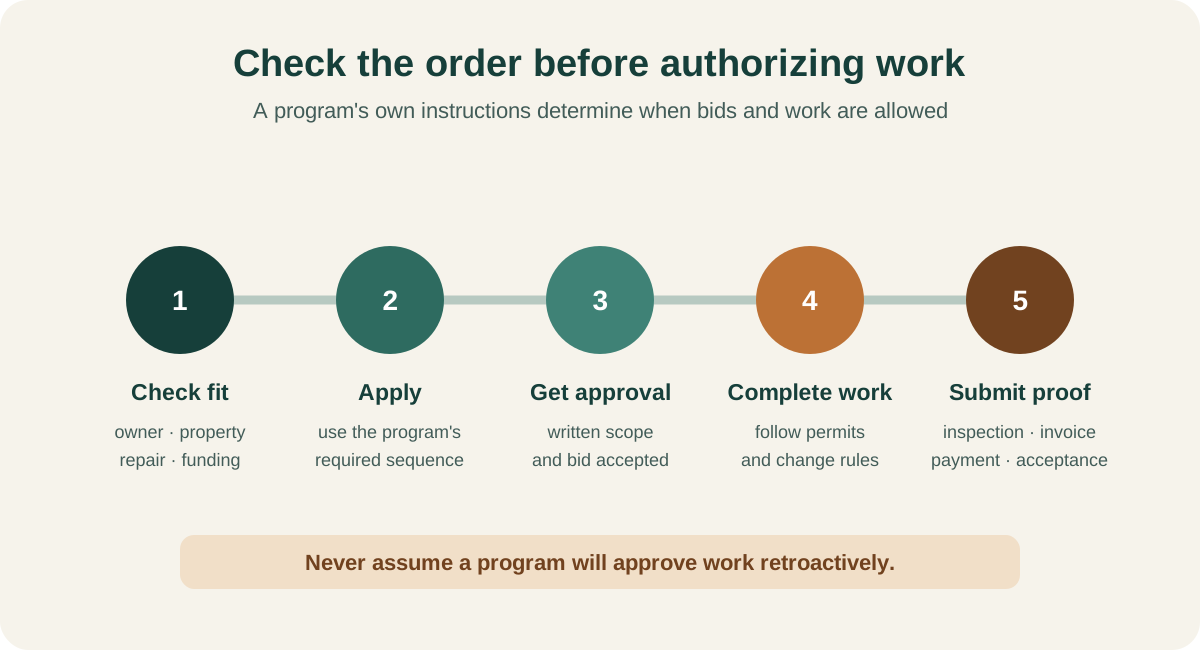
Do not start work on the assumption that a program will approve it retroactively. If an emergency requires immediate stabilization, ask the authority what documentation and notice are possible, but protect people and restore safe service with qualified help without waiting on unconfirmed aid. A prompt emergency call does not guarantee that later permanent work will qualify.
Separate the gross quote, cash needed now, and eventual cost
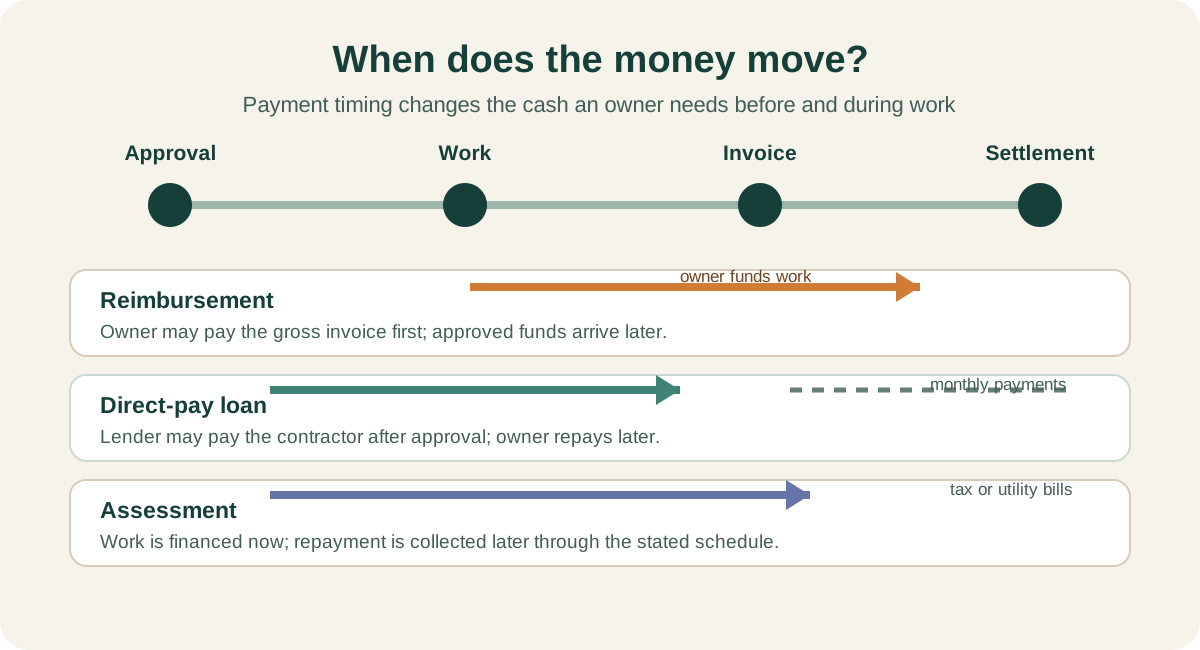
An award can reduce the owner’s eventual cost while leaving the full project amount due first. A direct-payment loan may reduce the cash advanced to a contractor but create monthly debt and a lien. A property-tax assessment can defer payment yet add interest and an administrative fee. A reimbursement may arrive months after the owner has paid the contractor and supplied a complete packet.
For a symbolic illustration, let B be the lowest bid the program approves for eligible full replacement and X be the separately quoted work it excludes. A 50% cost share applies to B only, subject to the program’s cap; it does not automatically apply to X. The gross project is B plus X, and an owner may need to fund that full amount until an approved reimbursement arrives. Eventual cost is the gross project minus the grant actually paid, plus any financing or other charges. This framework explains the timing and scope; it is not a quote, eligibility finding, guaranteed award, or tax conclusion.
Use three lines in your own worksheet:
| View | Include |
|---|---|
| Gross project | Every contractor, municipal, testing, access, and restoration amount needed to complete the agreed scope |
| Cash before and during work | Deposits, invoice timing, permit charges, owner contribution, temporary financing, and costs excluded from assistance |
| Eventual owner cost | Gross amount less an approved nonrepayable grant, plus any loan principal, interest, fees, taxes, deductible, or remaining excluded work |
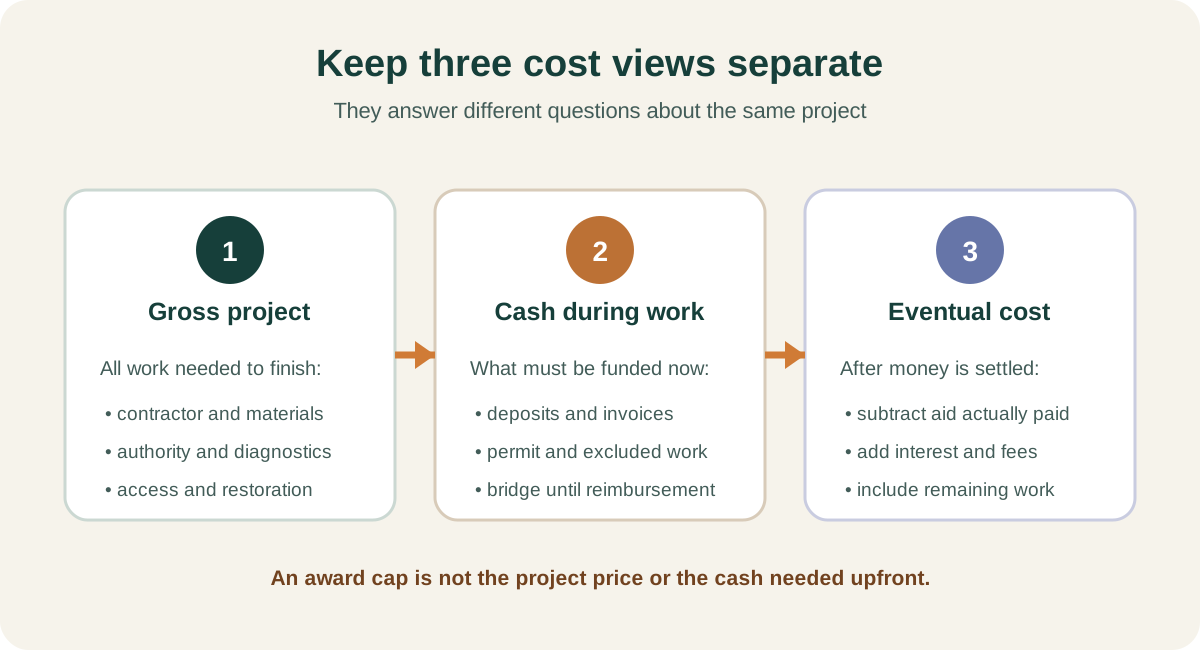
Keep the grant basis separate from costs outside its approved scope. If the program reimburses “the lowest approved bid,” do not apply the percentage to a larger combined total without confirmation. If it pays a contractor directly, ask whether you owe the provider anything before the payment or if a deposit is required.
Compare repayment beyond the monthly amount
For a loan or assessment, request the current rate, whether it is fixed or variable, the term, payment schedule, total repayment, fees, lien or other security, late-payment effects, early-payoff process, and how the obligation is handled when the property is sold or refinanced. A low advertised rate does not reveal the total amount repaid or whether the project qualifies. Ask the lender or program administrator for a written payment schedule using the approved amount and term.
A lien or property-tax assessment attaches obligations to the property in a way that differs from a cash grant. Before signing, understand when the lien is recorded and released, who bills the owner, what happens if a bill is missed, and whether payment can be made early without penalty. Get qualified legal or financial advice for individual contract, title, or tax questions; this article does not determine those consequences.
Keep the records through acceptance and payment
Keep the application, eligibility response, bid set, approved scope, permit, change-order approval, test or inspection result, invoice, proof of payment, final acceptance, reimbursement packet, and loan or assessment terms. Record which charges were excluded and who paid them. If the scope changes after excavation, stop and follow the program’s change-approval process before assuming the added work qualifies.
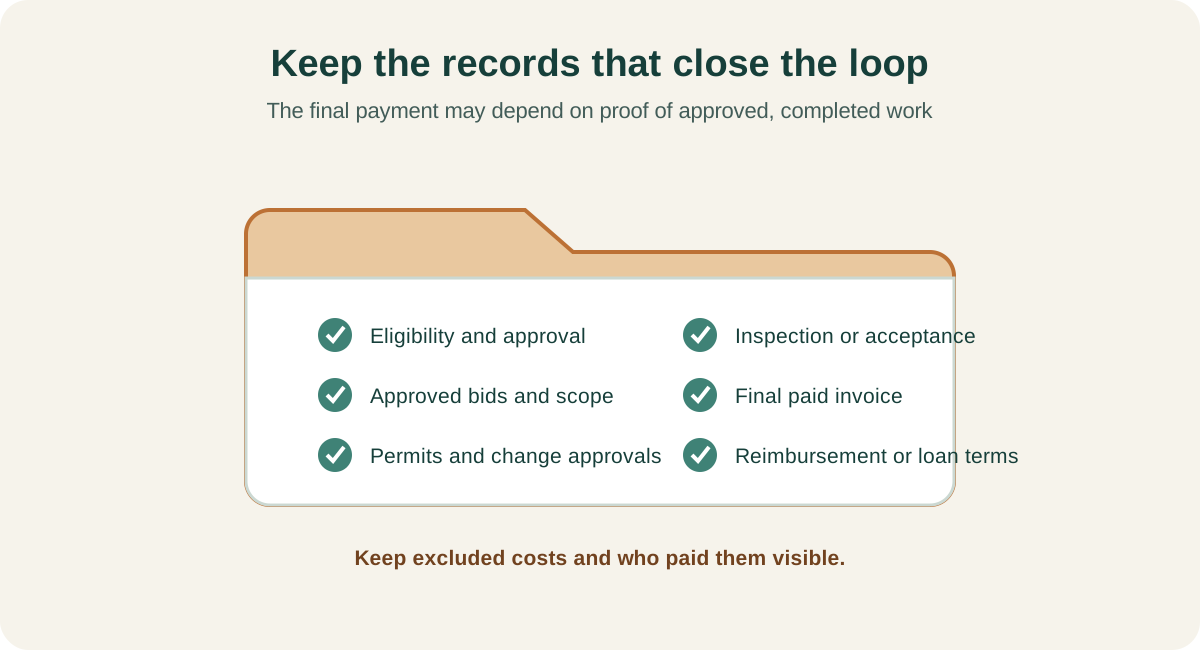
A successful closeout can require more than a paid invoice. The authority may need a final inspection, accepted video, as-built, permit sign-off, or lien filing. Ask when the reimbursement clock begins and what document counts as a complete packet. Keep a separate amount for a possible shortfall if the award is delayed, reduced, unavailable, or limited to a narrower segment than the contractor’s quote.
The practical sequence is: establish responsibility, price a complete known project, confirm an open program and eligible scope, secure approval, understand upfront cash and repayment, then authorize the work and preserve its acceptance record. Local assistance can change how a project is paid for, but it does not turn an uncertain grant into a lower contractor quote or erase costs outside the approved terms.