
A shared or party sewer serves more than one property, crosses another property, or uses a nonstandard private connection. The cost question is not simply “How much is the repair?” It is “Which segment failed, who uses it, what documents govern access and payment, and would repair or separation be the better project?” There is no universal cost-sharing formula.
Identify the physical configuration
Start with a camera inspection, route locate, available plans, title documents, easements, and connection records. Determine which buildings use each segment, where the line crosses property boundaries, where it meets the public system, and whether a segment is private, public, or nonconforming.
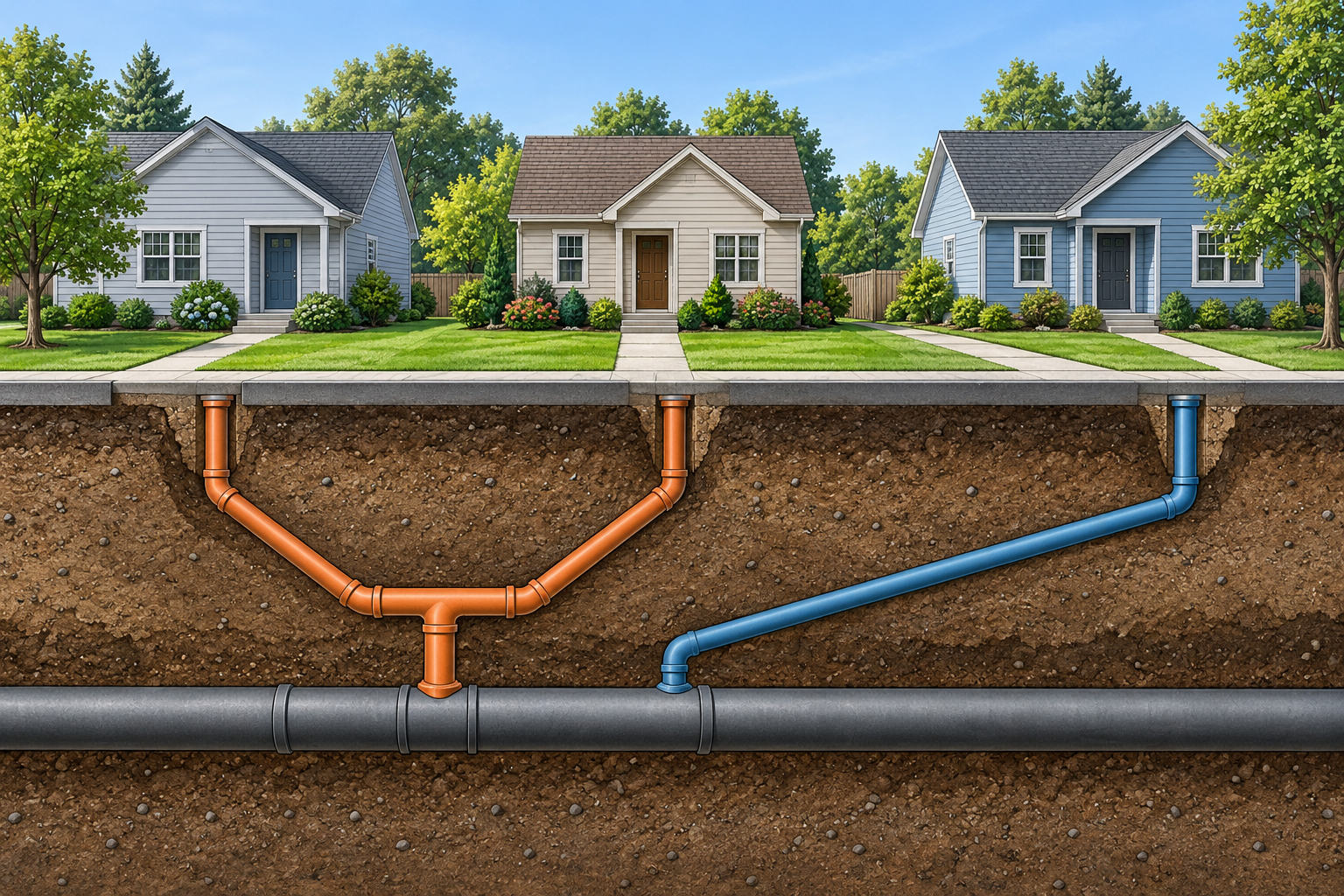
A landowner may host a pipe used by another property. A shared line may be private but serve several owners. A line may cross a lot without serving the lot. Those differences can change responsibility and the ability to access or replace it.
Local rules are examples, not a template
Portland defines a common private or party sewer as a private sewer serving buildings under different ownership. Its code generally assigns equal responsibility among owners using a damaged common section, while a user may bear full responsibility when a line traverses another property that does not use it. Written agreements or easements can alter the analysis.
That is a Portland rule, not a national standard. Ottawa’s local guidance likewise shows that cause and location can create different responsibility outcomes. Verify the municipality, utility, title, easement, and agreement that apply to the actual line.
Cost layers in a shared project
| Layer | Why shared configuration can add cost |
|---|---|
| Investigation | More routes, access points, records, and owners to coordinate |
| Responsibility | Legal, utility, easement, or agreement review |
| Repair | Length, defect extent, access, and method |
| Access | Another owner’s property, permission, protection, and restoration |
| Separation | New individual connection, route, public interface, permits |
| Administration | Notices, approvals, inspection, agreements, and dispute risk |
The pipe repair itself may be ordinary while coordination or access makes the project difficult.
Repair the shared line or separate?
Repair shared infrastructure may be the least disruptive choice when the line is serviceable except for a defined defect, the owners agree on scope and allocation, and the route remains useful.
Rehabilitate or replace the shared section may make sense when defects are distributed and repeated access or repair would be expensive. The method still depends on pipe condition, geometry, access, and local permission.
Separate connections create a new private or public-side construction project. It may reduce future dependence on a neighbor’s line but adds route, depth, connection, permit, restoration, and coordination costs. Separation is not automatically cheaper than repairing the existing line.
Scenario bands
One shared defect with clear agreement: Obtain a camera-defined repair scope and a written cost allocation before work. Include access and restoration for every property affected.
Line crosses a neighbor but serves only one property: Physical location and use may lead to different responsibility treatment. Check the easement and local rule before assuming the neighbor shares the cost.
Repeated failures and poor records: Pay for locating, documentation, and a professional scope before debating repair. A clear map can be more valuable than another informal estimate.
Sale or purchase: A shared or nonconforming connection can create disclosure, financing, insurance, or future-repair exposure. Obtain records and local advice before closing; this article is not contract or legal guidance.
Quote normalization
Ask bidders to state the same segment, owners served, endpoints, defect, method, access, service connections, permits, restoration, testing, and warranty. A shared repair quote should identify what remains outside the repaired section. A separation quote should identify the new route and public interface.
Keep legal, survey, engineering, permit, and restoration costs separate from pipe work. Do not hide neighbor coordination or uncertain access inside an unlimited contingency. Agree on who can authorize additional work and what evidence is required.
Communication and access
Before work, owners should receive the camera report, marked route, scope, schedule, access plan, restoration standard, and allocation basis. Written permission may be needed to enter another property or excavate under an easement. The contractor should identify protection of landscaping, pavement, structures, and occupied spaces.
If owners disagree, the cheapest plumbing proposal may not be executable. A local attorney, surveyor, utility, or municipal office may be needed to resolve authority or document questions. That cost is part of the uncertainty budget, not proof that a repair is impossible.
Questions to ask
- Which properties use each affected segment?
- Does the line cross land that does not use it?
- What do title documents, easements, or agreements say?
- Does local code assign equal, proportional, or individual responsibility?
- Is the proposed work repair, rehabilitation, replacement, or separation?
- Who obtains access, permits, inspection, and public approval?
- What restoration is included for each property?
- What happens if the camera cannot view the entire route?
The responsible decision is a coordinated one: establish the physical facts, verify the local rule, price the defined shared or separate project, and document what each owner receives. Do not turn a local example into a universal promise about who pays.
Distinguish shared use from a line that only crosses a lot
The pipe diagram should show who uses each segment, not just whose land it crosses. A common or party sewer serves more than one ownership; a traversing line may pass under a property without serving that property. Easement rights, connection records, and local definitions can affect access and payment. Portland’s code is one local example that treats common-use and traversing arrangements differently; another city may use a different rule or agreement.
Before asking neighbors to contribute, identify the damaged segment, every property connected to it, and the maintenance document or local provision that applies. A split based only on the number of homes, frontage, or land area may not match the governing agreement. If no written allocation exists, obtain local legal or utility guidance before representing an informal percentage as required.
Compare repair allocation with a new connection
Repairing a shared line can preserve an existing useful route when the defect is bounded and the owners can agree on access, scope, payment, and future maintenance. Separation may reduce future dependence on another property’s route, but it can require a new connection, tap, private pipe, permits, excavation, restoration, and closure of the old route. A new connection may also be infeasible because of elevation, capacity, or local approval. Price it as a separate project before treating it as a way to avoid an argument.
For a project crossing multiple properties, ask whether one contractor can coordinate the full scope, who contracts with the vendor, where each owner’s work begins, and how payment is handled if one owner refuses access or approval. The lowest pipe bid may not be executable until those administrative costs are addressed. Identify temporary wastewater service and access to all affected properties as part of the schedule.
Put future responsibility into writing
Before work begins, owners should agree on the approved scope, allocation basis, payment dates, change-order authority, restoration, contractor warranty, access, and what future maintenance each owner will perform. If an easement or written agreement already governs the line, have the relevant professional review it rather than creating a conflicting informal arrangement. Record the completed route and which properties it serves.
An agreement should also state what happens if excavation finds another defect or the planned repair cannot be completed. Decide who can authorize emergency stabilization, how additional cost is shared, and how evidence is distributed. Clear conditions reduce the risk that a common repair becomes an open-ended dispute during construction.
Budget the non-pipe coordination
Separate camera inspection and locating, document review, access permission, survey or legal advice, design, permits, contractor work, restoration, and utility inspection. Not every shared line needs every professional, but an unusual route may cost more to investigate and coordinate than an ordinary private lateral. Use quotes and authority responses for actual amounts; the evidence does not support a universal surcharge for shared ownership.
The budget should mark which line items benefit all owners, which correct a single owner’s segment, which restore each property, and which are optional. That makes an eventual allocation more transparent and gives each owner a basis to approve the project rather than simply dividing one unexplained total.
Before collection begins, share the same bid, camera report, scope boundary, and allocation basis with every affected owner. Ask whether the quote is conditional on all owners granting access and whether one owner can authorize emergency stabilization if another is unavailable. A written record reduces disagreement about whether a later extra is common work or belongs to one property.
When the project includes both a common segment and a single-property branch, request separate line items for each. The common portion may require a documented allocation among users, while branch work may be assigned under a different agreement or local rule. Keeping those scopes visible can prevent a single total from being divided in a way no owner expected.
If owners disagree about whether to repair or separate, compare the shared repair with the complete new-connection project, including approvals, excavation, public tap, restoration, and ongoing responsibility. A contractor should price a feasible design, while a utility or local professional confirms the route and requirements. No universal percentage or payback period resolves that choice.