
There is no universal answer to who pays for a sewer lateral. Some jurisdictions place the owner’s responsibility at the property line; others place it farther toward the public main, including under a street. Cause, location, easements, shared use, local code, and utility policy can all matter. Do not authorize a large repair based only on the word “lateral” or on the fact that the defect is near the road.
Four questions are often confused
- Who owns the pipe?
- Who must maintain it?
- Who must repair a particular failure?
- Who may reimburse or assist with the cost?
Those answers can differ. A municipality may require an owner to arrange work while offering an assistance program for a narrow condition, or a shared-line agreement may allocate costs differently from physical ownership.
An existing municipal program can affect who ultimately pays without changing the physical responsibility boundary. Check it separately from ownership and repair duty.
Examples show variation, not a national rule
EPA describes private sewer laterals as connections between individual properties and public systems and notes that ownership arrangements vary. Winnipeg states that, in its local model, owners maintain the private sewer pipe from the house to the city main, including under the street. Calgary describes owner or builder responsibility for private-side connections from the property line to building plumbing. Vancouver describes owner maintenance up to the city connection.
Ottawa’s guidance uses cause and location: private blockages are generally the homeowner’s responsibility, while certain city-owned tree or city-property conditions may create exceptions or reimbursement paths. These examples cannot be combined into one rule for the United States or Canada. Verify the actual authority for the property.
Mishawaka, Indiana, illustrates a locally funded approach: the City says a monthly fee appears on qualifying residential utility bills and a fund pays covered repair costs above a stated deductible for certain failed laterals. Its page also says routine cleaning remains the homeowner’s expense. Although the City calls this an insurance program, its funding and terms are a municipal example, not a private policy template or a benefit available elsewhere. Ask your utility whether an existing program covers this address, defect, and segment before counting on reimbursement.
Locate before you argue about payment
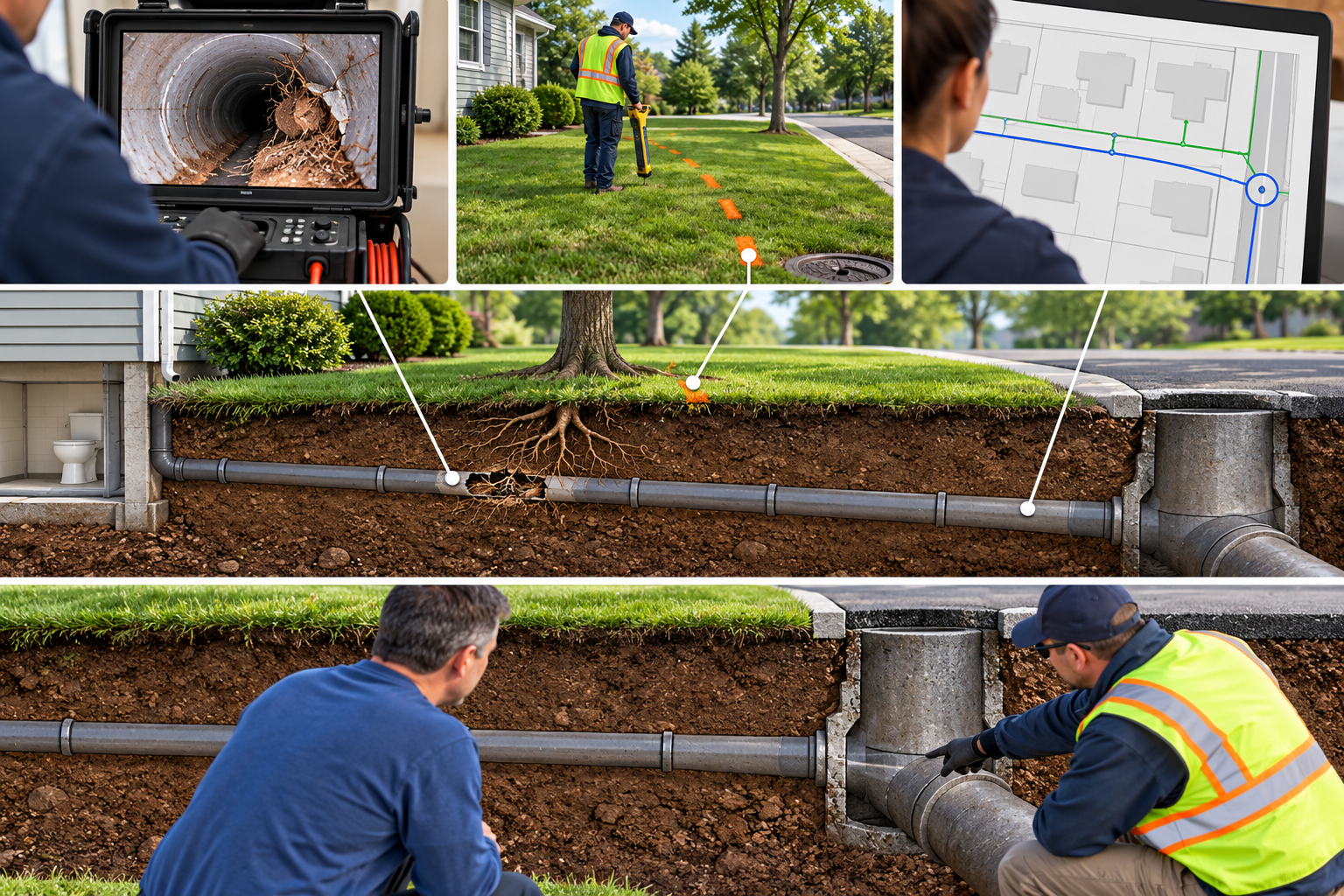
A camera report can identify a defect from the access point, but surface location and ownership may require electronic locating, route mapping, depth estimation, records, or utility investigation. Ask for the defect’s approximate position relative to the house, property line, street, and main. Keep the complete video and written report.
If the line is blocked, clearing may be needed before the camera can view the relevant section. That emergency cost may remain private even if a later investigation identifies a public issue, depending on local policy. Ask the utility how it handles the initial service and what evidence it requires.
The public/private boundary affects the quote
If the homeowner is responsible, the project may include cleaning, inspection, repair, replacement, permits, right-of-way, traffic control, and restoration. If the utility is responsible, it may have a separate investigation or contractor process. A private plumber’s quote does not bind the utility or prove that the homeowner owes the full amount.
When the defect is near public property, contact the authority before excavation. Confirm whether permission, inspection, public restoration, or approved contractors are required. Do not rely on a contractor’s assumption about a city-owned segment.
Tree and root cases
Roots can enter through a private defect, but a nearby or public tree does not automatically determine payment. Ottawa’s examples illustrate that cause, location, and municipal confirmation can change the result. Root responsibility, reimbursement, and public-tree programs are local and time-sensitive.
Request the applicable written policy and keep photographs, camera distance, locate information, invoices, and utility communications. If the dispute turns on title, easement, or legal interpretation, use local legal advice.
Shared and easement complications
A sewer may serve more than one property, cross another lot, or run under an easement. The owner of the land under the pipe may not be the only user, and the user may not own every segment. Written agreements and local law can allocate repair or access obligations differently.
Do not divide a quote equally among neighbors without checking the documents and local rule. The shared-sewer guide covers the separate economic and responsibility questions that arise in these configurations.
A responsibility-verification sequence
- obtain the camera report and route information;
- identify the suspected defect and the segment it affects;
- ask the utility whether it investigates or maintains that segment;
- check current municipal code, bylaw, or connection policy;
- review title, easement, shared-line, and prior-repair records;
- ask about assistance, reimbursement, or approved contractors;
- get a private quote only for the scope the responsible party has confirmed;
- keep public, private, restoration, and legal costs separate.
This is a practical verification sequence, not legal advice. Local terms and programs can change.
Quote and evidence questions
- What finding and location support the proposed work?
- Is the price for private, public, shared, or unknown responsibility?
- Who applied for permits and scheduled inspection?
- Is right-of-way restoration included?
- What happens if the utility disputes the boundary?
- Is reimbursement conditional on prior approval?
- Which emergency, cleaning, locating, or restoration costs are excluded?
The cost can be zero to the homeowner, a private repair bill, a shared allocation, or a larger project with assistance—but no number is responsible until the boundary is verified. The first economic task is often not choosing a repair method. It is determining whether you should be authorizing that repair at all.
Do not confuse a utility visit with a guarantee of payment
A utility may investigate a suspected public problem without accepting responsibility for a private repair, restoration, or emergency cleaning charge. Ask what the investigation determines, what evidence is required, and whether prior approval is needed for reimbursement. Keep private quotes conditional until that answer is documented.
If no authority accepts the segment, price the owner’s likely scope while preserving the right to revisit the boundary when the locate, bylaw, easement, or shared-line review is complete. This avoids both delaying necessary stabilization and paying for a larger unverified obligation.
Match the evidence to the responsibility question
Different records answer different questions. A camera video shows conditions from an access point; an electronic locate relates a finding to the surface; a property plan or easement may show a recorded route; a municipal policy states a local maintenance rule; and a utility investigation may address a public-system event. None alone necessarily proves who owns a pipe, who must repair a specific failure, or who may reimburse the cost. Ask the authority which evidence it relies on and keep its response in writing.
When a quote crosses the property line, street, or a shared segment, ask the contractor to split the scope at that boundary. The private bid can identify work the owner may need to arrange while the utility evaluates another portion. Confirm whether emergency clearing, inspection, and permanent correction are treated differently under local rules. Do not assume a later public finding automatically refunds an earlier private service bill.
Separate responsibility from the work authorization
Responsibility answers who may have to arrange or pay for a defined segment. It does not by itself establish the repair method or approve a contractor’s total. After the boundary is checked, obtain a camera-based scope with endpoints, length, method, access, permits, connections, restoration, and what remains outside the job. If a utility must approve work or provide a contractor, wait for that process before authorizing excavation in its system.
If the segment is shared, identify the properties served and any written maintenance agreement before dividing costs. A physical line that crosses a neighbor’s land may not serve that neighbor; a shared line may serve several homes while lying entirely on one lot. Title, easement, local code, and utility policy may each play a role. Use local professional advice where documents create a legal dispute rather than treating a general cost guide as a ruling.
Keep financing as a separate decision
Once you know which private segment could become the owner’s responsibility, decide separately whether to retain the risk or compare insurance and repair-plan terms. An endorsement or service contract does not change who owns or maintains the line, and a local repair-assistance program does not automatically cover every event. The coverage comparison explains why responsibility, covered segment, limit, and actual repair scope must be checked together without assuming that a particular plan will pay.
Keep the utility’s boundary response and any camera locate with a coverage inquiry. A policy endorsement or service plan may define different endpoints or require a condition check at enrollment, so the responsibility span alone does not establish eligibility or payment.
If reimbursement or public payment is possible, ask whether approval must come before work and which records are required. Keep the original camera report, marked location, dated photographs, itemized invoice, permit, and utility response. For an identified project, the assistance and financing guide compares eligibility, approval, upfront cash, and repayment. An emergency may require prompt stabilization, but do not assume the final repair or private contractor will qualify without written program terms.
Keep the responsibility finding current
When a utility changes its connection policy or a property is subdivided, renovated, or newly connected, old assumptions may no longer describe the line. Retain the dated local guidance and ask the authority to confirm the current segment boundary for a major project. If the answer is verbal, record the office, contact, date, property, and question, then request the applicable written rule or reference.
Before work is covered, document which segment the owner paid for and whether any public or shared portion remains unresolved. That record supports future sale, insurance, and repair conversations but does not replace title documents or legal advice. A clear responsibility record is useful precisely because physical proximity to the street does not settle responsibility by itself.