
Window age is a weak replacement rule on its own. The useful decision compares the failed component, the condition of the frame and opening, the result the homeowner needs, the availability of parts, and the cost of leaving a recurring problem in place.
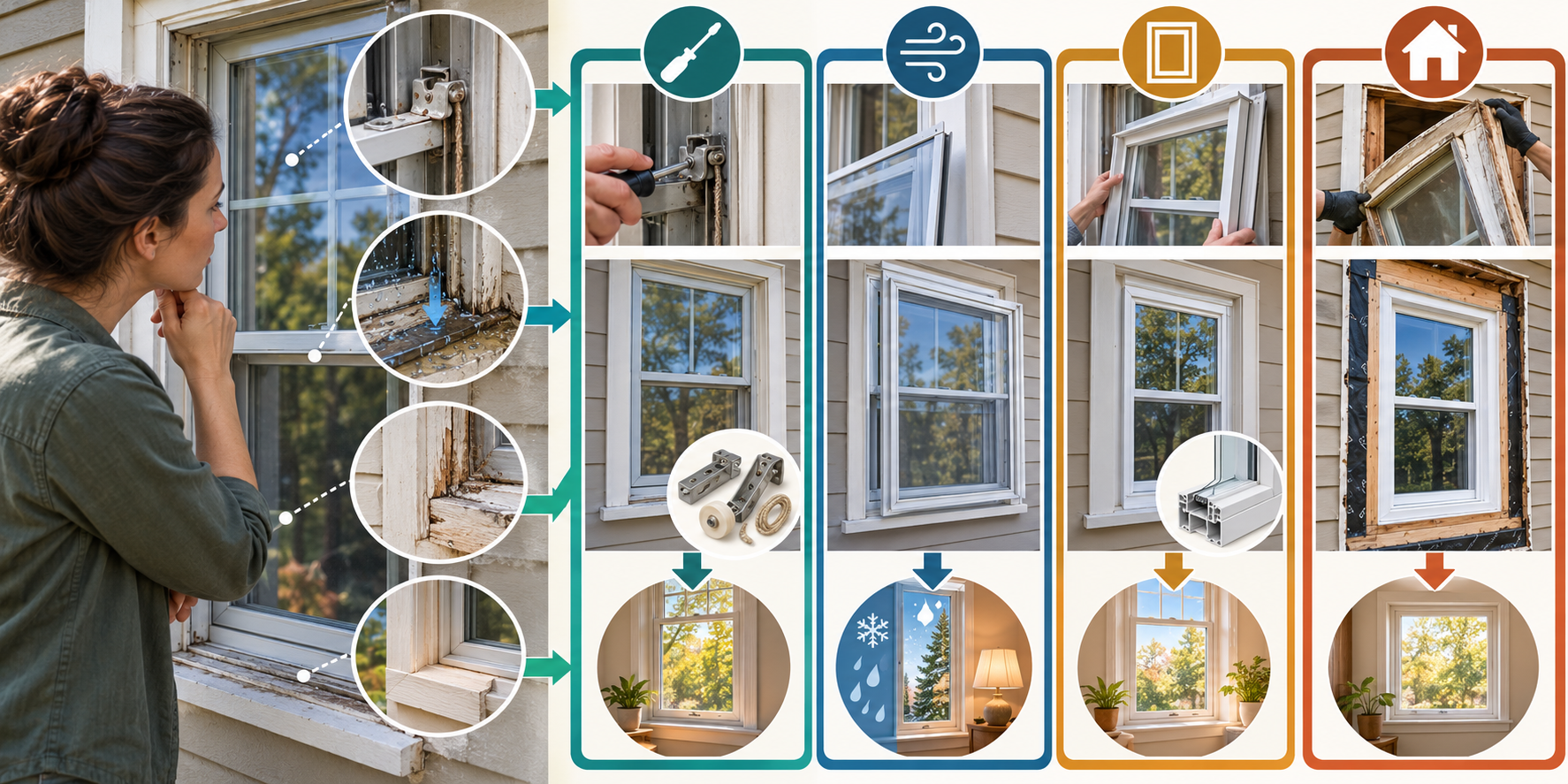
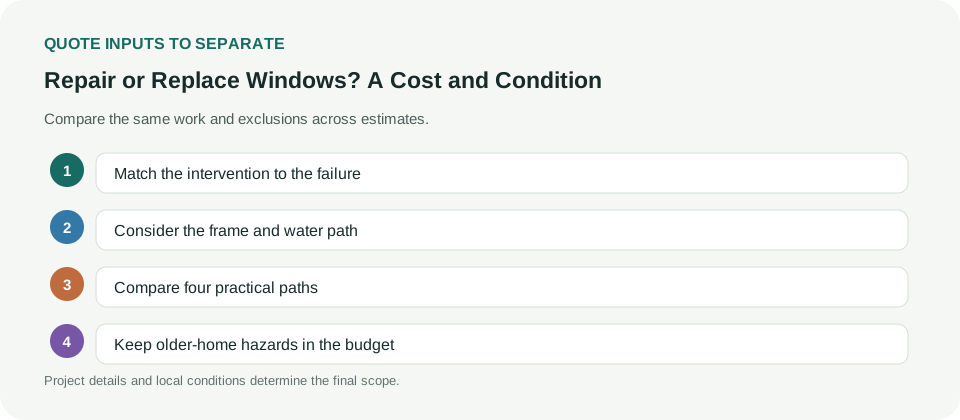
Match the intervention to the failure
| Condition | Repair or targeted work is more plausible when… | Replacement becomes more plausible when… |
|---|---|---|
| Broken glass | The frame, sash, drainage, and finish are sound and a compatible unit is available | The frame or sash is also failing or the required glass is unavailable |
| Failed seal or fogging | The frame and sash are serviceable and an IGU or sash is supported | Several components fail, parts are obsolete, or the window cannot meet the desired outcome |
| Hardware problem | One mechanism is identifiable and the window remains square and weather-tight | Distortion, rot, multiple failures, or unavailable parts make operation unreliable |
| Draft or comfort complaint | Air leakage is localized and can be sealed or improved with an attachment | The complete product and installation are poor, or the complaint is part of a broader enclosure problem |
| Water intrusion | The entry path is identified and the opening can be correctly flashed and restored | Concealed damage is extensive, the frame is unsound, or the source cannot be corrected within the opening scope |
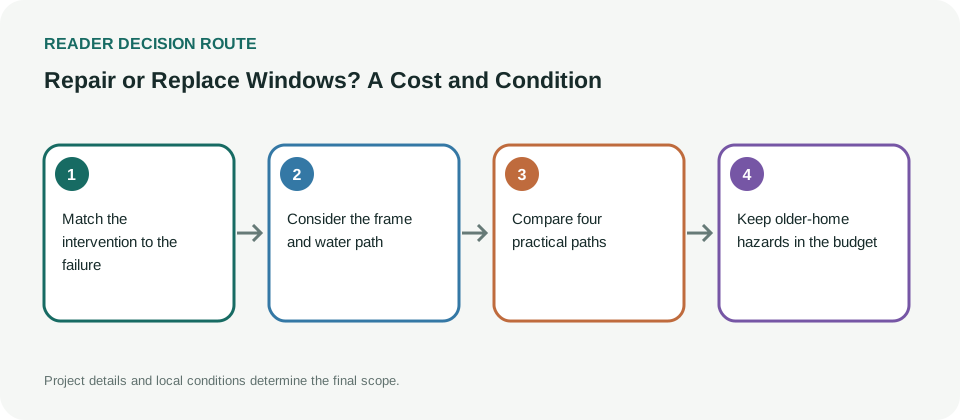
These are decision signals, not an automatic formula. A cheap repair that leaves water entering the wall is poor value; a complete replacement that does not address a wall or humidity problem is also poor value.
Consider the frame and water path
Building America guidance treats the sill, side, and head flashing around windows as an integrated drainage-plane system. If the frame is rotten, the opening leaks, or cladding conceals damage, the choice is not simply “repair the glass or buy a new window.” The quote should show how the water source will be addressed and what finish restoration is included.
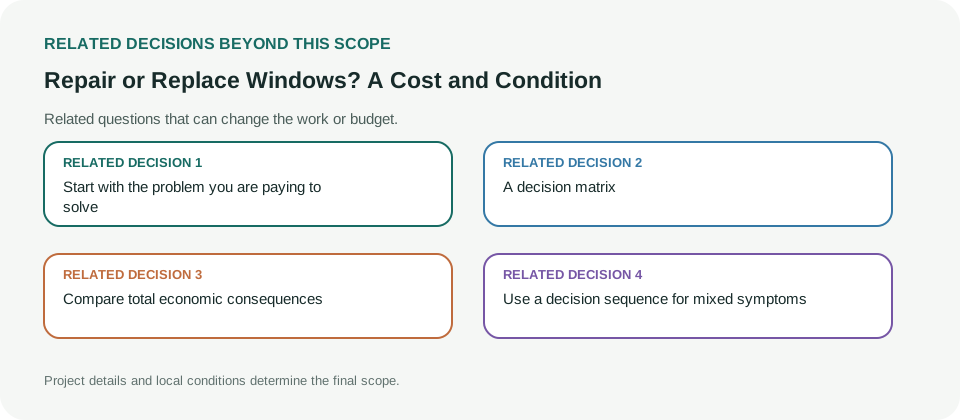
Compare four practical paths
- Repair a component: Best for bounded glass, seal, hardware, or localized frame failures.
- Use an attachment: Storm windows, interior panels, or film may improve a specific comfort, solar, or leakage objective when the existing window is eligible and sound.
- Install an insert: Retains the existing frame and can reduce disturbance, but it depends on frame condition, size, trim, and water management.
- Use full-frame replacement: Exposes more of the opening and can address frame condition, flashing, finish, and configuration, but usually has broader labor and restoration scope.
DOE research treats storm-window panels and films as different attachment categories, not guaranteed substitutes for every replacement. Performance and cost depend on the existing product and installation.
Keep older-home hazards in the budget
EPA says paid window replacement that disturbs paint in pre-1978 U.S. housing is covered by the federal RRP rule, generally requiring certified firms and lead-safe practices. Health Canada warns that disturbing lead paint on older windows and doors can create health risks, and asbestos may also be present in older renovation materials. Confirm the current local requirements and qualified roles before work begins.
Start with the problem you are paying to solve
Separate the current symptom from the desired improvement. A cracked pane, failed seal, broken balance, rotten sill, rain leak, draft, poor operation, noise complaint, and wish for a different view are not the same decision. The right comparison may be glass versus an IGU, hardware versus a sash, flashing repair versus a unit, an insert versus a full-frame replacement, or a window change that belongs inside a larger remodeling project.
The first question for a quote is therefore: what will be different after the work? If the answer is “the sash will operate,” a full replacement may be excessive unless condition or performance adds another reason. If the answer is “the wall will stop getting wet,” a new window is not sufficient unless the opening and drainage path are corrected. If the answer is “the room will be quieter,” glass, frame, wall, vents, and other openings may need to be considered together.
A decision matrix
| Situation | Repair often deserves the first comparison | Replacement becomes more plausible |
|---|---|---|
| Broken glass | Frame, sash, seals, and opening are sound | Frame or sash is damaged, glazing is incompatible, or the goal has changed |
| Failed hardware | Compatible part is available and the frame is aligned | Parts are obsolete or several mechanisms fail |
| Fog between panes | A matching IGU or sash is available | Frame, opening, or many units are also failing |
| Rotten frame or sill | Damage is localized and the water source can be corrected | Deterioration is broad or restoration nearly equals a new opening |
| Rain leakage | A defined flashing or perimeter defect can be corrected | The frame and wall transition are broadly damaged |
| Draft or discomfort | Sash, weatherstrip, or perimeter air sealing is the cause | The product is distorted or a defined performance upgrade is wanted |
The matrix is a starting framework, not a remote diagnosis. A repair can be poor value if it leaves the cause in place, while a replacement can be poor value if it simply covers an enclosure problem.
Compare total economic consequences
For repair, include diagnosis, service minimums, parts, return visits, access, finish disturbance, and the remaining service horizon. For replacement, include the unit, removal, disposal, flashing, air sealing, trim, cladding, interior restoration, access, and concealed-condition risk. An inexpensive repair may be the best answer when it restores the needed function for a sound opening. A higher initial replacement cost may be reasonable when it combines several failing components or a planned opening change.
Do not promise a payback based only on age. Energy outcomes depend on climate, orientation, shading, ratings, installation, existing windows, and energy prices. Comfort, noise, operation, appearance, and water protection can be valuable even when energy savings alone would not justify the work. State which benefit is carrying the decision.
Use a decision sequence for mixed symptoms
When a window has more than one complaint, choose an order that avoids paying twice. First separate immediate hazards or active water entry from comfort concerns. Then identify whether the failure belongs to glass, sash hardware, the frame, the installation perimeter, or the surrounding wall. A replacement quote is easier to evaluate once the homeowner knows which condition it is meant to solve and which conditions will remain.
Next, compare the intervention that restores the needed function with the larger option. A failed lock may justify hardware work if the sash and frame are sound. A failed insulated-glass unit may be a contained repair if a compatible unit is available. Recurring leaks, widespread frame deterioration, incompatible replacement parts, or a deliberate size change may justify the broader removal and installation scope. These are indicators to investigate, not automatic rules.
Estimate the complete cost of each alternative: diagnosis, part or unit, labor, access, removal, flashing or perimeter repair, disposal, interior and exterior finishes, and any separately scoped wall work. For repair, record what useful life or limitation remains uncertain. For replacement, record what performance or operating improvement is actually specified. Do not compare a repair subtotal with a replacement quote that includes extensive finish restoration, or subtract hypothetical energy savings from one option without a household-specific basis.
If the work may be under a manufacturer, installer, or builder promise, check that route before authorizing overlapping paid work. Identify the exact product, date, owner, and affected component, and ask in writing whether inspection or approval is required. A potential claim does not establish coverage, labor payment, or a safe reason to delay urgent protection. Keep the claim decision and independent repair quote separate so the homeowner can compare the actual remaining bill.
Special cases that change the threshold
Historic windows may have repair and preservation value that a generic replacement comparison misses. Condo or shared-property owners may need approval or responsibility clarification before choosing a physical intervention. An opening that serves a bedroom, changes a wall, requires impact protection, or affects accessibility has higher-consequence requirements than an ordinary same-size replacement. Verify the applicable local rules and product documentation instead of assuming a standard window is acceptable.
Older homes also need a disturbance check. U.S. EPA RRP guidance generally covers paid work disturbing paint in pre-1978 housing; Canadian guidance warns about lead paint and asbestos-containing materials in older homes. Ask for the qualified assessment and current local work plan before demolition.
When comparing bids, ask for the diagnosed failure, repair boundary, replacement method, opening condition, finish assumptions, product documentation, warranty, and the discovery that would change the scope. A sound decision is not “repair if cheap, replace if expensive.” It is the smallest responsible intervention that solves the defined problem while accounting for recurrence, compatibility, disruption, and future work.
Ask the contractor to identify the failure, evidence of the diagnosis, repair boundary, expected result, parts availability, opening and frame condition, flashing or finish work, warranty, and next-step cost if concealed damage is found. Get an alternative quote only when it is a genuinely different intervention, such as an insert versus full-frame replacement.
Choose repair when it solves a bounded failure and preserves a credible serviceable opening. Choose replacement when it addresses the complete condition or a deliberate change in performance, size, operation, or appearance. Do not choose by age or a universal repair-percentage rule.