
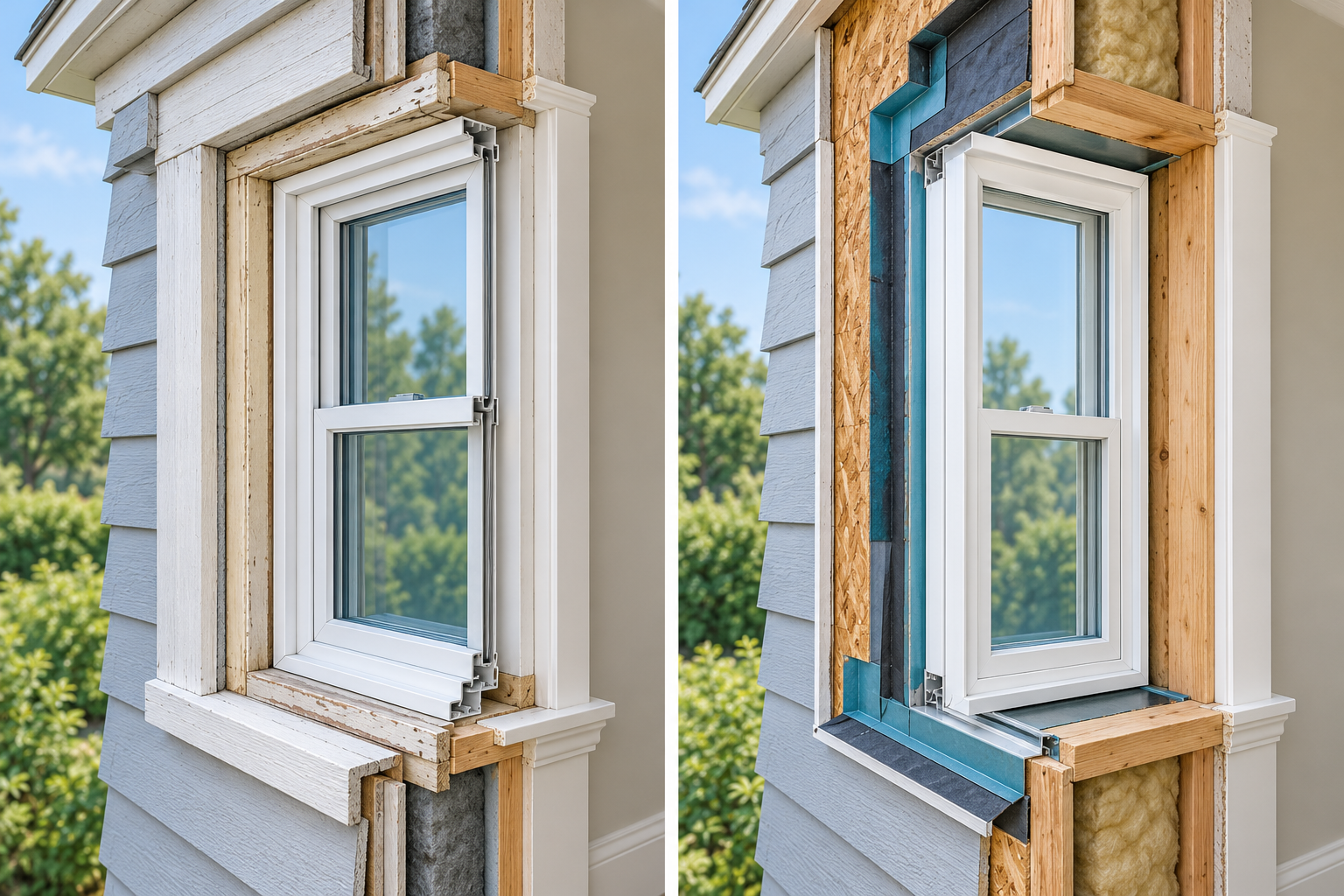
An insert, pocket, or retrofit replacement usually fits inside the existing frame. A full-frame replacement removes more of the existing assembly so the installer can address the frame and rough-opening perimeter. The labels are not perfectly standardized, so the quote must describe the actual removal and installation boundary.
What each method preserves
| Method | Usually preserves | Can make sense when… |
|---|---|---|
| Insert or pocket | Existing frame, exterior trim, and much of the surrounding finish | The frame is sound, square, dry, correctly sized, and compatible with the new unit |
| Full-frame | Less of the old window assembly; trim and cladding may be disturbed | The frame or sill is damaged, the size or configuration changes, or the opening needs inspection and water-management work |
An insert can reduce demolition and finish restoration, but the retained frame remains part of the new window’s performance and appearance. Full-frame work can expose concealed conditions and provide more opportunity to repair the perimeter, but it is not automatically the better product or the lower long-term cost.
The frame and water path decide more than the label
Building America guidance treats windows as interruptions in the wall’s drainage plane. Sill or pan flashing, side flashing, head flashing, and the wall water-control layer need to work together. If a retained frame has failed flashing, rot, distortion, or an unresolved leak, an insert may leave the underlying problem in place.
Full-frame does not guarantee correct installation either. The quote should state the flashing approach, air-sealing boundary, cladding and trim removal, interior restoration, and what happens when the rough opening is damaged. Ask to see the scope before it is covered.
Other tradeoffs
- Glass area: An insert may reduce visible glass because it fits inside the old frame. Confirm the finished sightline.
- Size and operation: A different operating style or opening size may require more than an insert can provide.
- Exterior appearance: Existing trim and cladding may be valuable or difficult to match; historic work needs additional preservation judgment.
- Labor and disposal: Full-frame work usually has more demolition, protection, disposal, and finish scope, but the total difference depends on access and concealed conditions.
- Performance: U-factor, SHGC, air leakage, condensation resistance, frame, and glazing are properties of the complete rated product and installation, not of the method name alone.
Canadian specialist pricing for standard existing-opening replacements is a broad planning signal only. The evidence does not establish a universal insert premium or full-frame premium in either market.
What is actually being retained
An insert, pocket, or retrofit installation usually retains some or all of the existing frame. That can preserve interior and exterior trim and reduce disturbance when the frame is square, dry, structurally adequate for the product, and compatible with the replacement. It can also preserve an old sill, perimeter seal, or geometry that is part of the current problem. Ask the contractor to identify exactly which components stay in place.
A full-frame installation exposes more of the opening. Depending on the product and contractor terminology, the existing sashes, frame, stops, trim, or surrounding material may be removed and the new assembly installed closer to the rough opening. That can make hidden conditions easier to inspect and can permit a change in size or configuration, but it usually creates more finish and water-management work.
Compare scenarios instead of labels
An insert can fit a sound existing frame where the homeowner wants a narrower, lower-disturbance replacement with the same basic geometry. It is a weaker choice when the frame is rotten, bowed, leaking, out of square, too small for the desired glass, or dependent on a failed perimeter detail. A full-frame quote can fit a deteriorated or altered opening, but it is not automatically better if the installer does not reconnect flashing, air sealing, and finishes correctly.
| Question | Insert may be reasonable | Full-frame deserves consideration |
|---|---|---|
| Existing frame | Sound, square, dry, and compatible | Rot, distortion, leakage, or unknown condition |
| Size and style | Retained geometry meets the goal | New size, operation, glass area, or configuration is wanted |
| Trim and cladding | Preserving finishes has value | Finish is already failing or must be opened to correct water management |
| Performance | Existing perimeter is serviceable | Air, water, or installation limitations need investigation |
| Project risk | Lower disturbance is important | Access to concealed damage is worth the added scope |
These are economic comparisons, not permission to decide structural or safety questions from an image.
Water management is part of the method
Building America treats the sill or pan, side, and head flashing as connected to the wall drainage plane. Retaining an old frame can also retain the limits of the old water detail. Removing the frame can expose damage but does not guarantee that the new opening will be flashed correctly. Ask for the installation detail, the materials being removed, the air-sealing boundary, and the exterior finish restored.
If a window has leaked, request an explanation of where water is believed to enter and what will be opened to verify it. If the problem is above or beside the window, neither an insert nor a full-frame unit alone solves the source. If the wall or cladding work becomes dominant, coordinate that scope with the appropriate specialist.
Cost and performance comparisons
Compare like with like: same size, operation, frame, glazing, screens, hardware, finish, disposal, access, and taxes. A quoted insert premium or full-frame premium is not universal because the starting frame and finish conditions differ. A lower product price can be offset by custom trim, hidden rot, or later repairs.
Product metrics also need to be compared on the complete rated assembly. U-factor, solar heat gain coefficient, air leakage, visible transmittance, and condensation resistance answer different questions. A new product does not create a guaranteed energy payback, and U.S. program criteria should not be treated as Canadian code or a Canadian price basis.
What the site visit should establish
The word “insert” or “retrofit” does not tell a homeowner whether the existing frame is suitable to retain. Before comparing the methods, ask the installer to inspect the sill, jambs, head, operating clearances, visible water marks, and exterior cladding connection. The visit should identify what can be seen without removing trim and what would remain hidden if the frame stays in place.
For an insert proposal, document the existing frame dimensions and condition, the new unit’s fit, the reduction in visible glass area, and how the retained frame will be sealed. Ask which water-management layers are not being exposed and what signs would make the installer stop and recommend full-frame work. An insert can reduce disturbance when the frame is sound and the new unit fits; it does not repair concealed rot or correct every installation defect.
For full-frame work, ask how the old frame will be removed, what exterior trim or cladding will be disturbed, how the new frame will connect to the drainage plane, and which interior finishes are restored. Full-frame work can reveal problems that an insert would leave hidden, but it also makes access, disposal, and finish assumptions more important. The quote should include a conditional process for concealed damage rather than quietly treating it as included or excluded.
When the proposals use different methods, request a side-by-side alternate for the same product and finish level. Compare total price, preserved trim, expected visible glass area, exposed water-management work, and repair of any discovered damage. That comparison makes clear whether one method costs more because of the frame strategy or because the bids also differ in product, glass, access, or restoration.
One practical test is to ask the installer to point to the surfaces the chosen method leaves in place. If the sill, jamb, or exterior interface cannot be inspected without removal, the retained-frame option carries that uncertainty forward. The quote should say whether the homeowner accepts that limitation and how any discovered damage would change the work.
Older and specialized openings
Historic trim, masonry, lead paint, asbestos-suspect materials, impact requirements, egress, and shared-property approvals can change the method. U.S. EPA RRP guidance generally covers paid work disturbing paint in pre-1978 housing, while Canadian guidance calls for appropriate assessment of older paint and suspect materials. Ask who evaluates the condition and how containment, cleanup, and finish matching are included.
Before signing, require the quote to define retained components, rough-opening dimensions, flashing, air sealing, trim and cladding removal, interior and exterior restoration, concealed-work triggers, warranty, and the expected finished outcome. “Insert” and “full-frame” are useful starting labels; the complete scope determines the value.
Ask whether the existing frame is being retained, what was inspected, how rot and water damage will be handled, whether the sill and head flashing are included, how much trim or cladding is removed, and what interior and exterior finishes are restored. Confirm finished opening dimensions, glass area, screens, hardware, disposal, taxes, warranty, and conditional work.
Choose an insert when the existing frame is genuinely sound and the retained geometry serves the project. Choose full-frame when the opening condition, water management, configuration, or finish objective requires broader access. “Retrofit” should never be accepted as a complete scope description.