
Window replacement cost is the price of a complete opening project, not just the window displayed in a catalogue. A quote can include a unit, removal, installation, air sealing, flashing, trim, disposal, interior repair, exterior cladding work, and access. If those items are not separated, two apparently similar prices may describe very different jobs.
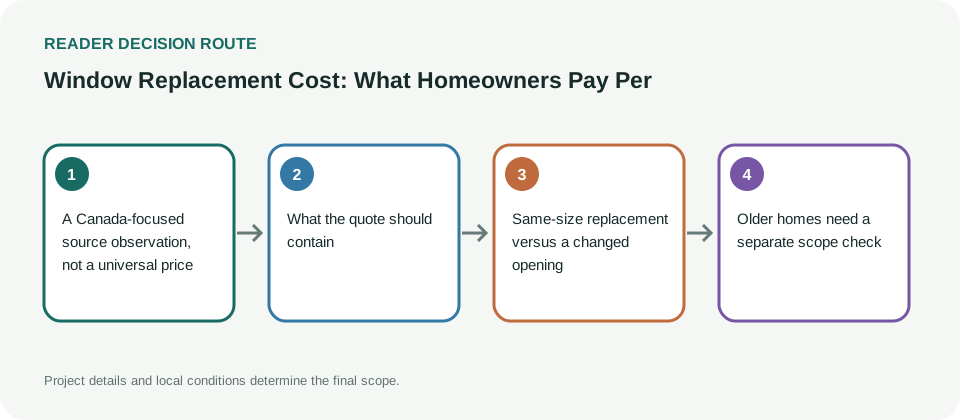
A Canada-focused source observation, not a universal price
The Canada-focused HomeStars page displays $300–1,000 per standard window for common residential sizes, basic vinyl frames, and double-pane glass in an existing opening, but it does not identify the currency. Treat this as an un-denominated source observation, not a confirmed CAD or USD quote or a national price. It does not represent custom sizes, difficult access, extensive finish work, or U.S. pricing. Do not convert it into another currency.
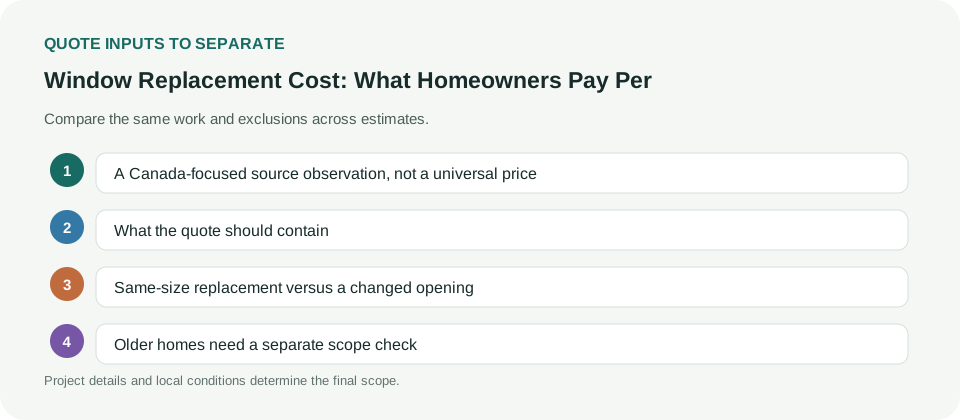
For either market, use the figure only to understand scale. Ask for a local quote that states the product, opening condition, installation method, finish assumptions, taxes, and exclusions.
What the quote should contain
| Line item | Why it matters |
|---|---|
| Window unit | Frame, operating type, size, glazing, coatings, hardware, screens, and warranty can change the product price. |
| Removal and disposal | Old units, trim, fasteners, and damaged materials may require different labor or disposal handling. |
| Opening preparation | Rot, uneven framing, masonry, or a damaged sill can make a same-size replacement a repair project. |
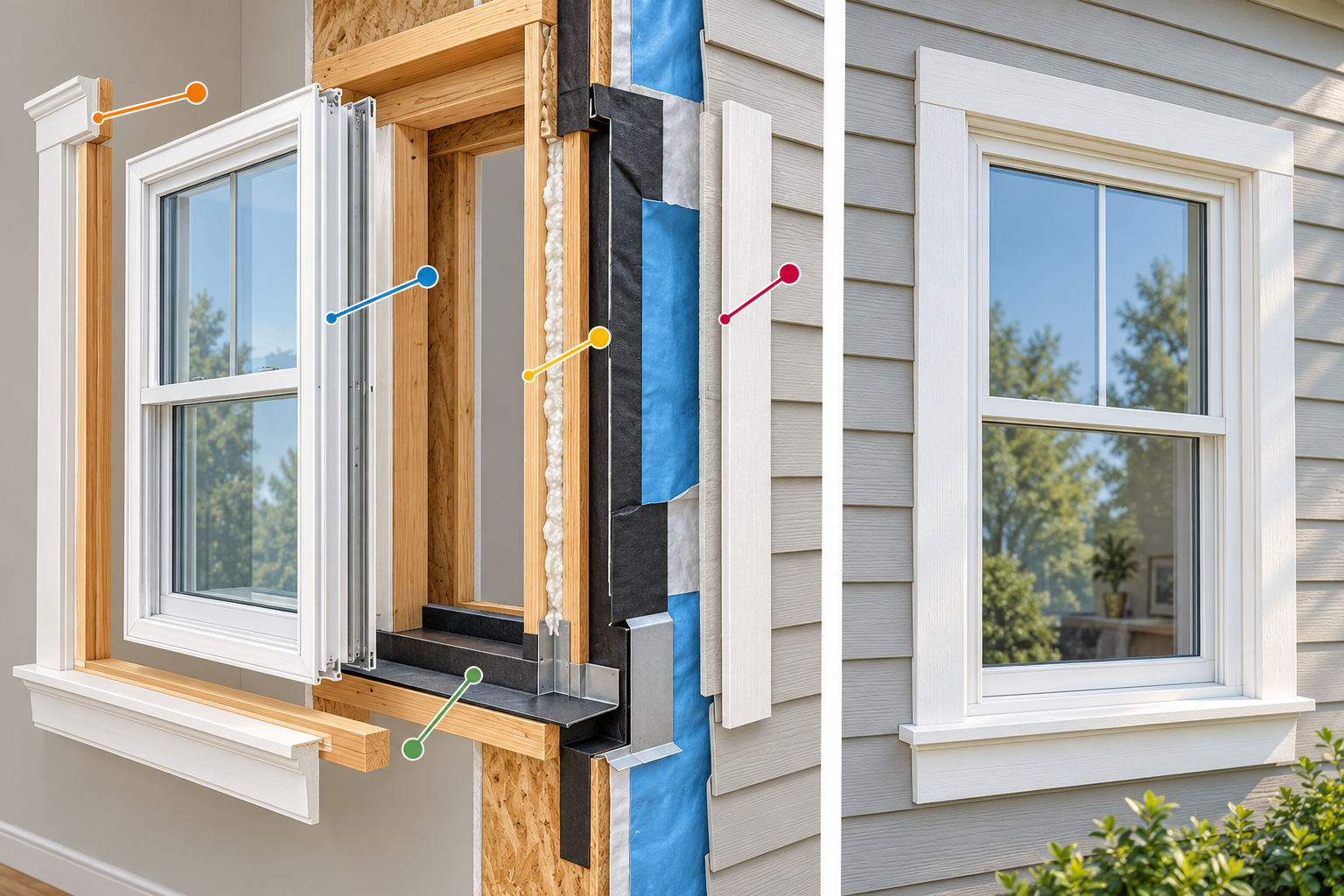
| Water and air control | Sill or pan flashing, side and head flashing, and integration with the wall drainage plane protect the opening. |
| Interior and exterior finish | Casing, drywall, paint, siding, stucco, brick, and trim may need repair or matching. |
| Access and protection | Upper floors, tight interiors, scaffolding, furniture protection, and weather exposure add setup. |
The Building America Solution Center describes windows as interruptions in the wall drainage plane and treats sill, side, and head flashing as a connected water-management system. A nominal replacement can therefore expose work that was not visible during the initial measurement.
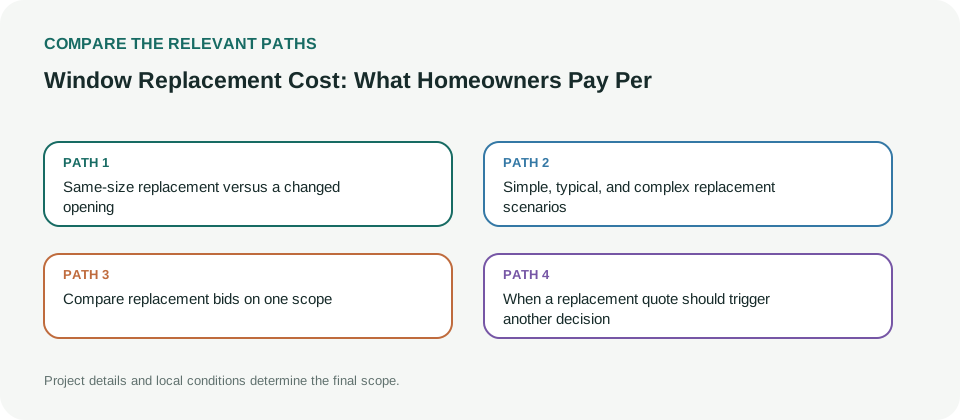
Same-size replacement versus a changed opening
Replacing a window in the same rough opening is usually a narrower project than enlarging, reducing, relocating, or adding an opening. A changed opening may require structural review, new framing, cladding and interior restoration, utility relocation, or local approval. Do not compare its quote with an ordinary replacement price.
The installation method matters too. An insert or pocket unit can retain a sound existing frame, while full-frame work exposes more of the sill, jambs, flashing, and surrounding finish. If the frame is rotten, distorted, leaking, or the wrong size, the apparent savings from retaining it may not survive inspection.
Older homes need a separate scope check
Paid window replacement that disturbs painted surfaces in U.S. housing built before 1978 is generally covered by the EPA Renovation, Repair and Painting rule; EPA specifically identifies window replacement as covered regardless of the small-area minor-repair thresholds. In Canada, Health Canada warns that older homes may contain lead paint on windows and doors. These are planning boundaries, not a substitute for current state, tribal, provincial, territorial, local, or project-specific requirements. Ask who is responsible for testing, containment, cleanup, certification, and disposal before work starts.
Build a usable budget before collecting bids
Start with an opening schedule rather than a single count. Record the approximate width and height, operating type, frame material, glazing, floor level, exterior finish, interior trim, and visible damage for each window. Mark openings that are difficult to reach, unusually shaped, part of a bay or bow assembly, or needed for ventilation or emergency escape. This prevents a contractor from treating a simple first-floor replacement and a complicated upper-floor or basement opening as equivalent units.
The schedule should also state the intended result. A homeowner replacing cracked glass has a different scope from one correcting a leaking frame, changing a window style, improving comfort, or altering a room layout. If the reason for the project is not written down, a quote may optimize for a product sale rather than the condition that needs to be solved.
For each bidder, request a base scope and conditional allowances. The base scope might cover a sound, same-size opening. Separate allowances can cover localized rot, masonry or cladding repair, interior patching, scaffolding, utility relocation, testing, or engineering. An allowance is easier to compare when it says what observation activates it and whether unused funds are credited. An unexplained contingency percentage gives less useful information than a short description of the concealed condition it is intended to cover.
Simple, typical, and complex replacement scenarios
A simple project may involve one accessible, standard-size window in a sound opening. The quote may include the unit, removal, installation, basic air sealing, trim touch-up, and disposal. Even here, confirm whether the installer is retaining an existing frame or installing a full-frame unit, because those terms affect what is inspected and restored.
A typical project may include several openings with different operating types, minor trim work, new screens, interior protection, and a mixture of insert and full-frame installations. Product standardization can make ordering and maintenance easier, but it does not make every opening equally simple. A window with a failed sill or unusual exterior finish may need its own scope.
A complex project may involve water damage, a projecting window, a masonry wall, an upper floor, a changed opening, obsolete dimensions, or older painted materials. It may require multiple trades and a staged inspection after demolition. The price is driven by the work needed to make the entire opening weather-tight and finished, not by the catalogue price of the replacement unit.
Product comparisons that are worth making
Compare products only after the opening and project scope are comparable. Ask for the complete product’s frame, operating type, glazing, coatings, screens, hardware, and available performance information. U-factor and solar heat gain coefficient (SHGC) answer different questions, and a product selected for one climate or orientation may not be the best fit for another. Air leakage, visible transmittance, and condensation resistance can also matter, but none replaces proper installation.
Do not assume a more expensive material, a higher pane count, or an ENERGY STAR label guarantees a specific household payback. U.S. ENERGY STAR criteria are climate-zone based, and the program’s modeled savings are not a promise for an individual home. Canadian homeowners need product and local guidance applicable to their market rather than a converted U.S. assumption.
Compare replacement bids on one scope
A useful bid comparison starts by holding the product and opening method constant. A lower proposal may be pricing an insert in a sound frame while another includes full-frame removal, exterior trim work, and interior restoration. Those are different projects even when the window count is identical. Ask each bidder to list the same opening schedule, product series, operating type, glass package, frame color, screens, hardware, and installation method.
Then separate the work into unit, removal, installation, water-management details, disposal, and finishes. A line labeled “installation” should say whether it includes sill or pan preparation, perimeter air sealing, insulation, exterior trim or cladding repair, and interior patching. If these items are excluded, ask who will perform them and what their separate allowance is. A complete comparison also records access, taxes, permit assumptions, warranty responsibility, and the process for pricing concealed damage.
Do not compare only a per-window average when the openings vary. A large picture unit, a second-story casement, and a small ground-floor double-hung may have different product, handling, and finish costs. Keep each opening’s scope visible, then compare the overall total and the high-uncertainty openings separately. This makes it easier to reduce scope responsibly if the budget is too high—for example, by phasing sound openings—rather than accepting a quote that omits work needed to leave the installation complete.
When a replacement quote should trigger another decision
Pause before approving a standard replacement if the contractor finds a soft sill, staining beyond the frame, a distorted opening, active leakage, or a product that no longer fits the desired opening. A repair, glass-only replacement, storm-window attachment, insert, full-frame unit, or opening modification may each solve a different problem. A new window installed into a wet wall or failing frame can leave the underlying cost untouched.
Older-home work deserves a written disturbance plan. EPA guidance says the U.S. federal RRP rule generally covers paid work that disturbs paint in pre-1978 housing, and it specifically includes window replacement. Canadian public-health guidance warns that older homes may contain lead paint and asbestos-containing materials. Those sources do not determine every local requirement or prove that a particular surface is hazardous. Ask which qualified person evaluates the material, who controls dust and cleanup, and how the added scope is priced.
The best replacement budget has a clear base case, named cost drivers, separate conditional work, and a defined finished outcome. It lets the homeowner compare unlike quotes without mistaking a low unit price for a low total project cost.
Ask whether the price is for an insert or full-frame installation, whether flashing is included, what happens if rot is discovered, and which interior and exterior finishes are restored. Ask for the exact product line and performance label, the number and size of openings, disposal, screens, hardware, taxes, permits or engineering allowances where applicable, warranty conditions, and a clearly bounded concealed-work allowance.
The useful comparison is not “price per window.” It is the complete scope required to leave the opening weather-tight, operable, finished, and appropriate for the home.