
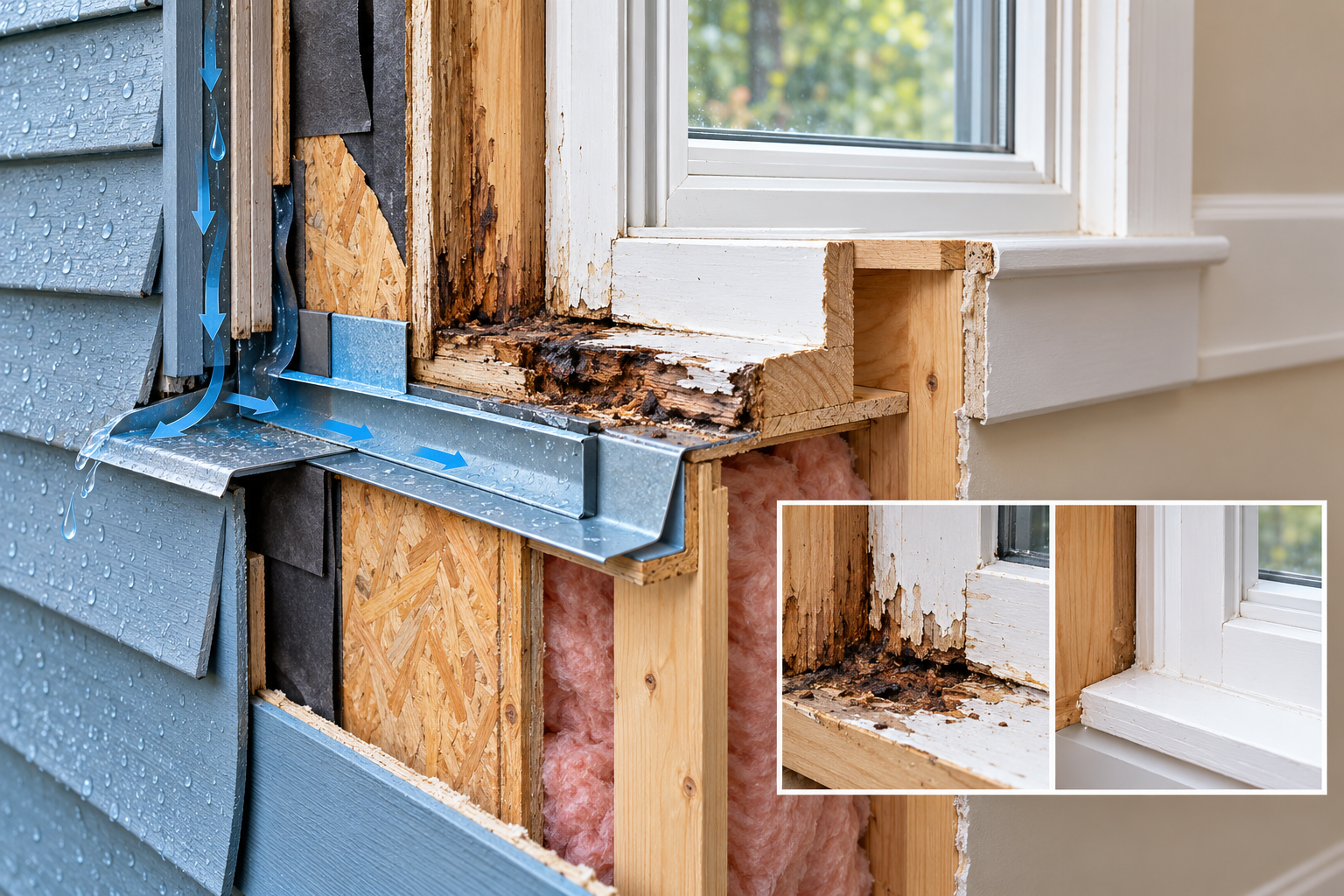
Rot at a window sill or frame is a material condition, not a complete diagnosis. The visible wood may be the first exposed part of a leak that also affected flashing, sheathing, trim, insulation, or the wall below. A responsible quote starts by finding the water path and defining what will be opened, repaired, and restored.
Localized damage versus an expanded scope
Localized deterioration may allow removal of damaged material, repair to sound wood, replacement of a sill section, and finish restoration. More extensive damage can require frame reconstruction, full-frame replacement, cladding removal, new flashing, interior patching, or investigation of adjacent wall framing. A soft sill does not prove that structural framing has failed, but it is a reason to inspect rather than cover the area cosmetically.
The quote should say what was visible, what was probed or opened, and what remains concealed. Ask for a conditional allowance with a defined trigger, such as damaged sheathing discovered after trim removal, rather than an unlimited “rot repair” line.
Correct the source before rebuilding
Building America guidance describes windows as interruptions in the wall’s drainage plane. Sill or pan flashing, side flashing, head flashing, and integration with the wall water-management layer work together. A new sill installed over a continuing leak can fail again, even if the replacement wood and finish look sound.
The source may be the window, its perimeter, cladding above or beside it, roof drainage, or a transition between materials. Water can appear indoors away from the entry point. Avoid treating a bead of exterior sealant as a universal repair; the appropriate detail depends on the wall assembly, product instructions, and local practice.
Main cost drivers
- extent of sill, jamb, frame, sheathing, and trim damage;
- insert repair versus full-frame access;
- siding, stucco, brick, or masonry removal and matching;
- interior casing, drywall, paint, insulation, and floor protection;
- access, weather protection, disposal, and return visits;
- custom material or discontinued window parts;
- testing, containment, cleanup, or qualified work in older homes.

HUD guidance identifies window sills and frames in older U.S. housing as places where lead paint and dust may be present. EPA’s current RRP guidance specifically covers paid window replacement in pre-1978 housing when painted surfaces are disturbed. Health Canada also warns that older Canadian homes may contain lead paint and asbestos-containing materials; the construction-era clues are not a substitute for project-specific assessment.
Read the damage as a scope question
Soft paint, swelling, staining, a musty smell, failed trim, or a spongy sill can indicate different stages of deterioration. A small area of damaged finish may be localized, while a sill that has been wet for a long time may have affected the frame, sheathing, insulation, or interior trim. Visual inspection alone cannot establish the full extent, especially when cladding and casing conceal the joint.
Ask what the contractor inspected and what remains covered. A useful proposal distinguishes observed damage from a conditional allowance for concealed material. It also identifies the likely water source. Rain may enter through the head, jamb, sill, cladding, roof, or another opening above and travel before appearing at the window. Replacing rotten wood without correcting that path can repeat the failure.
Repair scenarios
| Condition | Possible scope | Why the price changes |
|---|---|---|
| Localized trim or sill damage | Remove unsound material, repair or splice, prime and refinish | Access, matching, and finish work |
| Partial frame deterioration | Rebuild part of the sill or jamb and reconnect the window | Extent behind trim and compatibility with the existing sash |
| Failed opening water management | Open cladding or trim, correct flashing and air sealing, restore finishes | Wall assembly and exterior-finish disturbance |
| Broad frame or wall damage | Full-frame replacement or opening repair | Product, structural or sheathing work, drying, and restoration |
These categories are not a remote diagnosis. They help a homeowner understand why two repair proposals can differ substantially even when both describe “sill repair.”
Cost drivers beyond the wood repair
The most important drivers are the opening’s size and height, frame material, exterior cladding, interior trim, access, water-management detail, amount of removal, disposal, drying, and finish matching. Brick, stucco, stone, and older siding can be harder to remove and restore than a simple trim system. A projecting or unusually shaped window may require a separate support or roof/head treatment.
If the window must be removed, include temporary weather protection and a plan for keeping the opening secure. If insulation or air-control materials are disturbed, include restoration rather than assuming the trim will hide the gap. If the wall has movement or settlement, route the structural question to an appropriately qualified professional; a soft sill is not proof of structural failure, and a new frame is not a substitute for a structural assessment.
Repair versus full-frame replacement
Repair is more defensible when sound material remains, the water source can be corrected, the frame can be made square and weather-tight, and the window still meets the homeowner’s needs. Full-frame work becomes more credible when the frame is broadly deteriorated, the opening is distorted, the sash and hardware are also failing, or the repair would require removing nearly all surrounding finish anyway.
Compare the total finished scope, not just the repair line. A lower-cost patch may leave the old glazing, hardware, or installation limitations in place. A higher-cost replacement may still be poor value if it retains an unresolved wall leak. Ask each bidder to state the expected result, the work that will be exposed, the finish restored, the warranty, and the discovery that would change the recommendation.
Make the repair boundary visible
Rot repair is difficult to price from the visible surface because the opening may conceal softened framing, wet insulation, or a damaged connection to the wall. A proposal should distinguish the area that can be inspected now from the area that may be exposed during work. Ask for a photograph and description of the condition that would trigger a change order, plus the price or approval process before that additional work proceeds.
A complete scope describes both the removed material and the repair that stops the water path. Depending on the opening, that may involve replacing a sill or frame section, correcting a failed seal or flashing interface, reconnecting exterior cladding, and restoring interior trim or paint. Replacing the visible wood while leaving the source of recurring wetting unresolved can lead to a repeat repair. Conversely, a small bounded patch should not automatically be expanded into wall reconstruction without evidence of a wider defect.
Compare a localized repair with full-frame replacement using the same finish assumptions. A repair may preserve the existing glass, sash, and interior trim, but matching the profile and color can be difficult. A full-frame option may give better access to the opening perimeter, while also increasing removal, cladding, and finish work. Ask which parts remain, what is warranted, and whether the existing product is still serviceable after the repair.
If the water appears only during certain wind or rain conditions, tell the contractor when it occurs and what adjacent surfaces are wet. The entry point may be above or beside the window, and a surface stain alone does not establish the path. Where diagnosis is uncertain, ask whether an appropriate professional assessment is needed before committing to reconstruction. The estimate should make uncertainty explicit rather than hide it in a large undifferentiated contingency.
A useful closeout record identifies the source correction, the framing or trim replaced, any materials retained, and the finish that remains. Ask for photographs before the opening is closed and retain them with the estimate and warranty. This does not replace a professional inspection, but it helps a future contractor distinguish a repaired local area from a recurrence elsewhere in the wall.
Older-home disturbance
Window and sill repairs can disturb paint, putty, caulk, siding, plaster, insulation, or other older materials. EPA’s U.S. RRP guidance generally covers paid work that disturbs paint in pre-1978 housing and specifically includes window replacement. Health Canada warns that older Canadian homes may contain lead paint and asbestos-containing materials and recommends appropriate assessment before renovation. Neither source proves a hazard by appearance or replaces current local requirements.
Include qualified testing or assessment, containment, cleanup, certification, and disposal where they apply. The goal is not to turn a repair quote into a generic abatement plan; it is to prevent an apparently small opening repair from hiding a material health or restoration obligation.
Repair is more plausible when the damage is localized, the frame can be made sound, the water source can be corrected, and the remaining window meets the homeowner’s needs. Full-frame replacement becomes more plausible when the frame is broadly deteriorated, the sash and hardware are also failing, the opening is distorted, or restoration would approach the scope of a new unit. A broader wall or structural investigation is appropriate when damage extends beyond the opening or movement, settlement, or load-path concerns are present.
Ask for photographs of opened areas, the water-management repair, all finish inclusions, the repair boundary, warranty, and conditions that would move the project to replacement. Price the work that prevents recurrence, not just the visible wood patch.