
A product warranty can make a defective window or door less expensive to repair, but “covered” does not always mean that the complete service visit is free. The written terms may treat the part, labor, travel, shipping, removal, and surrounding finish differently. Before authorizing paid work, identify the exact product and ask the manufacturer or seller to state in writing what remedy is being offered and which costs remain yours.
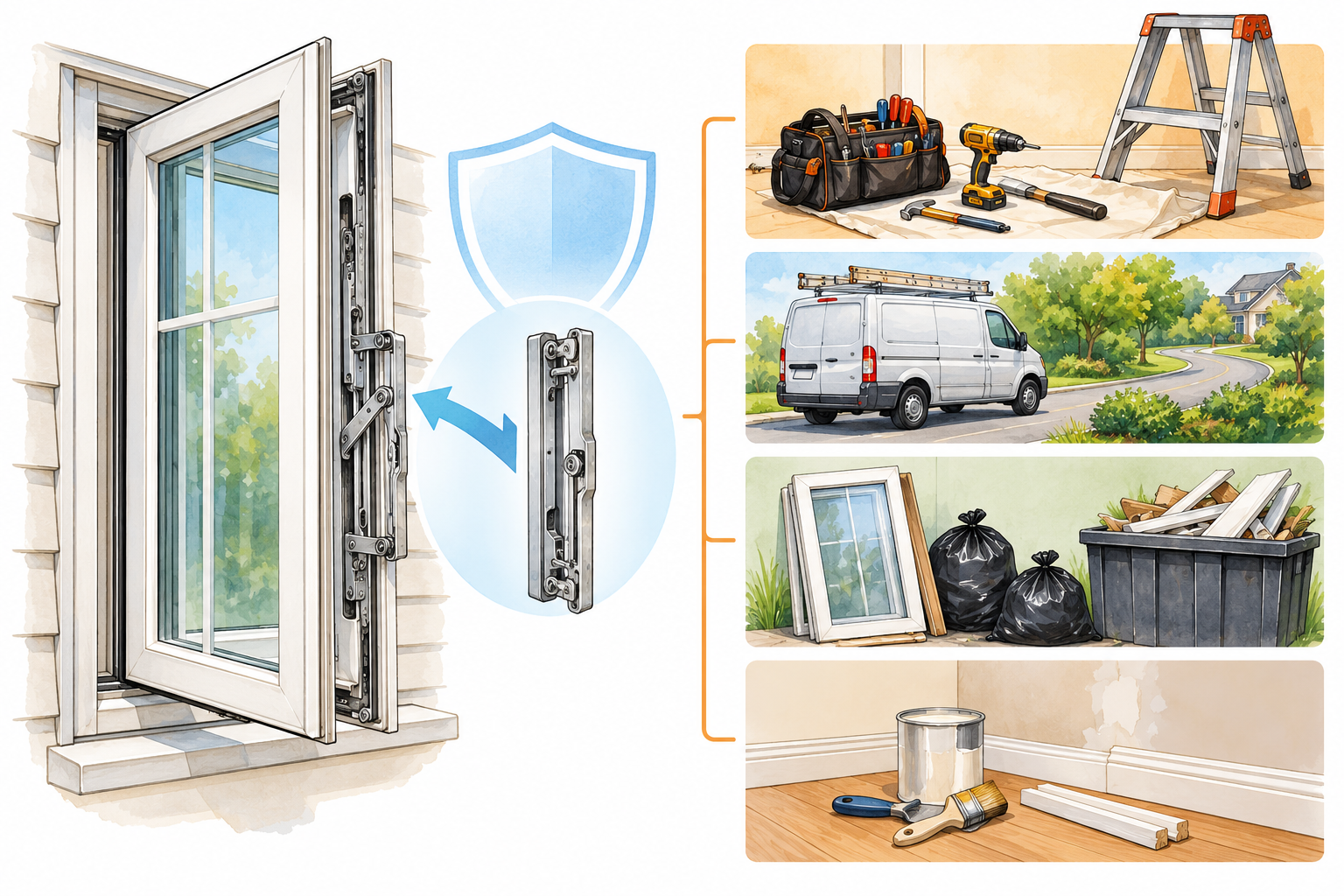
This guide covers existing residential windows, exterior entry doors, and patio doors. It helps you build a remaining-bill estimate; it cannot determine whether a specific defect qualifies or interpret a warranty dispute. Technical diagnosis and component prices belong in the repair guides for the affected part.
Identify the product and the document that applies
Start with the permanent label, order or invoice, spacer code, product number, manufacturer, series, and approximate installation or purchase date. Photograph the label before it fades or becomes inaccessible. Look for the original sales contract, warranty certificate, installation invoice, and any record of a home sale or warranty transfer. If you do not know the model, ask the original dealer or builder for the order information rather than choosing a current document based on brand name alone.
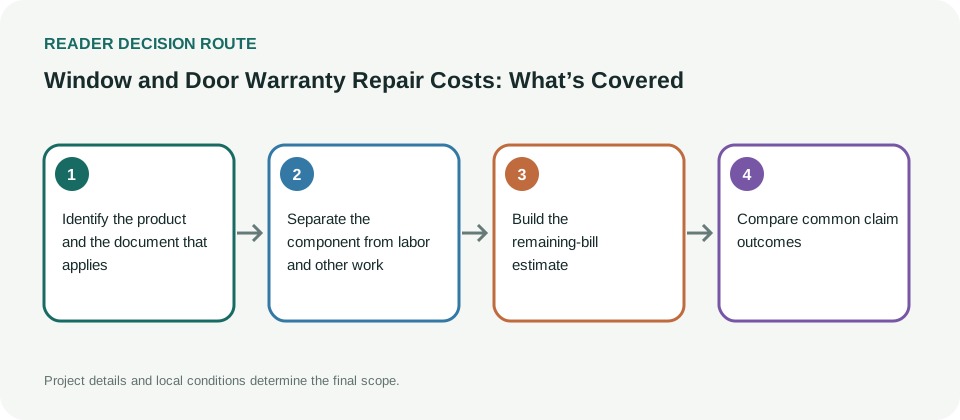
Select the written warranty by product family and the date that controls its terms. A schedule may use the manufacture date, purchase date, or installation date. A current document may explicitly leave earlier products under an older warranty. The document’s market, geography, structure type, component, and owner conditions matter too. A window in an owner-occupied single-family home may not have the same schedule as a rental, condominium, or commercial installation.
Use the manufacturer’s document registry or customer-care team to locate the correct version. JELD-WEN Canada, for example, lists different written documents by product family and effective period, including current window/patio-door and door schedules as well as older product-era documents. Its registry is a starting point; the exact product and manufacturing date still determine which document applies. Do not assume a warranty for the same brand or similar-looking product covers your opening.
Separate the component from labor and other work
Read the coverage table by the failed item, not by the largest term in a headline. Glass, insulated-glass seals, sash, frame, hardware, finish, screens, controls, and labor may have different durations and exclusions. Transferability may also change the term or require a transfer step. A “limited lifetime” phrase is not automatically a lifetime of free service, a promise of product life, or a guarantee that a later owner receives the original purchaser’s benefits.
The written schedules illustrate why a component-by-component check matters:
| Example document | Scope and dates | Cost distinction to verify |
|---|---|---|
| Pella Vista Series | The document applies to listed Vista windows and patio doors purchased on or after January 1, 2026, for installation in the United States and Canada. | For its owner-occupied single-family schedule, some frame/sash and glass terms differ from the separate repair/replacement labor term. It also limits surrounding trim and carpentry work and describes shipping/pickup terms. |
| JELD-WEN windows and patio doors | The current schedule covers specified products manufactured on or after June 1, 2019 in the U.S. and Canada, with stated product-family exceptions; older products remain under earlier terms. | Basic product and skilled-labor periods vary by material and structure. The document also excludes some travel, access equipment, removal/disposal, and refinishing costs, and permits an inspection fee in a denied-claim situation. |
| JELD-WEN door systems | The listed U.S./Canadian door schedule is effective for products manufactured on or after June 1, 2019. | The document distinguishes slab/component coverage from skilled labor, which has its own term, and excludes some installation or finish conditions. |
| ProVia entry systems and patio doors | The January 2026 card covers specified product families and excludes installation outside the Continental United States. | For an approved claim, ProVia chooses a remedy; its card says the purchaser pays installation labor and transportation from the authorized dealer to the home. It is not Canadian coverage. |
These are examples of named written terms, not a ranking or a summary of every product line. The dates, exclusions, and remedies above apply only within each document’s scope. Read the complete schedule before relying on a term, including its definitions, claim process, maintenance conditions, transfer rules, and exceptions.
Build the remaining-bill estimate
Ask the manufacturer or authorized service contact to itemize the proposed remedy and the work around it. Depending on the exact terms and repair, possible homeowner-paid lines can include:
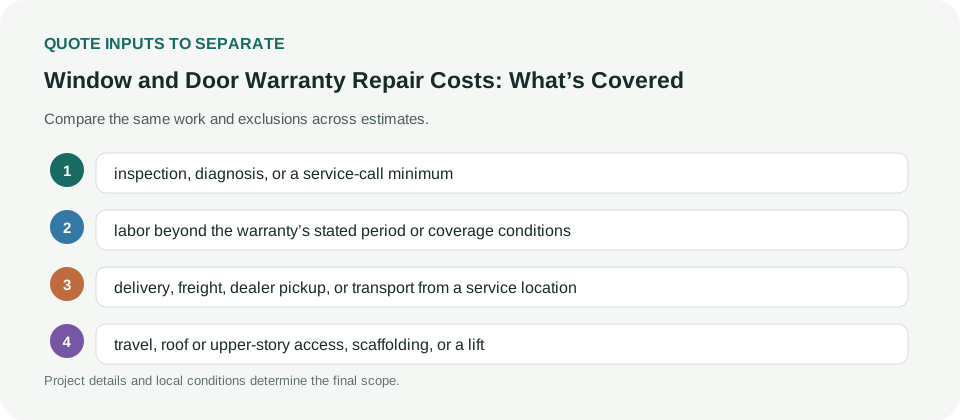
- inspection, diagnosis, or a service-call minimum;
- labor beyond the warranty’s stated period or coverage conditions;
- delivery, freight, dealer pickup, or transport from a service location;
- travel, roof or upper-story access, scaffolding, or a lift;
- removal and disposal of the failed component or complete opening;
- fitting or adapting a replacement part, including an equivalent current product;
- repair of flashing, water management, the rough opening, or unrelated wall damage;
- trim, siding, drywall, paint, flooring, or other finish restoration;
- taxes, permit, or separately contracted work where applicable.
Not every item applies to every claim. Do not add all of them to a quote by default. Ask which lines are included in the manufacturer’s remedy, which are outside the written warranty, and which are optional or unrelated. If the manufacturer proposes to ship a replacement part to a dealer, ask who will install it and what the trip from dealer to home costs. If the issue involves water, distinguish a product defect from the installation or surrounding wall condition; the repair may require a separate contractor even if a product component is covered.
There is no reliable national U.S. or Canadian estimate for the bill remaining after a warranty claim. The cited documents establish product-specific terms, not representative approval rates, service fees, or local labor prices. Use the itemized scope and a local quote rather than applying a broad repair range to a claim whose coverage and access are unknown.
Compare common claim outcomes
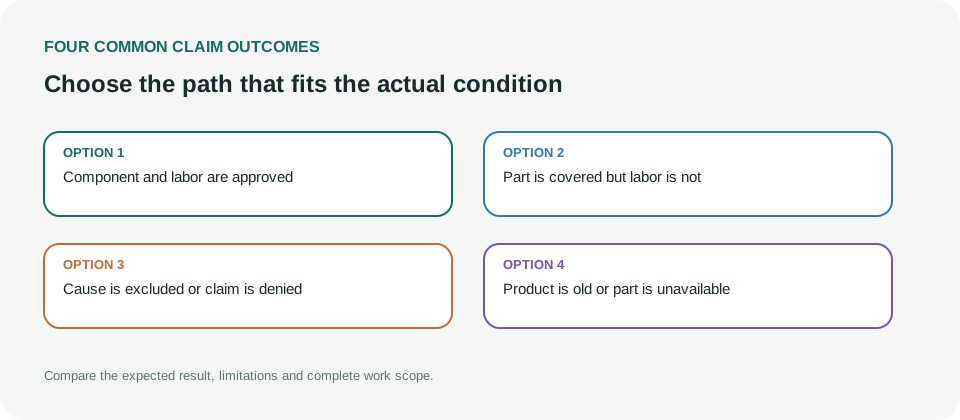
The component and labor are both approved. Confirm the approved repair method, scheduling, access, and whether any finish or transport remains outside the remedy. Ask if the replacement will match the original appearance and what warranty applies to the repaired component.
A part is covered but labor is not. Price the installer, fitting, service visit, travel, and any removal separately. Ask whether an authorized dealer is required and whether the manufacturer will provide a current equivalent if the original part is discontinued. Compare the total remaining bill with a local repair proposal, not with the part’s retail price alone.
The reported cause is excluded or the claim is denied. Request the reason and any inspection findings in writing. If the dispute concerns installation, moisture, maintenance, or building movement, a product claim and a paid repair are separate decisions. Get a defined repair scope before authorizing unrelated work, and ask whether the warranty terms permit or require manufacturer approval before the proposed service.
The product is old or the part is unavailable. Ask whether the written remedy allows a repair, replacement, refund, or nearest current equivalent, and whether the term runs for the balance of an earlier period. Compare adapting a part, replacing the sash or door component, and replacing the full unit only after checking the frame and surrounding opening. A claim outcome does not automatically determine which option is most economical.
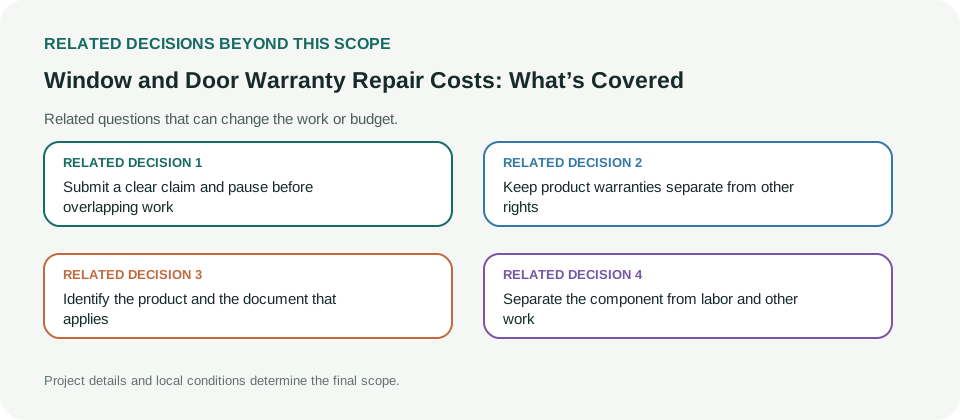
Submit a clear claim and pause before overlapping work
Send the manufacturer a concise description of the failure, photographs, label or model information, purchase/installation records, address, and proof of ownership or transfer if requested. Keep copies of messages, inspection notes, estimates, and the written decision. Ask who is authorized to inspect, whether there is a charge for a denied or inconclusive visit, what information is missing, and when the decision is expected.
Before a paid contractor removes or modifies a potentially covered component, ask the manufacturer whether inspection or approval is required. Do not assume that every third-party repair automatically voids every warranty; read the exact condition and ask the responsible party about the proposed work. If a broken pane, active leak, or unsafe opening needs immediate protection, arrange appropriate protective work and document the condition, while avoiding a dangerous delay just to wait for a claim response.
A recall is a separate safety-remedy route, not an ordinary warranty estimate. Check the exact model and product ID against current manufacturer and regulator notices. A named free recall repair applies only to the affected products and should not be counted as the price of routine repair for other windows or doors.
Keep product warranties separate from other rights
A manufacturer’s product warranty is different from an installer’s workmanship promise, a builder or new-home warranty, homeowners insurance, and a paid service contract. Each has its own document, responsible party, coverage, notice process, and exclusions. File the issue with the party whose work or product is involved and avoid assuming one document replaces another.
Consumer-protection rights can exist outside the written product warranty and depend on the transaction and jurisdiction. In the United States, the FTC Cooling-Off Rule covers certain sales made at a home or temporary location but has stated exceptions, including some repair or maintenance visits; it is not a general right to cancel any window or door contract. In Canada, federal consumer guidance directs homeowners to provincial or territorial consumer-affairs information for local warranty law. If your question is about canceling a sales contract or enforcing a legal right, check the current official rules for the place and transaction rather than relying on a manufacturer example.
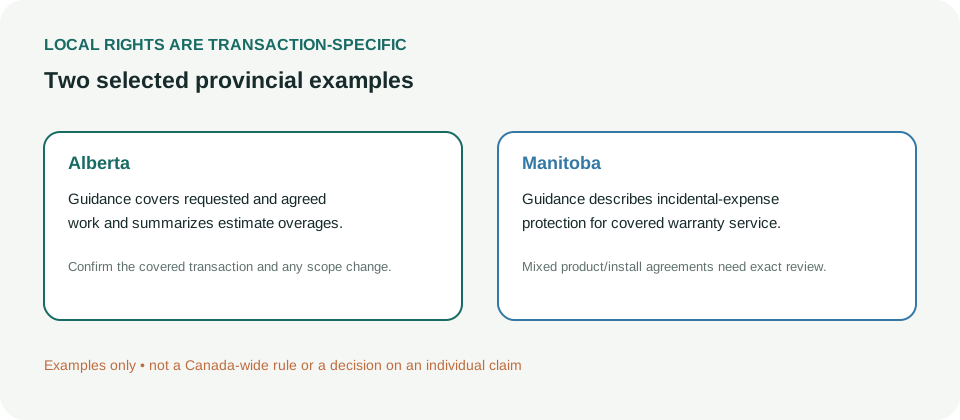
Selected provincial examples show why the transaction and written quote matter. Alberta government guidance says covered businesses may charge only for goods or services the consumer requested and agreed to, and summarizes a limit on estimate overages. Manitoba’s Consumer Protection Office describes protection from incidental expenses for covered goods serviced under a warranty. These summaries apply within their provincial and transaction scope; they do not decide whether a particular window supply-and-installation agreement or claim qualifies. Check the current rules and exact agreement before relying on them.
Compare the claim path with paid repair or replacement
Once the manufacturer states its proposed remedy and remaining charges, get a separate itemized local quote for paid repair if the homeowner is considering that route. Compare the same outcome: component, labor, access, water-management work, disposal, finish, schedule, and warranty. Avoid paying twice for a diagnosis or removal already included in the claim service, and avoid assuming the warranty route will correct a surrounding-wall problem.
A claim is most useful when the product is identified, the written schedule fits the dates and structure, and the remedy addresses the actual failure. A paid repair may be faster or broader, but it should be priced against the remaining serviceability of the opening. If replacement is being considered, use the dedicated repair or replacement guides for the failed window or door component. The decision is the total cost and result after the exact terms are applied—not the largest coverage phrase printed on a brochure.