
A vehicle can be a source of home backup only when the exact vehicle, equipment, home wiring, and local approval path work together. A vehicle’s battery capacity, charging connector, or backup feature name does not prove that it can safely power a home’s circuits. The first cost decision is whether a compatible path exists for the vehicle already in the driveway; buying a vehicle primarily for backup is a much larger transportation purchase and belongs in a separate budget.
Two different arrangements appear in current products. Bidirectional vehicle-to-home equipment transfers energy from an eligible vehicle through a compatible charger, inverter, and home isolation system. Some trucks instead have a high-power outlet that can work with a specific, approved home transfer product. The second arrangement is not automatically bidirectional charging and does not make any vehicle outlet suitable for home connection. Don’t adapt an outlet or connect equipment yourself.
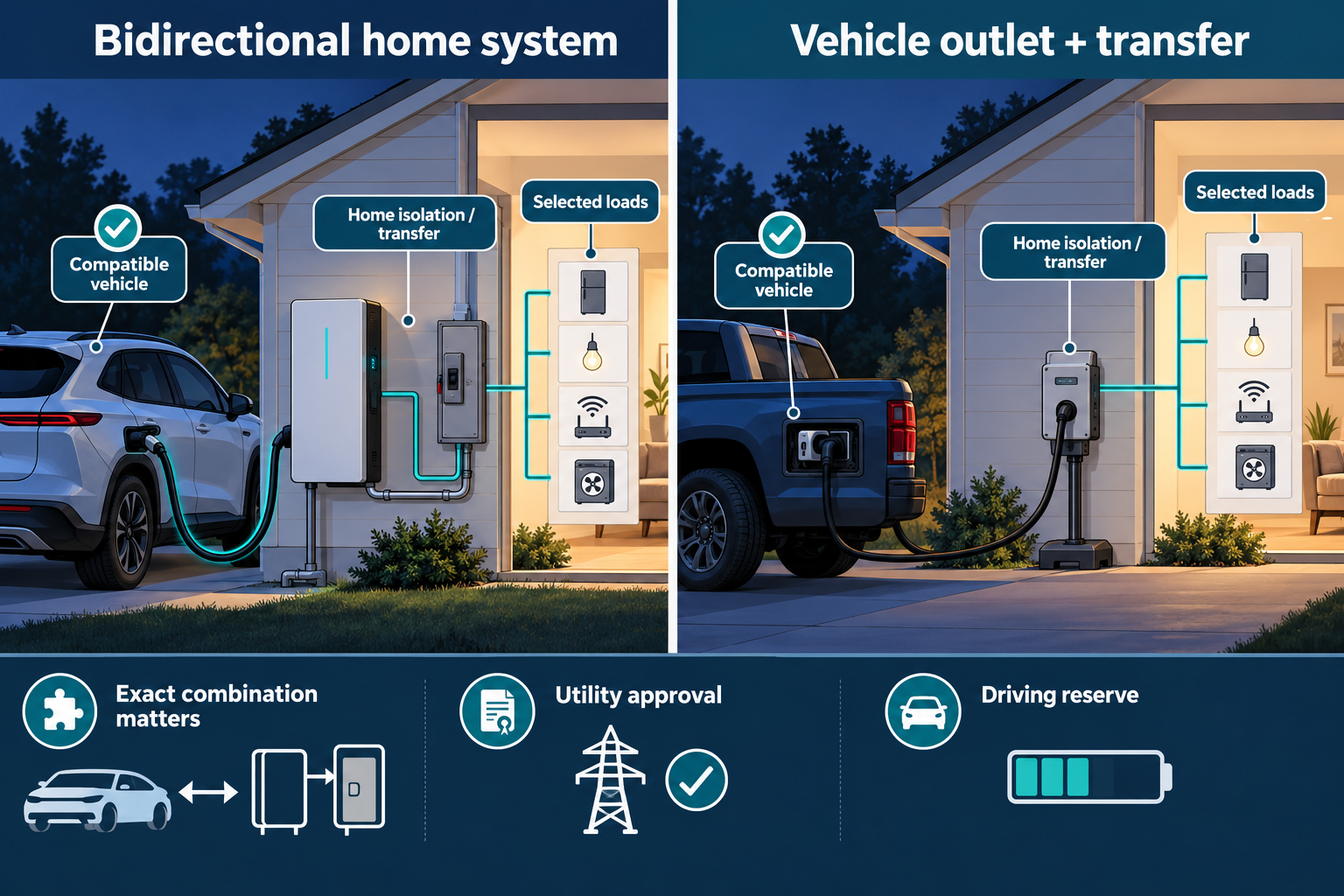
Verify a complete vehicle and home combination
Before requesting a price, collect the vehicle’s exact model year, trim, powertrain, outlet or bidirectional capability, software version, and warranty status. Then record existing home equipment: solar inverter, stationary batteries, service and panel configuration, transfer equipment, backed-up circuits, and utility account. Ask the vehicle and home-system manufacturers or an approved installer to confirm the complete combination in writing.
A badge, connector standard, or general statement that a vehicle supports power export is not enough. Manufacturer support can differ by model year, trim, software, region, and whether the home already has a Powerwall or another battery. An advertised charger may support ordinary one-way EV charging but not discharge back to the home. Get the exact bill of materials, allowed configuration, and warranty boundaries before buying equipment.
Current manufacturer examples illustrate why the configuration check matters:
- Tesla’s Powershare support page says a home with Powerwall needs a compatible Model 3, Model Y, or Cybertruck, a Powerwall, and a Universal Wall Connector or Wall Connector 3 registered to the same site and network, with activation through Tesla support. Without Powerwall, it lists Cybertruck, a Powershare Gateway, and a Universal Wall Connector. Tesla also says all Model 3 and Model Y vehicles ordered in the U.S. and Puerto Rico after October 1, 2026 support Powershare, while some earlier vehicles do; owners must check the exact vehicle.
- GM Energy’s current products page lists selected 2026 Chevrolet, GMC, and Cadillac electric models and the 2027 Chevrolet Bolt EV for its PowerShift Charger and V2H Enablement Kit. The page describes a 9.6 kW inverter and both whole-home and partial-home backup configurations. Check the exact vehicle identification, trim, software, and local installer approval; the displayed model family does not settle every configuration.
- Ford’s GenerLink article names 2021–2026 F-150 PowerBoost Hybrid trucks with the 7.2 kW 240-volt Pro Power Onboard outlet and 2022–2025 F-150 Lightning trucks with the 9.6 kW 240-volt outlet. Ford says local utility requirements affect whether a meter-mounted or meter-adjacent transfer arrangement is available.
These are examples for the named manufacturers and products, not a compatibility list for all vehicles or for Canada. A model not listed in a current manufacturer source should not be treated as compatible by inference.
Separate the two backup architectures
With bidirectional charging, the equipment may include a bidirectional charger, an inverter or home hub, a transfer or isolation device, controls, and the electrical work to connect the system. The home design may serve selected circuits or more of the panel, subject to the inverter, service, and load limits. Existing solar or batteries add another compatibility check; one manufacturer’s listed product may not integrate with another manufacturer’s storage.
With an outlet-and-transfer arrangement, the vehicle supplies power through its named outlet and an approved transfer product. It can avoid some bidirectional charging hardware, but it still depends on the exact vehicle outlet, compatible transfer equipment, local utility acceptance, and professional installation. A vehicle outlet powering a few devices is also different from a professionally integrated home system.
Ask the installer to state which circuits can operate, their simultaneous power limit, which loads are managed or excluded, and whether solar remains available during an outage. A maximum inverter rating is not the same as usable energy or runtime. Runtime depends on vehicle charge, accessible energy, home loads, conversion losses, the vehicle’s minimum driving reserve, and whether the vehicle remains parked at the property.
Build the complete home-cost scope
Ask for an itemized proposal that identifies:
- Vehicle-specific charging or discharge equipment, inverter, home hub, gateway, dark-start battery, and any required manufacturer control or subscription.
- Transfer or isolation equipment and the circuits or panel sections it serves.
- Panel, service, wiring, disconnect, or load-management changes, plus the site route and vehicle parking distance assumed.
- Utility review, permits, inspection, electrical work, configuration, commissioning, and documentation.
- Compatibility work for existing solar, storage, smart panels, or transfer equipment.
- Taxes, future service, software support, warranty exclusions, and any equipment that is sold separately.
Ask which items are included in the product price and which are quote-dependent. The vehicle itself may already be owned, leased, or still to be purchased. Record that separately. A driver who needs to buy a new vehicle cannot count it as a free backup asset simply because the family also needs transportation.
Dated prices show different parts of the budget
Prices below are product-specific examples checked on October 12, 2026. They do not establish a general installed price range:
| Example | Published amount | What it covers and leaves open |
|---|---|---|
| Ford-compatible GenerLink transfer package | Ford’s July 2026 article lists equipment at about $1,100. It estimates installation averaging $250–$450 for a meter-mounted setup or $1,000–$1,500 for a meter-adjacent setup. | A specific product path for listed F-150 configurations. Utility approval and installation method vary; this is not a bidirectional charger package or a whole-home project estimate. |
| GM Energy V2H Bundle | GM lists a $6,748 promotional product price through November 2, 2026 at 9 p.m. ET. | Includes a PowerShift Charger and V2H Enablement Kit. GM says installation and taxes are not included; an eligible vehicle and properly equipped home are required. |
These examples have different equipment, approvals, and price bases, so they should not be compared as equivalent systems. A Ford transfer installation estimate is not the cost of a Tesla or GM bidirectional system. A GM product promotion is not an installed total. Confirm current price, inventory, installation, tax, and exact vehicle eligibility before using either number in a decision.
Compare the incremental cost with other backup options
If you already own a compatible vehicle, compare the home equipment and installation with a stationary battery or generator for the same circuit list and outage duration. A vehicle may provide substantial energy, but it may be away during the outage or need to retain charge for driving. A stationary battery stays at the property but has its own usable-capacity, recharge, and replacement limits. A generator has fuel, maintenance, and transfer costs. Use the battery-versus-generator comparison, battery-only backup guide, or backup-duration worksheet to set the common service assumptions.
Compare at least an essential-circuit case and the broader coverage you actually want. Include running and starting loads, the need for pumps or heating controls, and how the system responds when the vehicle is not available. Don’t compare one system’s maximum power with another system’s energy capacity; kW describes power at a moment, while kWh describes energy over time. Ask an electrician or approved installer to confirm what the proposed system can supply under the home’s actual panel and load conditions.
Consider the tradeoff in mobility. The vehicle may be used for transportation, and leaving it connected for home backup can limit its state of charge or availability. If the vehicle is a plug-in hybrid, fuel and engine operating assumptions may be part of the backup model. If you lease the vehicle, review whether discharging it for home service is permitted and how warranty or lease terms apply. Do not assign a value to avoided fuel, outage losses, or resilience unless the household can explain the assumption.
Treat grid participation as a separate contract
Backup during an outage and exporting power to the grid are separate services. A utility may require an interconnection review or a specific program agreement before any vehicle-to-grid export or compensated event. The existence of a vehicle backup feature does not establish permission to send energy to the utility, program availability, eligibility, or payment. Leave expected grid-service income out of the base case until the local utility confirms the current terms in writing.
This decision is also separate from a stationary battery utility program. A vehicle’s availability, charge level, and warranty are different from a fixed battery’s; do not apply a home battery dispatch payment or reserve rule to a vehicle without a specific agreement.
Questions to resolve before buying equipment
- Does the manufacturer confirm the exact vehicle, trim, software, and home equipment combination?
- Is the proposed hardware a bidirectional home system or an outlet-plus-transfer path, and what equipment is required for that exact design?
- Does the utility allow the transfer equipment or interconnection at this property, and who obtains approval?
- Which circuits can operate together, what power limits apply, and what remains available for driving?
- How close must the vehicle park to the equipment, and is the route workable through weather and daily use?
- Are installation, panel changes, permit fees, taxes, commissioning, and future service included in the quote?
- What happens to solar, stationary storage, and existing backup equipment during an outage?
- What happens if the vehicle is sold, replaced, leased, updated, or out of warranty?
Require a written equipment schedule, compatibility confirmation, utility and permit responsibilities, load description, commissioning record, and support contact. Keep the vehicle acquisition decision separate from the incremental home project. Vehicle-based backup can be a useful option when the vehicle is already owned, the exact integration is supported, and the home installation fits the family’s outage needs. If the compatibility or approval path is unresolved, price a stationary battery or generator using the same loads before committing to a product.