
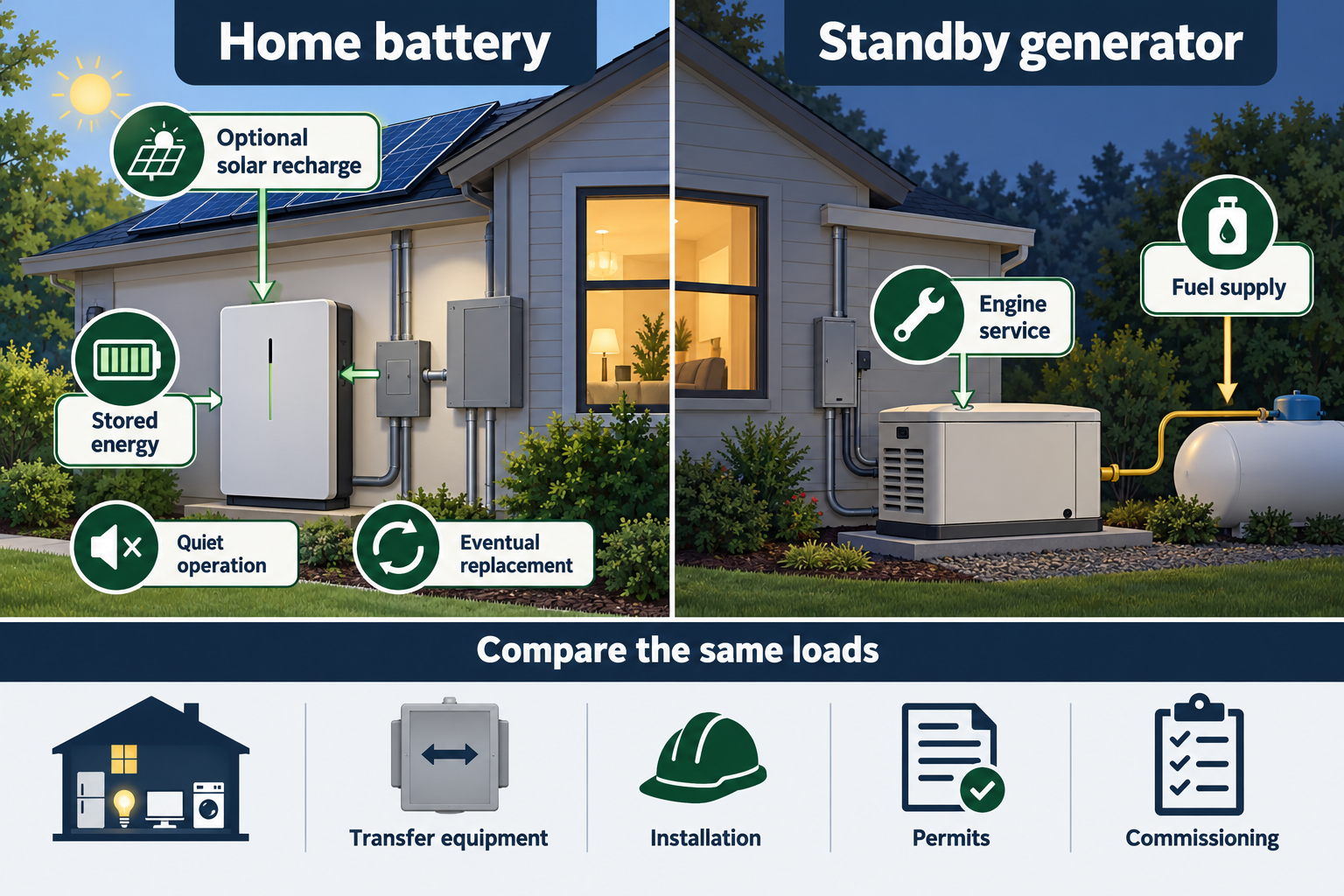
A battery and a standby generator provide different outage services. A battery starts with stored energy and may integrate with solar; a generator converts fuel into sustained power while it runs. Compare complete installation and ownership cost over the outages you actually face, including transfer equipment, load scope, maintenance, fuel, recharge, noise, and the value of non-outage operation.
Upfront scope
A battery project may include storage units, inverter or charger, gateway, transfer controls, critical-load circuits, wiring, mounting, permits, utility work, and commissioning. A standby generator may include the engine, pad, automatic transfer equipment, electrical work, fuel connection, permits, load management, commissioning, and maintenance setup. Neither equipment price alone is comparable.
The current evidence does not produce a matched installed-price comparison. EnergySage’s H1 2026 battery platform report gives an average of $15,647 before incentives for a representative 13.5 kWh installation; Consumer Reports separately estimates $3,400 to nearly $7,000 for equipment in its generator ratings and $5,000 to $10,000 or more for installation. The sources use different methods and do not define fully matched scope, so the figures must not be added into an apples-to-apples system comparison. Use local bids with the same loads, transfer work, site conditions, and commissioning.
Location and service configuration can materially change both projects. A difficult battery location or panel retrofit adds wiring and controls. A generator may need gas or propane work, site preparation, exhaust and placement review, and a connection that complies with local requirements.
Runtime and load
Battery runtime is limited by usable kWh and load; its power and surge rating also limit what can start. Solar may recharge a properly configured solar-plus-storage system, but weather, season, shading, and load affect that benefit. A generator can run for extended periods while fuel is available, but fuel supply and service conditions matter.
A compatible vehicle may be another backup path, but outlet-based backup and bidirectional vehicle-to-home systems have different equipment, approval, and vehicle requirements. See vehicle-to-home backup cost for those bounded system examples; they are not a general substitute for this battery-versus-generator comparison.
Whole-home coverage is not a simple label for either technology. Central air, electric heat, ranges, pumps, and EV charging can change the power design. A critical-load system may cost less and meet the actual objective if refrigeration, communications, lights, and pumps are the priority.
Recurring economics
Battery ownership includes capacity retention, eventual replacement, software or monitoring support, and possible inverter replacement. Generator ownership includes fuel, oil and filter service, starter battery, exercise, repairs, and fuel-system maintenance. A battery may supply tariff or solar self-consumption value; a generator generally supplies outage value only, unless another use is explicitly modeled.
Three decision scenarios
Short, frequent outages: A battery may provide quiet automatic support and can recharge from the grid or solar, subject to its design.
Long or uncertain outages: A generator’s fuel-based runtime may be valuable, while a battery needs enough stored energy or a recharge plan. Hybrid systems may reduce fuel use but add complexity.
Priority circuits only: Either technology can be sized to essential loads, reducing capital and transfer scope. The load list and startup demands must be documented.
Battery installation and generator connection have product- and jurisdiction-specific safety requirements. Portable generators must never be treated as improvised indoor or backfeed solutions. There is no dependable current apples-to-apples installed price for every property. Use local quotes and compare the service delivered, not the nameplate or a monthly advertisement.
Compare the outage you are buying against
Write down outage frequency, likely duration, seasonal conditions, fuel availability, acceptable noise, automatic-operation needs, and critical loads. A battery may be the better fit for short interruptions and daily solar or tariff use. A generator may be stronger for long outages where fuel can be supplied. If the event is rare but consequential, price resilience as a separate benefit rather than pretending the bill savings alone justify either system.
Check load architecture
Ask both proposals to show continuous and starting power, selected circuits, transfer or isolation equipment, and what happens when capacity is exceeded. A generator may need load shedding; a battery may need a larger inverter or more units. Whole-home labels do not prove every load can operate simultaneously.
Include the next replacement
Model battery capacity retention and eventual replacement alongside generator engine service, fuel, starter battery, and repairs. Include installation access and the risk of discontinued controls. The lower first invoice can become the higher ownership cost when recurring service or fuel is ignored.
Compare outage objectives, not labels
For a short outage, automatic transfer, quiet operation, and a small critical-load list may matter most. For a long event, fuel delivery, solar recharge, battery reserve, and load reduction matter more. For frequent outages, a battery’s non-outage energy value may justify cost that a rarely used generator cannot. Write down the service being purchased before comparing technologies.
Normalize ownership cost
Use the same backed-up circuits and load assumptions for both bids. Add transfer equipment, installation, permits, commissioning, fuel, service, monitoring, replacement, and the cost of a second mobilization. If one option includes a critical-load panel and the other assumes existing equipment, the apparent price difference is meaningless.
Decision threshold
Choose battery when its power, usable energy, recharge, and support path fit the outage objective and its other uses have real value. Choose generator when sustained output and available fuel matter more than quiet or daily operation. Choose a hybrid only when the extra capability resolves a documented long-outage or recharge problem.
Include convenience and disruption
Battery backup may avoid fuel storage, engine noise, and routine engine service, while a generator may avoid buying large stored energy for a long event. A generator can require periodic exercise and service visits; a battery can require platform support and eventual replacement. Put these recurring tasks and disruptions into the ownership comparison instead of describing them as free preferences.
Ask for a bounded guarantee
The installer should state backed-up circuits, continuous and starting output, usable battery energy, generator load, fuel or recharge assumptions, and the conditions under which the system disconnects loads. This gives the homeowner a basis for comparing offers and for recognizing that “backup” has limits even when the equipment is properly installed.
Use a total-cost worksheet
For each option, record installation, permits, transfer or control work, fuel or recharge, routine service, likely corrective work, starting battery or consumables, access, noise or storage burden, replacement, and the consequence of an unavailable source. Keep the load list and event duration identical. Then identify which costs are certain, which are conditional, and which are owner choices. This prevents a battery from being compared with a generator price that excludes fuel infrastructure or a generator from being compared with a battery price that excludes future replacement.
The result does not need to produce a universal winner. A battery may win for short, quiet, low-maintenance backup; a generator may win for sustained high loads when fuel and service are practical; a hybrid or smaller critical-load design may fit between them. Choose the option whose failure and recovery path the homeowner can actually support.
Compare failure and recovery paths
For a battery, ask what happens when stored energy reaches reserve, the inverter limits output, the battery is unavailable, or the grid remains out for longer than expected. For a generator, ask what happens when fuel is unavailable, the engine fails to start, a transfer control trips, or the service plan cannot respond. Both systems need a recovery plan; the difference is whether the limiting resource is stored energy, recharge, fuel, engine service, or approved load capacity.
Use the same priority loads and event horizon in each quote. A generator may be the stronger long-event source but require fuel infrastructure, exercise, noise tolerance, and maintenance. A battery may be the stronger short-event or indoor-convenience choice but require more stored capacity or a second source for extended outages. Neither technology should be evaluated from nameplate output alone.
Include the value of preserving normal use
The homeowner may value quiet operation, automatic response, no fuel delivery, low routine attention, or the ability to run a motor during an outage. Those benefits can be real, but they should be recorded beside installation, service, replacement, and disruption costs. A decision that is financially close may reasonably turn on these operating preferences; a decision that is not close should not be rescued by a vague convenience claim.