
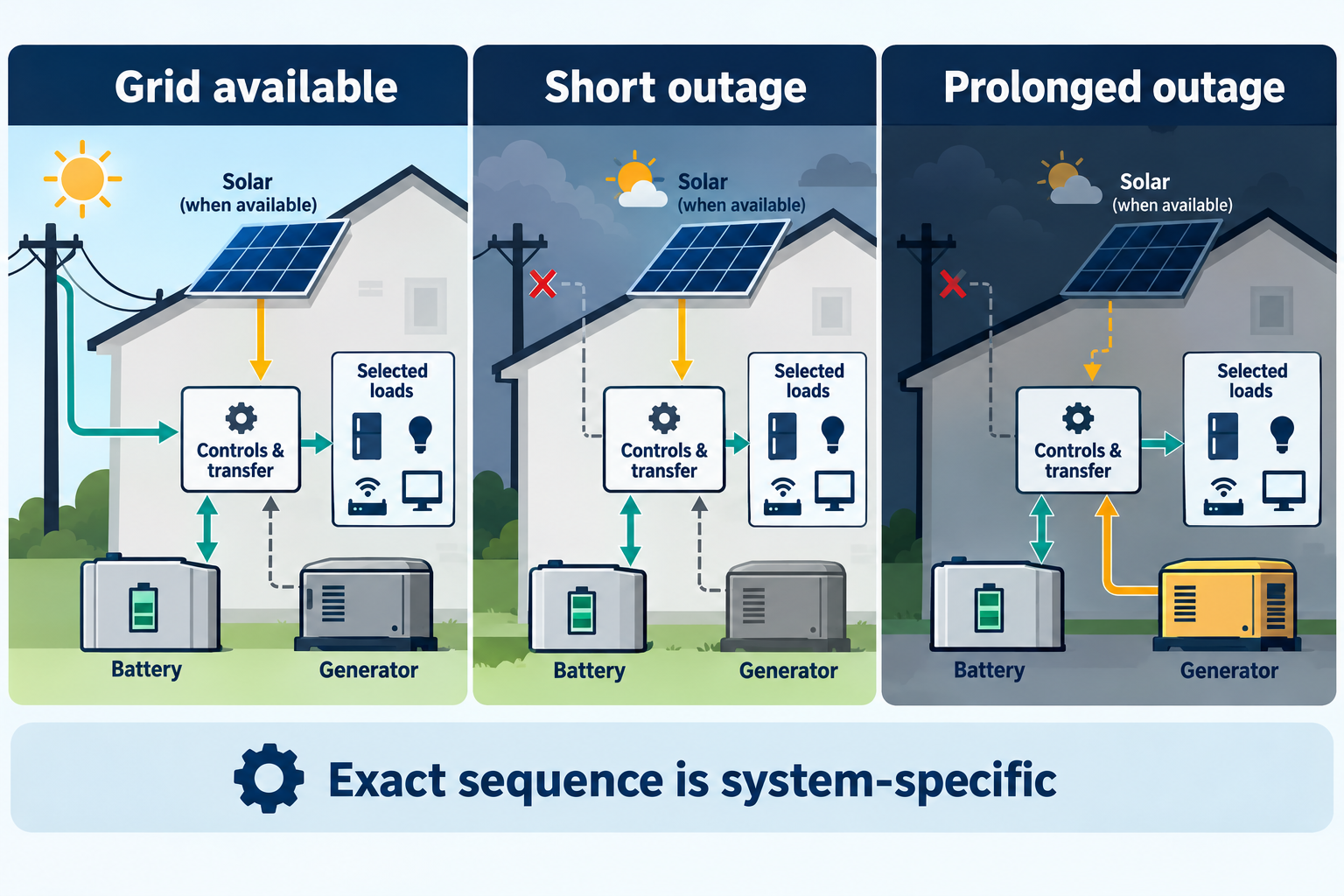
A hybrid system combines solar generation, stationary storage, and an engine-driven generator under a coordinated control architecture. Solar can recharge storage when conditions permit, the battery can handle short interruptions or selected loads, and the generator can support longer events. The benefit is flexibility; the cost is additional equipment, controls, interoperability, commissioning, and maintenance.
What the system must do
Define the sequence before pricing it. Does the battery carry critical loads first? Can solar operate during an outage? Can it recharge the battery? Can the generator start, support loads, or recharge storage? Which loads are shed, and what happens when fuel or battery energy is limited? These behaviors depend on the exact platforms and design.
The system needs an isolation and transfer strategy so it does not backfeed the utility. Battery and generator grounding, bonding, protection, and control interactions require qualified design and local approval. A generic collection of compatible-looking products is not a safe system specification.
Vehicle-based backup is a separate design path with exact vehicle, transfer-equipment, compatibility, and approval limits. Compare it in the vehicle-to-home backup cost guide rather than assuming it can be added to a stationary hybrid system.
Cost structure
Price solar equipment, roof or ground mounting, battery units, inverter and gateway, generator, pad, fuel infrastructure, transfer equipment, critical-load or managed circuits, wiring, permits, utility work, commissioning, monitoring, and documentation separately. Some components may be shared in a combined design; do not count a package discount as evidence of which costs are avoided.
Controls and commissioning are especially important. A hybrid system can fail economically if the homeowner pays for three technologies but their operating modes are not tested together. Require a written operating sequence and responsibility for future software, firmware, warranty, and service coordination.
Three scenarios
Short outages: Battery handles priority loads and solar may recharge it. The generator is reserved for longer events, reducing fuel use but adding standby equipment.
Extended outages: The generator provides sustained support while solar and battery reduce run time or cover transitions. Fuel availability and load management become decisive.
Remote or high-consequence property: Redundant options may justify complexity, but service availability, fuel delivery, communications, and commissioning records are part of the economic decision.
Compare the alternatives
A battery-only system may be quieter and simpler but limited by stored energy and recharge conditions. A generator-only system may provide sustained power with a simpler energy path but requires fuel and engine maintenance. Solar plus battery may solve generation and resilience without a fuel system, but not every outage duration. Compare the service each option provides over the actual outage profile.
The evidence does not establish a general current installed range or universal interoperability rule. Use integrator and manufacturer-specific design, local safety review, and separate U.S. or Canadian quotes. Choose a hybrid system only when its additional outage capability and fuel-saving value justify the added control and lifecycle burden.
Start with a failure sequence
Ask what happens when the grid fails, when the battery reaches reserve, when solar production is poor, when the generator starts, and when a large motor requests power. The system should identify which source is forming the local backup system and which controls prevent unsafe parallel operation. A hybrid quote without this sequence is an equipment list, not a complete outage plan.
Price integration and service
Include software or controls, commissioning under each mode, monitoring, firmware support, warranty boundaries, and future service coordination. Three manufacturers or three installers do not automatically create one supported system. Ask who owns the diagnosis when the solar, battery, generator, or transfer equipment appears to be at fault.
Test whether the third technology is justified
Compare hybrid with battery-only, generator-only, and solar-plus-storage options for the same critical loads and outage duration. A hybrid may be justified by long events, limited fuel, solar recharge, or high consequence of interruption. If its added controls and maintenance supply no material benefit, the extra architecture is a cost rather than resilience.
Require a shared design record
The final record should show the solar array, battery usable capacity and power, generator output and fuel assumptions, transfer boundary, critical loads, controls, operating modes, warranty contacts, and maintenance responsibilities. Ask who can service the complete system when a fault crosses a manufacturer boundary. This documentation is part of the value of an expensive hybrid installation.
Test economic alternatives
If the real need is brief outages, a battery and critical-load panel may be enough. If the need is long events, a generator with a smaller battery may provide a better balance. If the real need is bill management, a solar-and-storage design without generator complexity may be sufficient. Compare those choices using the same loads and event horizon before accepting the hybrid premium.
Make commissioning a gate
Before treating the hybrid as complete, require a professional test of grid loss, transfer, battery discharge, solar recharge where applicable, generator start, load shedding, and return to normal service within the approved scope. Record what was tested and which conditions were not tested. Commissioning has economic value because it verifies that the three systems cooperate rather than merely coexist.
Map the energy and control sequence
A hybrid quote should explain what happens when the grid is available, when it fails during daylight, when it fails at night, when the battery reaches reserve, and when the generator starts. The array may not operate during an outage unless the storage and controls can safely form the required operating condition. The generator may recharge the battery, carry loads directly, or remain a separate source. Those are different services with different equipment, fuel, controls, approval, and commissioning costs.
Ask for the priority-load list, simultaneous starting loads, source limits, load-shedding sequence, reserve setting, recharge assumptions, fuel duration, and manual intervention. If one of those inputs is unknown, the quote should show a conditional branch rather than imply that all three technologies automatically cooperate. This is especially important for pumps, heating, cooling, and other cycling or motor loads.
Compare the ownership burden of three systems
The initial project can include solar equipment, battery and controls, generator, transfer equipment, critical-load panels, fuel infrastructure, wiring, structural or site work, approvals, commissioning, and monitoring. Later ownership adds solar and battery service, generator exercise and maintenance, fuel, starting-battery replacement, platform support, access, and eventual replacement of equipment with different lifecycles. A hybrid may reduce generator run time or improve short-outage response, but it also creates more interfaces to diagnose.
Use the same outage objective for a solar-plus-battery case, a battery-plus-generator case, and a generator-only or critical-load case. Compare brief outages, prolonged outages, and a component-failure case. A hybrid is economically credible when the third technology solves a documented failure mode or reduces a meaningful operating burden; it is weak when it merely adds redundancy without a clear service or recovery advantage.
Require a failure and service boundary
Name who diagnoses a solar fault, battery fault, generator fault, transfer problem, fuel problem, and utility or approval issue. Ask whether one provider can coordinate the system and what happens when a component is discontinued. Keep the single-line design, equipment schedule, circuit list, test results, monitoring credentials, warranties, and operating instructions together. The documentation is part of the cost because future service will be more expensive if each technician has to reconstruct the relationship between three sources.