
A critical-load system separates selected household circuits from loads that the battery or generator cannot support. The project may include a subpanel, transfer equipment, relays, load-management controls, circuit relocation, new wiring, labels, testing, and commissioning. It belongs to backup-power architecture; ordinary panel or circuit repair remains a separate electrical decision.
What the system is solving
The homeowner chooses what must operate during an outage: refrigeration, communications, lighting, selected receptacles, a well pump, sump pump, controls, or other priority equipment. Large electric heat, central air, cooking, dryers, and EV charging may be excluded or managed. The load list must state which loads can operate together and which starting demands require special review.
Cost components
Panel space, service configuration, distance, circuit accessibility, transfer method, control equipment, wiring, labeling, permits, inspection, and commissioning affect cost. A battery may use a gateway or managed controls rather than a traditional critical-load panel. A generator may need transfer equipment with different grounding and bonding treatment.
California battery-ready requirements are a separate scope
The California Energy Commission’s 2025 Energy Code §150.0(s) is limited to qualifying newly constructed one- or two-dwelling single-family buildings whose electric service exceeds 125 A; additions and alterations are excluded, as are buildings with a battery already installed. The CEC FAQ describes either BESS-ready interconnection equipment with at least 60 A of backed-up capacity or a dedicated 1-inch raceway to a subpanel. The readiness provisions also include at least four backed-up circuits (including a refrigerator, egress-area lighting, and a sleeping-room receptacle), a 225 A minimum main-panel busbar, and space for future isolation/transfer equipment within 3 feet of the main panel. This is a California new-construction readiness example, not a battery, runtime, retrofit mandate, price estimate, or universal code rule; confirm project applicability with the local authority.
An existing full panel or crowded service can make circuit relocation more involved. Ask which circuits move, whether new conductors are required, how the backup source is isolated, and what happens when the source reaches its limit. This article does not provide DIY panel-modification instructions.
Three scenarios
Small selected-circuit system: A short priority list and accessible panel keep scope focused.
Motor-load system: A well or sump pump adds starting and cycling requirements; the source must be sized from actual equipment data.
Managed broad backup: More circuits are available, but controls shed loads to preserve source capacity. The quote should describe that sequence in plain language.
Compare alternatives
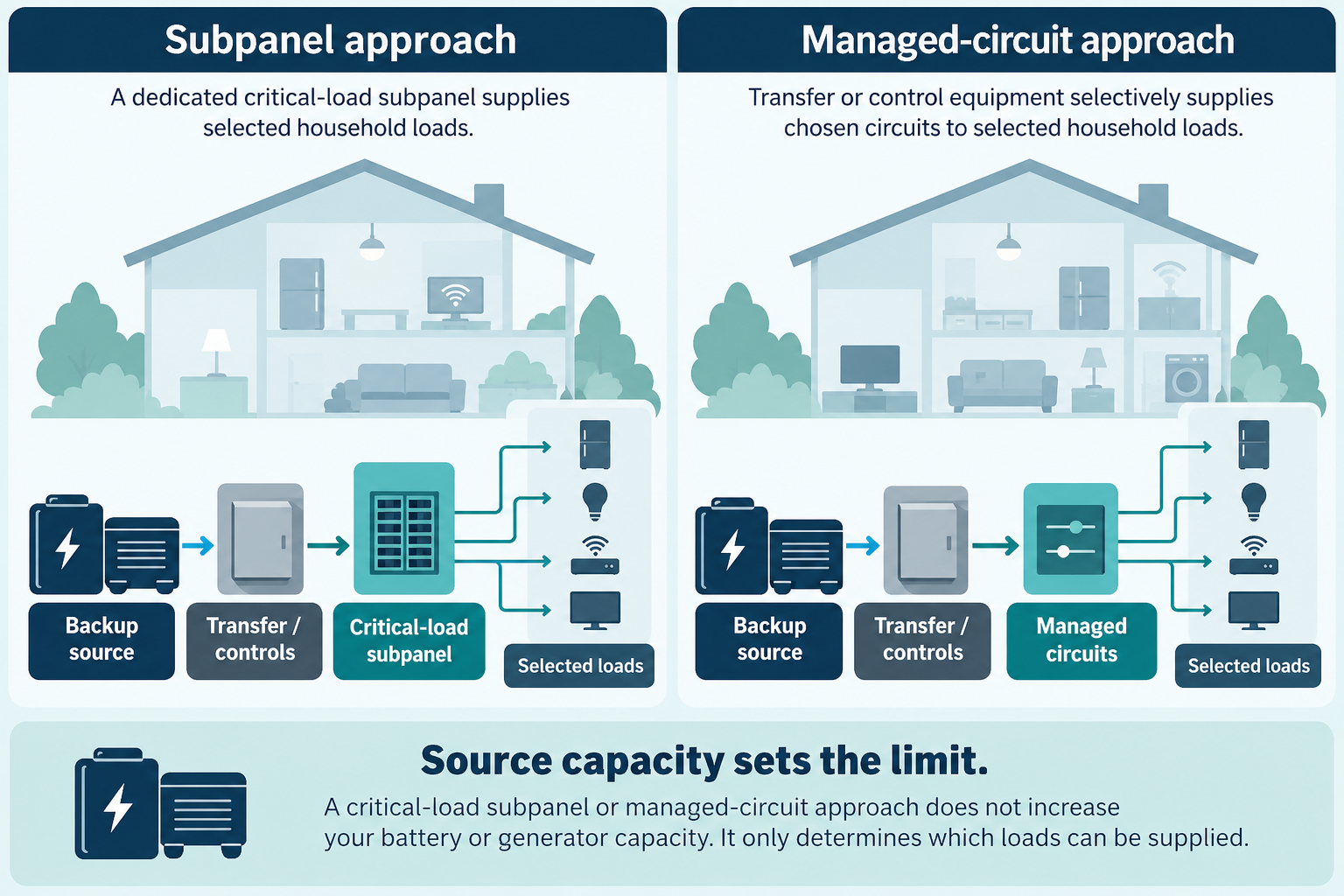
A critical-load panel may cost less than whole-home transfer but can require homeowner load choices and circuit changes. Whole-home equipment may simplify behavior while requiring more generator power, battery capacity, service work, or load management. Some systems manage circuits without a conventional subpanel. Compare the installed architecture, not panel labels.
Qualified electrical design and local rules control the installation. The evidence does not establish one current universal price. Obtain an itemized local quote that names source, circuits, transfer equipment, controls, approvals, and commissioning, and keep ordinary electrical-service work in its proper category.
Circuit selection is the economic lever
Moving a few accessible circuits may be relatively focused. A circuit buried in a finished wall, a pump in a remote panel, or a shared circuit serving both priority and non-priority loads can require more work. Ask the electrician to identify shared circuits, proposed relocations, new conductors, and any loads that cannot be separated cleanly.
Controls may replace a larger panel
Some battery and generator systems manage priorities with relays or software rather than a conventional critical-load subpanel. That can change installation cost, but it does not remove the need to define power limits, failure behavior, manual overrides, and service responsibility. Compare a managed system with a panel-based system by the actual backed-up circuits and operating sequence.
Closeout matters
Require labels, a circuit schedule, transfer behavior, commissioning results, warranty records, and instructions for adding or changing loads. A future electrician should be able to understand the backup boundary. A low quote that leaves the circuit scope undocumented creates risk at the next outage or renovation.
Panel work and source capacity are linked
Moving circuits into a backup panel does not increase the battery or generator’s output. The source still needs to handle the selected loads, starting demand, and priority sequence. Ask for both the electrical distribution scope and the source sizing assumptions so a low panel price does not create an unusable backup system.
Plan for later changes
Document spare capacity, excluded circuits, labeling, and the process for adding a heat pump, vehicle charger, pump, or other load. A future change may require a new load calculation or control setting. Keeping the boundary visible protects both the installation and the homeowner’s expectations.
Start with circuit consequences
Ask what each backed-up circuit supplies and what happens if it shares a circuit with a non-priority load. A pump, freezer, communications device, or heating control may need a different arrangement from a simple receptacle. The electrician should explain the proposed boundary and any circuit that cannot be separated without additional work.
Source, panel, and controls must match
The panel does not create battery kWh or generator kW. Confirm the source’s continuous and starting limits, transfer method, and control sequence alongside the panel design. If load shedding is used, document priorities and the point at which loads disconnect. This is the difference between a panel installation and a functioning backup system.
Price the next change
Future electrification, vehicle charging, pump replacement, or renovation can alter the priority list. Ask whether the system has documented spare capacity and what a future change would require. A small amount of useful planning now can prevent a later circuit relocation or incompatible control upgrade.
Compare panel and control architectures
One proposal may use a subpanel and manual choices; another may use automatic relays or source controls. Compare the backed-up circuits, source limits, failure behavior, manual intervention, service access, and future changes. A different physical layout is not a different service unless it changes what the homeowner can actually run.
Include testing and documentation
The price should cover a circuit schedule, labels, transfer or control test, source interaction, commissioning record, and instructions for a future electrician. Without those items, the homeowner may not know which loads are safe to operate or how a later circuit change affects the backup boundary.
Treat circuit selection as a service decision
Moving a circuit into a backup panel changes what can operate together and may expose hidden dependencies. A refrigerator may need nearby controls or receptacles; a well or sump pump may need its own starting-load review; heating equipment may rely on a separate control or blower. Ask the designer to identify the complete circuit path and any load that must remain outside the backup boundary for source or safety reasons.
The low case may involve a clear circuit group and spare panel capacity. The expected case may require relocation, new wiring, labeling, and load management. The difficult case may involve a crowded panel, shared circuits, service limitations, or several motor loads starting together. These scenarios explain why a panel price cannot be compared without the source and circuit list.
Preserve a change path
Future electrification, a new pump, an added refrigerator, or a change in occupancy can make today’s priority list inadequate. Ask whether the panel has physical space, whether controls can be expanded, and which changes require a new approval or source calculation. A smaller system can be economical when it leaves a documented route for the next change; it is false economy when every later adjustment requires rebuilding the transfer architecture.
The closeout record should include the backed-up circuits, excluded loads, source limit, transfer behavior, labels, test result, and responsible professional. That record is part of the value of the project and reduces the cost of the next repair or alteration.
Make the circuit list measurable
Ask for the estimated running and starting demand of the priority circuits, the order in which they are picked up, and the source limit at which a control will shed a load. A critical-load label does not guarantee that every listed appliance can operate simultaneously. The calculation should identify dependencies such as pumps, heating controls, refrigeration, or communications equipment and should state what is intentionally excluded.
This detail helps compare architectures with different physical layouts. A subpanel, transfer device, relay set, or managed circuit may each be reasonable, but the value is the service delivered and the clarity of future changes. Include the documentation and commissioning cost because it is what lets the next electrician alter the circuit list without guessing.