
Some battery systems can charge from the grid and serve household loads or backup circuits without rooftop solar, but that capability is product- and configuration-specific. The project still needs an inverter or charger, transfer and isolation controls, wiring, commissioning, and a load plan. Do not assume a battery marketed with solar can operate safely or legally as a standalone backup system.
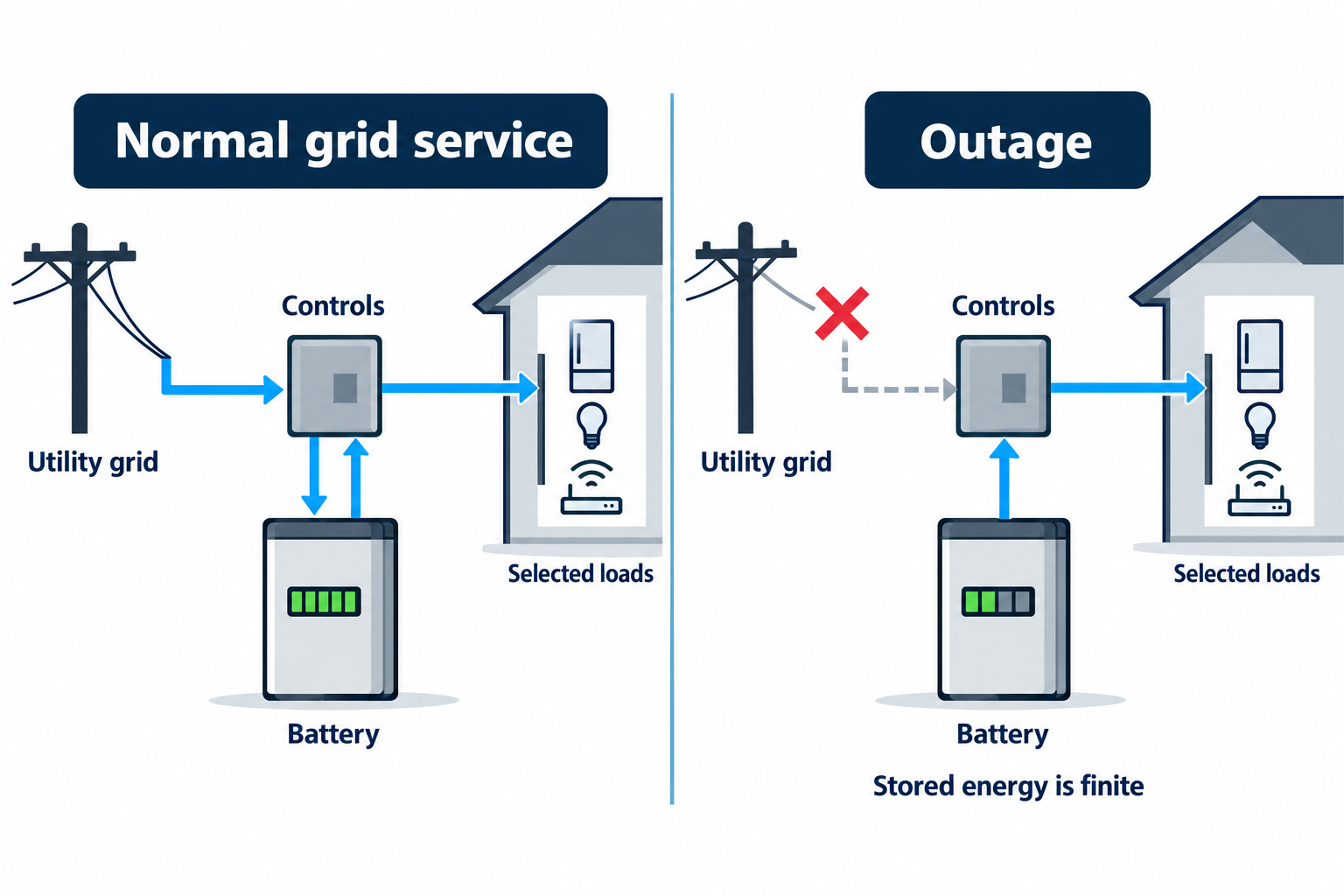
Define the operating mode
There are at least three different objectives: shift grid energy to a later period, provide short outage backup, or provide broader outage continuity. Each changes usable capacity, power output, transfer equipment, controls, and economics. If the battery cannot recharge during a prolonged outage, its value depends on the expected outage length and load discipline.
What changes without solar
Without PV, the grid is the normal charging source. During an outage, a properly configured system isolates the home or selected circuits from the grid. A battery without the required grid-forming or transfer architecture should not be represented as backup merely because it stores energy. Ask the installer to identify the normal, outage, and recharge modes in writing.
The battery may serve a critical-load panel or broader household circuits. Continuous load, motor starting, electric heat, air conditioning, cooking, and vehicle charging can exceed power output even when total daily energy appears modest.
Cost components and scenarios
Small critical-load system: Battery, inverter, gateway, selected circuits, installation, and commissioning. The economical choice often protects refrigeration, communications, lighting, and a few outlets rather than every load.
Panel-integrated system: The battery interfaces with the service equipment and manages a larger load set. Panel space, transfer controls, wiring, and approval work become important.
Whole-home backup: Higher power, surge, control, and load-management requirements may make the project approach the complexity of a solar-plus-storage or generator installation without solar’s recharge source.
Location, access, equipment compatibility, code and fire requirements, and utility rules are property- and jurisdiction-specific. The available evidence does not support a universal installed price. Obtain a local quote that states usable kWh, continuous and surge kW, circuit scope, recharge assumptions, downtime, and conditional work.
Battery versus generator
A battery can avoid fuel deliveries and may operate quietly, but runtime is limited by stored energy and load. A generator can provide sustained output while fuel is available, but adds fuel, engine maintenance, noise, emissions, and transfer requirements. Compare the outage profile and total ownership cost rather than only equipment price.
Without solar, a battery is most defensible when the desired backup period and load scope fit its stored energy, or when non-outage energy management supplies additional value. Verify the exact product’s independent operation before relying on it for an outage decision.
Ask how the battery recharges
Without solar, an outage that lasts beyond the stored energy requires grid restoration, another charging source, or a lower load plan. A battery can therefore be a good fit for short interruptions and a poor fit for a multi-day event unless the design has a documented recharge strategy. Ask how much usable energy remains after reserve settings and which loads are shed first.
Compare the complete service
The quote should show inverter or charger, battery, gateway, transfer equipment, panel or circuit work, wiring, installation location, permits, commissioning, monitoring, and warranty. A system marketed as “whole-home” should list its simultaneous power and surge limits. A critical-load system should list the circuits and any manual decisions required during an outage.
Three economic tests
Use a short-outage case, a prolonged-outage case, and a non-outage energy-management case. Include replacement, capacity retention, and service. If the battery is valuable only for a rare outage, compare that resilience value honestly with a generator or a smaller critical-load design rather than forcing a bill-payback conclusion.
Distinguish backup from load shifting
A battery that charges from the grid and discharges at a chosen time may reduce purchases without providing outage power. Outage capability requires the right inverter, isolation, transfer controls, wiring, and operating mode. Ask the installer to state whether the proposed system continues to serve loads when the utility fails and which loads are included.
Capacity, power, and cost
Price usable kWh and continuous or surge kW separately. Add transfer equipment, panel changes, installation location, permits, commissioning, monitoring, warranty, and future replacement. A larger battery is not automatically a better purchase if the outage load is small or if a generator provides better prolonged-runtime value.
Do not read a general battery marketplace average as the price of a solar-free system. EnergySage’s H1 2026 observations do not fully distinguish standalone, solar-paired, and retrofit configurations; compare a quote that identifies the actual charging, transfer, and backup scope.
Battery location and authority review
The installation still needs a product-specific location, protection, wiring, transfer or isolation equipment, and commissioning. Building, fire, electrical, and utility requirements can differ by jurisdiction and product. Ask what review is required and what changes if the battery moves from a service area to another location. Do not use an online installation diagram as a local approval answer.
California’s 2025 battery-ready provision applies only to a defined new-construction cohort and specifies infrastructure for possible future storage; it does not require a battery in every home or establish a retrofit rule. The critical-load panel guide summarizes that boundary.
A useful quote comparison
Request a battery-only critical-load option, a broader battery option, and a generator alternative when prolonged outages matter. Record usable kWh, continuous and surge kW, circuits, transfer, runtime, recharge, warranty, service, and replacement. This makes clear whether the purchase is for short backup, energy management, or a longer resilience plan.
Make the recharge limit visible
Without solar, the battery’s stored energy is finite unless the grid returns or another approved source can recharge it. Ask how the system behaves after a long outage, how much reserve is protected, whether a portable or standby generator can interact with it, and which loads are disabled to extend runtime. A larger battery may postpone the problem but does not remove the need for a recharge plan. If the outage objective is measured in days rather than hours, compare a generator or hybrid architecture rather than adding capacity by habit.
The bill-management case is also separate. A battery may shift grid purchases or provide other services when the grid is present, but the tariff, controls, cycling, and replacement reserve determine whether those savings justify the equipment. Do not use outage runtime as proof of financial payback or financial savings as proof of outage performance.
Match the installation to the property
Location, access, wiring path, service capacity, panel arrangement, approval, and commissioning can dominate a retrofit. A nearby wall may be unsuitable for the exact product; a distant location may add conduit, protection, or labor. Ask for the chosen location, excluded site work, load list, and future service route before comparing battery prices. The best quote identifies what happens when the grid is present, when it fails, and when the reserve or recharge limit is reached.
Compare the replacement horizon now
The battery is not a one-time outage purchase. Include platform support, warranty boundaries, usable-capacity change, monitoring, service access, disposal or return, and eventual replacement. A battery that is economical over a short ownership period may be less attractive if replacement falls within the homeowner’s horizon. A generator may have different recurring work and fuel exposure, while a smaller battery may reduce the capital tied up in an occasional service.
Ask for a conservative ownership worksheet showing upfront installation, expected service, the first replacement decision, and the consequence of an extended outage. If the economics depend on frequent cycling, a favorable tariff, or a value that is not guaranteed, keep that assumption separate from the resilience case. The system is easier to evaluate when bill management, short backup, and long-outage capability are treated as distinct purchases.