
An “8-hour battery” is not a complete specification. Runtime depends on usable kWh, continuous power, motor-starting surge, which loads operate together, weather and season, battery reserve settings, conversion losses, and whether solar can recharge during the outage. A system can have enough energy for a long period but not enough power to start a pump or run several loads at once.
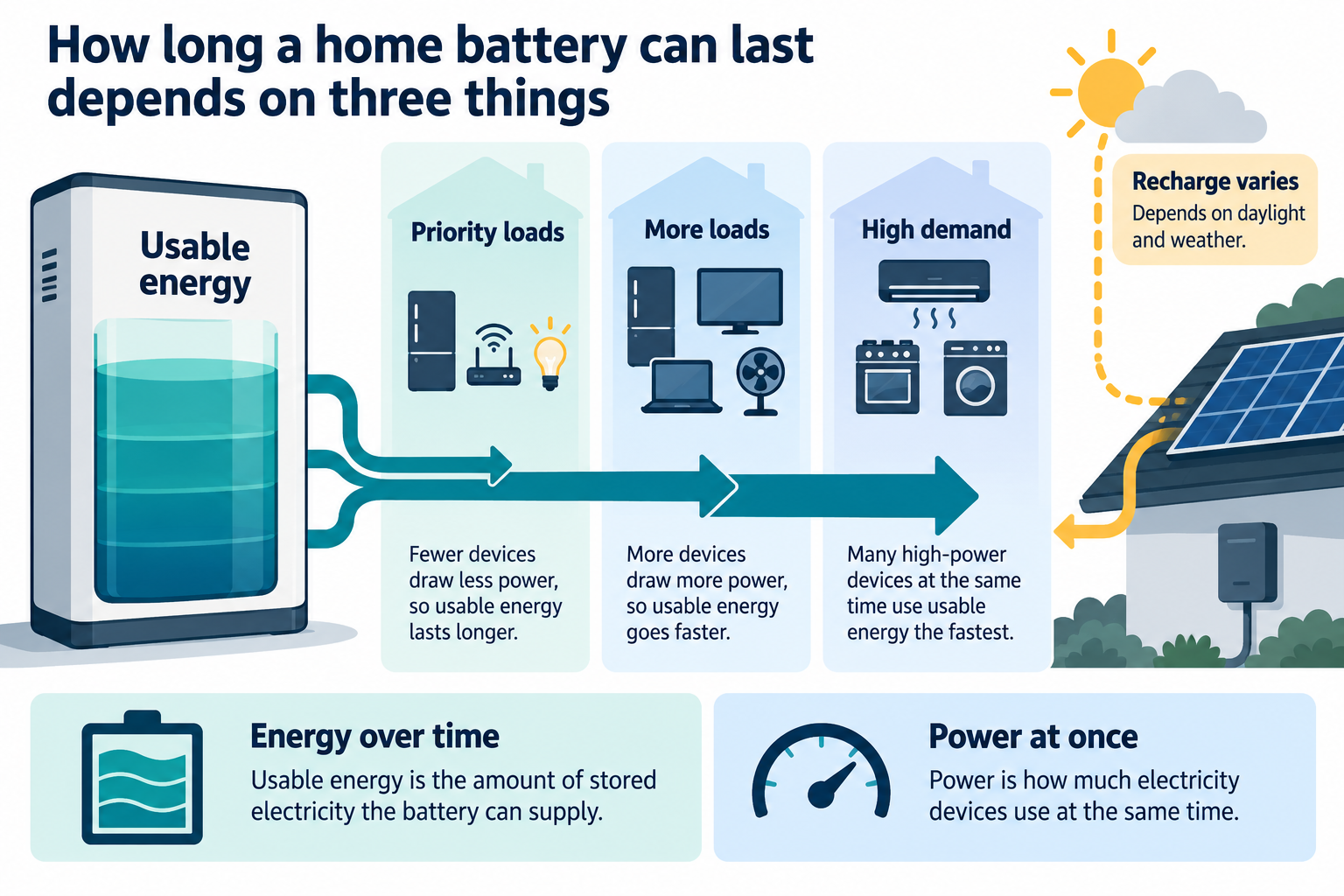
Start with the load list
Record must-run circuits, approximate running power, starting demand, duty cycle, and whether loads can be staggered. Refrigeration cycles rather than running continuously. A sump pump may run occasionally in ordinary weather and nearly continuously during a storm. A well pump’s pressure-tank behavior affects cycling. Electric heat and air conditioning can dominate the instantaneous requirement.
Separate energy and power. Energy is the amount used over time; power is the rate at which it is delivered. Ask for usable rather than nameplate capacity and identify the manufacturer’s operating reserve or discharge assumptions. The installer should verify actual equipment characteristics instead of inferring them from a generic appliance list.
Model the three horizons
Short outage: The system may cover priority circuits with limited stored energy. Power and surge can still be the binding constraint.
Day-long outage: Seasonal loads, refrigerator cycling, pumps, communications, lighting, and recharge prospects matter. Critical-load discipline becomes more valuable.
Two-day outage: A battery-only system may need much greater capacity or a reduced load plan. Solar recharge, weather, snow cover, and cloudy conditions become important; generator integration may be considered for extended events.
Do not promise a runtime from a nominal battery size without a duty-cycle and outage assumption. The evidence supports the variables, not a universal 8-, 24-, or 48-hour capacity recommendation.
What increases cost
Longer duration usually increases usable storage, but greater simultaneous power may require additional inverter capacity or units. Whole-home coverage adds transfer and load management. A critical-load panel or circuit work adds electrical labor. Solar recharge can add or enlarge an array, controls, and interconnection scope. Generator support adds another technology and maintenance stream.
Location, wiring distance, existing solar compatibility, approvals, and access also affect the project. Use local quotes and state whether price includes batteries, inverter, controls, installation, permits, commissioning, and future service.
A practical sizing worksheet
Create a must-run list, estimate running and startup requirements, identify simultaneous loads, select a reserve policy, state desired duration, and describe recharge. Then obtain a professional design showing usable kWh, continuous and surge kW, expected runtime, conditions that shorten it, and the circuits that disconnect first.
Compare the cost of longer duration with the cost of reducing the load list. For many households, protecting a smaller set of important circuits for a realistic outage is more economical than buying enough capacity to preserve every convenience. For a pump or medical-support load, obtain equipment-specific guidance rather than applying a generic household formula.
Use a load-priority ladder
Place loads into must-run, useful, and deferrable groups. Estimate which must-run loads overlap and which have motor starts. Then ask for runtime for each group, not only one whole-home number. This exposes the tradeoff between adding storage and accepting a smaller service. A battery may carry refrigeration and communications for two days while supporting a pump only intermittently; that is a different promise from ordinary full-home operation.
Weather and recharge are not footnotes
Solar recharge depends on daylight, season, snow or shading, and the loads operating at the same time. A cloudy event can extend the outage while reducing recharge. A generator can change the duration plan but adds fuel, transfer, and maintenance costs. Include a no-recharge case when the outage objective is important.
What the quote should guarantee
Ask for usable kWh, continuous and surge kW, reserve, circuit scope, assumed duty cycle, expected runtime, recharge conditions, and the point at which loads disconnect. Treat “24-hour backup” as incomplete until those assumptions are written down.
Runtime examples without false precision
Consider a household that backs up refrigeration, lights, communications, and an occasional pump. Its runtime depends on the pump’s cycles and the refrigerator’s duty cycle, not simply on adding appliance nameplates. A different household that backs up electric heat may use its available energy much faster. These examples explain why a general battery size would mislead.
Source options change duration
Solar recharge can extend runtime in good conditions but may be reduced by clouds, snow, shade, or the loads operating during daylight. Generator support can extend an event but adds fuel, transfer, controls, and maintenance. Compare those options with reducing the backed-up load list. The least costly duration strategy may be a narrower service rather than another battery.
Do not confuse capacity with guarantee
Usable capacity declines with operating conditions and age, and actual loads vary. Ask whether the quoted runtime is a design estimate, a guaranteed performance condition, or an example under a stated duty cycle. The homeowner should know which assumptions are outside the installer’s control. A conservative reserve can protect important loads but reduces energy available for ordinary use.
Decide where more capacity stops helping
Once the source can meet the priority loads for the intended event, additional capacity may have less value than improving recharge, reducing demand, or adding a generator. Compare the next battery unit with load controls, efficiency, a different circuit scope, and maintenance. The right stopping point depends on event consequence and the cost of being without service.
Treat runtime as a range of operating cases
Create a short-event case with the priority loads operating normally, a long-event case with conservative demand, and a difficult case with cold weather, poor solar production, delayed fuel, or a failed recharge opportunity. Identify which loads are shed first and which must remain available. This often reveals that the household is buying two different services: uninterrupted operation for a few important loads and a lower-power reserve for the remainder of the outage.
Runtime also depends on controls and behavior. A heat pump, well pump, sump pump, refrigerator, or communications system may cycle rather than run continuously, but the source must still tolerate its starting demand. Ask whether the calculation uses measured load data, nameplate assumptions, or an installer estimate. If the result is sensitive to one motor or seasonal load, that sensitivity belongs in the quote.
Compare more capacity with less demand
Before adding another battery, price load management, a smaller backed-up circuit list, efficiency work, a generator recharge source, or a changed reserve setting. These options have different installation and ownership costs, but they may deliver the desired duration more economically than storing every possible load. The right answer is the smallest complete system that meets the stated outage consequence with an honest recharge and failure boundary.
Ask what happens at the boundary
The source should identify which loads are disconnected first, whether the homeowner receives a warning, what reserve remains for a controlled shutdown, and whether the system can restart after recharge. A runtime estimate is not a promise that every load will remain energized until the last watt is used. It is a design result under stated load, temperature, reserve, and source assumptions.
This matters for loads with consequences beyond inconvenience. A refrigerator, communications system, well pump, sump pump, medical-support device, or heating control may deserve a separate reserve or a different source. The quote should show whether those loads are included, how they are prioritized, and what alternative is available if the outage outlasts the modeled horizon. That boundary is more useful than adding an arbitrary number of hours to a nominal battery size.