
Community solar can let a household receive credits from an off-site shared solar project without putting panels on its own roof. It may be useful when the roof is shaded, the home is rented, the owner cannot approve rooftop work, or the upfront cost of a system is not a fit. The economic decision is a contract comparison: what credit may appear on the utility bill, what the subscriber must pay, and what happens when the household moves or cancels.
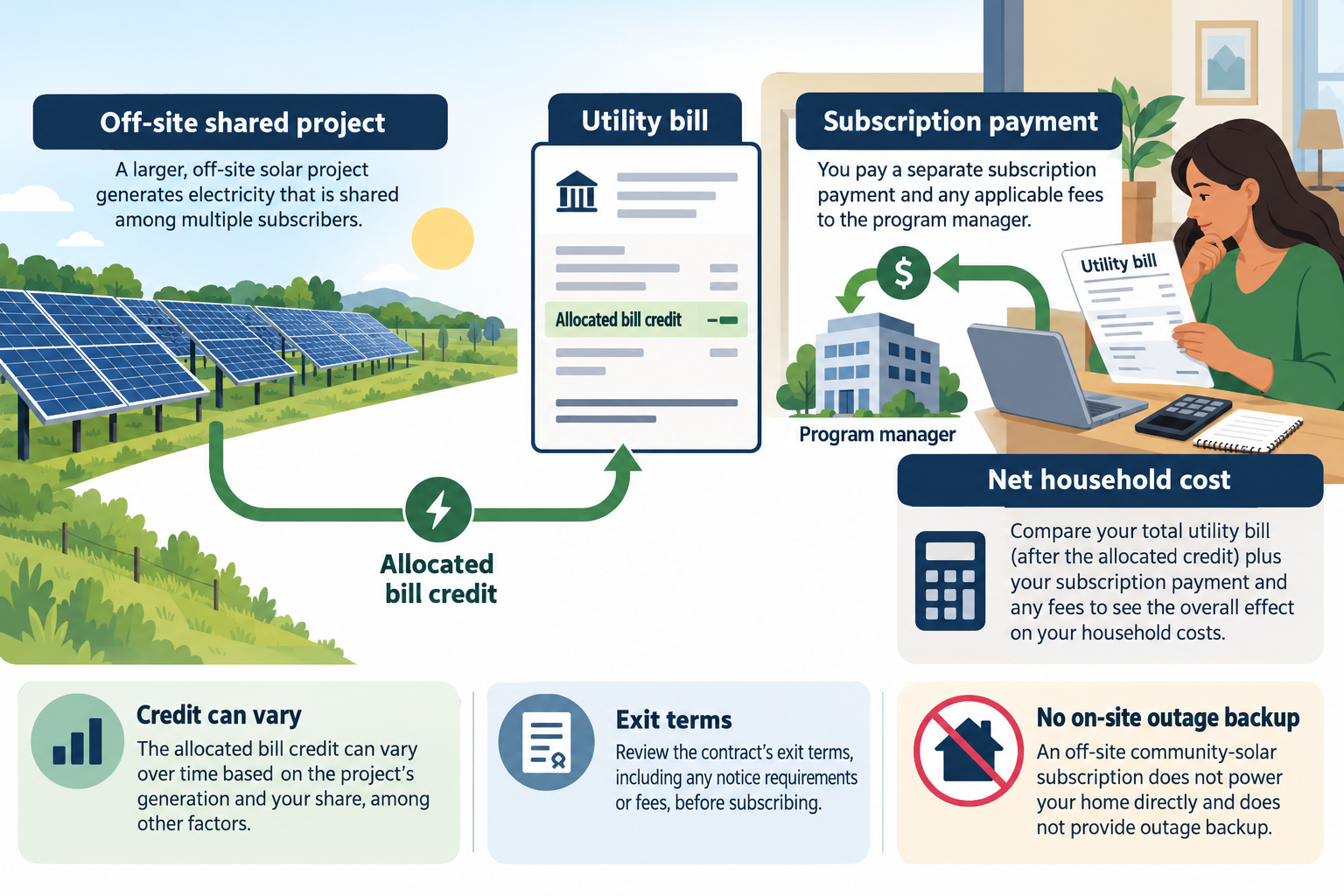
The solar project does not usually power the subscriber’s home separately or provide outage backup. The utility still supplies electricity, and the subscription changes how the customer participates in or receives value from a shared project. Compare rooftop solar cost only when installing a system at the home is a genuine alternative. If on-site panels are financed, leased, or purchased through a power-purchase agreement, use the ownership and payment comparison as a separate decision.
Confirm that a real local offer is available
Start with the electric account and service address, not a national sign-up form or a savings advertisement. Ask the utility or program administrator whether a community-solar project is operating, accepting residential subscriptions, and connected to the customer’s service territory. A project may be full, have a waitlist, or accept only customers in a defined geography, rate class, utility account, community, or income-qualified program.
Request the project name, subscriber agreement, current price schedule, utility-credit description, and cancellation rules before sharing payment or account information. Confirm whether the subscription is attached to the customer account, meter, property, or named person; whether it transfers to another address; and whether changing electricity providers ends the agreement. A credit offered in one service territory does not establish availability across an entire state, province, or utility.
The U.S. Department of Energy describes community solar as a shared project or purchasing program whose benefits flow to multiple customers. In many models the subscriber receives a bill credit for a share of generation, but local program rules determine how that credit is calculated and applied. A credit is not automatically worth the same as the retail price of electricity, and it does not remove fixed utility charges unless the tariff specifically says so.
Find every payment and credit in the offer
Write down each payment separately. Depending on the specific offer, a subscriber might face an upfront payment, a recurring fixed fee, a charge tied to allocated energy, or another contract amount. The project may describe the charge as a subscription payment, discount, or share of output. Do not assume one pricing model is standard or available in the reader’s market; use the actual written agreement.
DOE’s program-design presentation describes upfront, fixed-monthly, per-kWh, and floating-rate subscription structures. It is a 2023 design resource, not a current offer or evidence that any one model is standard.
Then identify how credits are earned and posted. Ask whether the credit follows measured project generation, an assigned share, a fixed rate, a percentage of a bill, or a utility tariff formula. Check whether it appears on the ordinary utility bill or on a separate statement, how long after generation it is posted, whether unused credits carry forward, and whether any balance expires. If a credit and payment arrive in different months, compare them over the same calendar period.
Separate the gross bill credit from the household’s net benefit. A worksheet can use:
Net subscription value = utility bill without the subscription − utility bill with the subscription − subscription payments − other fees.
Use the bills’ actual charge categories. A credit that reduces an energy charge may not reduce fixed service charges, taxes, delivery charges, or minimum bills. If the subscriber pays a separate project invoice, subtract it once; do not subtract the same fee both from the bill credit and again as a payment. Include any one-time payment in the period where it is due, then show the result over the contract’s expected duration.
Use a bounded program example, not a forecast
Nova Scotia’s government program illustrates why the credit method matters. As described by the Government of Nova Scotia, an eligible Nova Scotia Power customer can choose an allocation from 10% to 100% of electricity use, subject to the program and project terms. The utility bases monthly credits on the subscriber’s share of actual garden generation. The stated bill-credit rate is CAD $0.02 per kWh and does not change during the subscription, while the amount credited varies with monthly generation.
For arithmetic only, 1,000 kWh of allocated generation at $0.02/kWh would produce $20 in gross credits over the period in which that generation is allocated. That is not a typical subscriber result or a net-savings estimate: the actual generation and billing month vary, and the project’s own subscription terms determine whether there are separate payments or other charges. In this Nova Scotia example, subscribers must be current Nova Scotia Power customers in good standing and cannot be enrolled in another Nova Scotia Power solar program such as net metering. Some project owners may further limit who can subscribe. These are local conditions, not Canadian-wide rules.
The DOE and U.S. Department of Health and Human Services’ Clean Energy Connector is another bounded case. Its 20% minimum bill-credit discount rate applies to qualifying projects using that Connector, which is a pilot pathway for eligible LIHEAP households in participating jurisdictions. It is not a 20% savings promise for every community-solar subscription, household, or project. Confirm that the address, program, and project actually qualify before using the criterion in a comparison.
Stress-test production, charges, and timing
The share of a community project that is allocated to a customer may not produce the same credit every month. Weather, season, project output, allocation, utility billing dates, and account use can shift the credit. If the subscription payment is fixed while the bill credit varies, the subscriber may owe the same payment in a low-generation month while receiving a smaller credit.
Build at least three cases from the written agreement:
- Expected: Use the program’s stated allocation, payment, and credit method, with timing taken from the utility or subscriber agreement.
- Lower-credit: Reduce project generation or apply the offer’s worst stated credit period, while keeping any fixed payment and unavoidable bill charges.
- Exit or move: Include notice time, any early-cancellation fee or remaining balance, transfer eligibility, and credits that may post after the customer leaves.
Do not insert a utility’s retail rate for a community project’s credit unless the project and tariff say that is how the credit works. Do not assume a forecast of future electricity prices or generation is guaranteed. If the company will not state a charge, credit basis, or exit term in writing, leave it out of the favorable case and treat it as unresolved.
Read the contract for exit and project risk
Check the minimum term, automatic renewal, cancellation deadline, transfer process, early-exit payment, and what happens if the solar project stops operating or the subscription manager changes. Ask who is responsible for reconciling credits already earned but not yet posted. If you move, find out whether you can take the subscription to the new utility, transfer it to another customer, or cancel without cost. A statement that subscribers can cancel without a program penalty does not necessarily remove project-specific contract conditions.
Review how a subscription is billed and how the utility describes the credits. If the project claims that its bill credit is a fixed percentage of the customer’s bill, ask which bill component is being discounted and whether the fee is still due when a credit is delayed. Compare total utility payments plus subscription payments against the expected utility-only bill. The comparison should use the same household consumption and calendar, not the subscription’s best month against a full year’s utility bill.
Consider housing and assistance rules carefully
If the account is tied to a shared property, confirm who may sign, how costs and credits are assigned, and whether common-area or individual meters are eligible. For HUD-assisted housing, do not assume that community-solar credits have the same effect under every housing model. DOE’s summary of HUD guidance covers certain subscription models and notes that state-specific guidance may be needed; ask the housing provider or relevant administrator to confirm the current treatment for that property and program.
Income-qualified offers also have their own eligibility checks and consumer protections. The Connector example does not make every LIHEAP recipient eligible in every location, and it is not a general public enrollment directory. Ask the utility or program manager for current project availability, eligibility, discount calculation, payment terms, and the expected effect on the household’s bill before providing authorization.
Compare it with the realistic alternatives
An off-site subscription may solve an access problem, but it is not the only choice. A homeowner with a suitable roof can compare it with on-site ownership using rooftop solar cost and solar payback. A renter or owner who cannot install equipment may prefer to wait, keep the current utility arrangement, or enroll only if a local offer has clear terms and a reasonable exit.
Do not compare a monthly subscription payment with the full installed cost of a rooftop system in isolation. One buys a contract right to allocated bill credits; the other may buy equipment, construction, maintenance obligations, and a longer-term production asset. Compare the time period, taxes, financing, utility charges, cancellation rights, and responsibility for equipment. If the household may move soon, the ability to end or transfer the subscription can matter more than a modeled long-term savings figure.
A community-solar subscription also does not install backup hardware at the home. It should not be counted as a substitute for a battery, generator, transfer equipment, or another outage plan.
Questions to answer before enrollment
- Is the project currently accepting subscribers at this address and utility account?
- What exact share of generation is allocated, and how is it changed if use changes?
- How are credits calculated, when are they posted, and which utility charges remain?
- What payment is owed, to whom, and during months when generation or credits are low?
- Are there enrollment, account, billing, processing, or cancellation fees?
- What are the term, renewal, move, transfer, and early-exit rules?
- What happens to an earned credit or subscription payment if the project is delayed or closes?
- Is the household eligible for an assistance or housing-specific program, and who confirms the effect on other benefits?
Keep the offer, utility tariff, enrollment confirmation, and monthly bill records together. Reconcile credits and payments after the first few billing cycles before relying on the projected value. Enroll when a real local offer has a clear credit mechanism, transparent total payments, and exit terms that match the household’s plans. Wait or decline when availability is uncertain, the contract hides fees, or the result depends on a savings claim the written terms do not establish.