
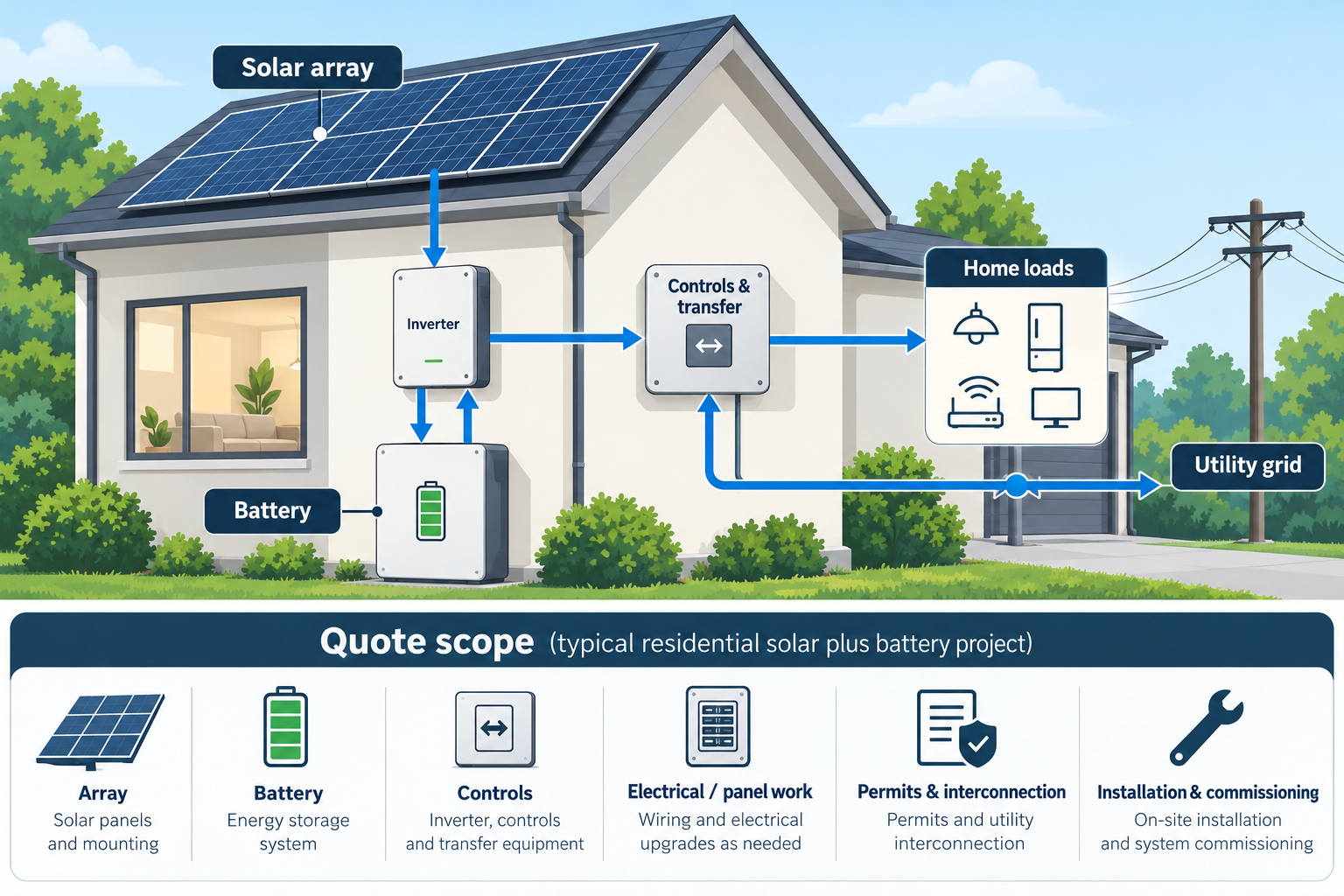
Solar plus battery storage combines two related but different purchases. Solar generates energy; the battery stores and controls energy for later use and may support outage loads. The combined quote can include the array, racking, inverters, battery units, gateway, transfer controls, wiring, roof work, permits, interconnection, commissioning, and monitoring. The cost cannot be reduced to solar price plus a retail battery price.
Define the purpose first
Decide whether the battery is primarily for evening self-consumption, rate management, outage backup, or a hybrid objective. The solar system’s production profile, the home’s loads, utility export treatment, desired backup circuits, and recharge expectations should be explicit. Solar panels alone generally do not operate a grid-dependent system during an outage; outage capability requires a properly configured inverter and storage architecture.
New combined installation
A new installation can coordinate the array and battery topology from the beginning. That may reduce duplicated design and wiring, but it does not guarantee the cheapest result. The battery may need a larger or different inverter, separate controls, a critical-load panel, or additional utility review. Installation location and access can add structural, enclosure, or electrical work.
Ask for separate solar-only, battery-only, and combined line items. Then identify savings that are genuinely avoided by doing the work together. Shared mobilization or design may be real; a generic “package discount” is not a scope explanation.
Cost drivers
Battery usable kWh and power output drive equipment. Whole-home coverage usually requires more power and transfer capacity than a small critical-load set. Roof planes, shading, future loads, service capacity, and inverter architecture drive solar. Distance between array, battery, and service drives wiring and equipment.
Approvals and utility treatment remain local. A battery can change interconnection, export behavior, and operating modes. Incentives or rebates can have product, installer, timing, and approval conditions. Verify before including them in net cost.
Three scenarios
Solar with modest storage: The battery shifts a portion of generation and supports limited circuits. The design may be economically attractive when export value is low or evening consumption is high.
Solar with critical-load resilience: The battery keeps selected refrigeration, communications, lighting, and pumps available. The load list and runtime matter more than the home’s total square footage.
Solar with broad outage coverage: Higher simultaneous loads require more power, controls, and possibly load management. Electric heat, central air, ranges, dryers, and EV charging can make whole-home operation a fundamentally different budget.
Ownership economics
Compare energy savings, export value, outage value, maintenance, inverter replacement, capacity retention, and eventual battery replacement. Storage can have value beyond payback, but state that value separately. If the battery is sized for rare outages, its financial case may rely on resilience rather than bill savings.
Reliable comparable current installed-price coverage is limited for U.S. and Canadian solar-plus-storage projects. Use local quotes, separate USD and CAD market references, and ask for an equipment and control schedule. The best comparison is a transparent system that delivers the intended services with a credible service and replacement path.
One dated U.S. reference can help normalize proposals without solving the local-price question. Lawrence Berkeley National Laboratory’s August 2026 update reports a 2025 median up-front installed price of $4.90 per watt of PV DC capacity for host-owned residential systems pairing solar and storage, before incentives. About 80% of the paired-system price observations came from California. This is a combined-system metric per unit of solar capacity: it is not a battery price, a battery-only add-on cost, a Canadian estimate, or a quote for a specific home. Compare it with a local proposal only after matching system size, battery capacity and power, ownership, and included work.
A separate EnergySage H1 2026 marketplace report gives $1,159 per kWh and $15,647 before incentives for a representative 13.5 kWh battery installation. Its quote-platform scope does not establish a matched solar-plus-storage price or an isolated battery premium, so do not add it to or directly compare it with the LBNL per-watt paired-system median.
Do not hide the battery’s second job
A battery used for daily energy management may be operated differently from one reserved for outages. A reserve setting that protects outage capacity can reduce daily bill-shifting value. A system optimized for daily cycling may not provide the duration the homeowner expects. Require the proposal to state its operating priority and the value assigned to each service.
Roof, service, and approval dependencies
The solar portion may require roof assessment, attachments, structural review, and a utility application. The storage portion may require different controls, a critical-load panel, service capacity, and an approval or rebate application. A shared installation date does not make the scopes interchangeable. Identify which costs disappear if the battery is deferred and which must be done for solar regardless.
Compare staged options
Request solar-only, solar-plus-storage, and storage-ready alternatives where the design genuinely supports them. A staged option can preserve capital but may later require a new inverter, gateway, or approval. A combined option can coordinate equipment but may increase initial capital. The best choice depends on the homeowner’s load, outage risk, export value, and ownership horizon.
Storage can solve a different problem from solar
If exports have low value, storage may increase self-consumption. If outages are the concern, the battery may be held in reserve and cycle less for bill savings. If production is insufficient, adding storage cannot create energy that the array never generates. Ask the proposal to show which benefit comes from solar, which comes from storage, and which depends on the utility program.
Test a deferred battery
If capital is limited, compare installing solar with a documented future battery path against installing both now. Include the risk that future equipment will require an inverter or gateway change, a new approval, or different wiring. A staged plan is valid only when the current architecture genuinely preserves that option.
Use a service-by-service comparison
For each proposal, identify solar production, direct household use, export, stored energy, outage circuits, transfer behavior, and recharge. A battery can be expensive if it is sized for an outage but used only for a small daily load, or if it is sized for bill management but does not deliver the expected outage service. Keep the functions separate so one benefit does not conceal a missing one.
Future replacement matters
Solar modules, inverters, controls, and batteries may have different replacement timing. Ask which components are expected to be replaced together and which can be serviced independently. Include access, downtime, compatibility, and disposal in the ownership model. Coordinated new installation is valuable only when it leaves a credible future service path.
Separate the two jobs in one proposal
Solar and storage can share design, permitting, wiring, and commissioning, but they deliver different services. Solar primarily changes the source of energy; storage changes when energy is used and may support selected loads during an outage. Ask the installer to show the price and performance of the solar-only case, the battery-only or deferred-battery case where practical, and the combined case. This reveals which work is genuinely shared and which cost exists only because the second system was added.
The combined design may need a different inverter topology, controls, service capacity, critical-load panel, monitoring path, or utility approval. A lower combined price can be real when a single design avoids rework, but it should not erase the future replacement cost of two different equipment families. Record the operating mode when the grid is present and absent; a grid-tied array is not automatically backup power.
Decide whether staging preserves value
Defer storage when the household needs bill reduction but has no clear outage load list, when the roof or service is unresolved, or when the storage platform is not yet supported locally. Install together when outage architecture, controls, approval, and location are already defined and a second mobilization would create substantial rework. In either case, ask what must be installed now to keep the alternative feasible and what will become more expensive if postponed.
The strongest quote makes those choices visible instead of presenting combined equipment as an inevitable package. It should state usable capacity at commissioning, backed-up circuits, recharge assumptions, export behavior, replacement responsibilities, and the conditions under which the system will not provide the promised service.