
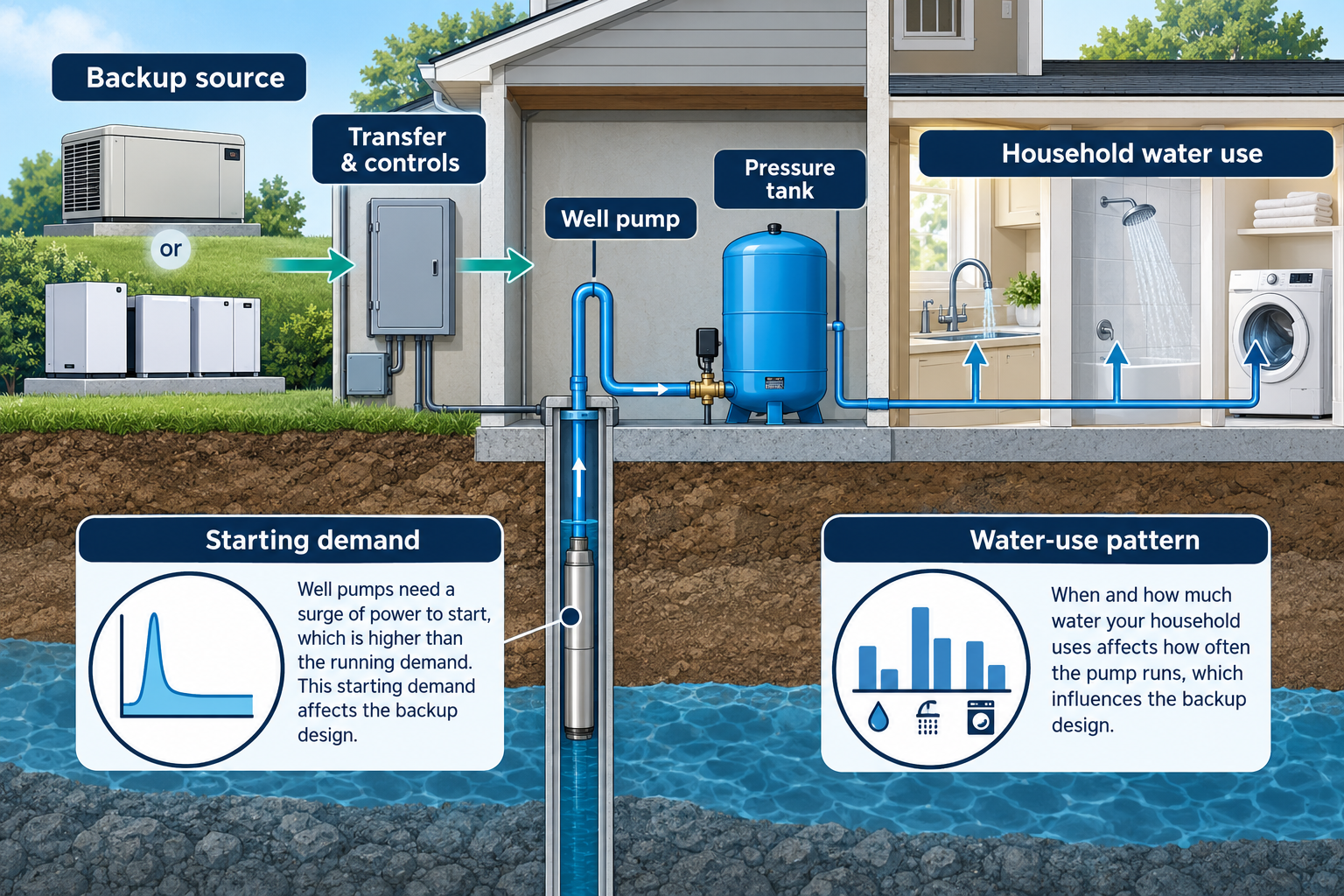
A home supplied by a well cannot treat the pump like an ordinary small appliance. Voltage, running power, starting surge, pump controls, pressure tank, cycling, water-use pattern, and desired outage duration affect backup selection. The well system itself belongs to the private-water category; this guide covers the power architecture that keeps it available.
Start with actual pump information
Find the pump and control-box documentation, circuit rating, voltage, phase, motor characteristics, pressure settings, and condition of the existing equipment. Do not infer pump size from well depth. The pump’s starting demand can be more important than the energy used over a day, especially for a battery or a smaller generator.
Manufacturer data illustrate why the exact motor matters. Franklin Electric’s 2026 manual lists a 230 V, two-wire, 1/2 hp submersible motor at 5.0 A full load and 32.2 A locked rotor; a listed 1 hp configuration is 8.2 A and 48.7 A. The Myers MFL/MPL manual instead lists 9.9 A maximum load for its 1/2 hp convertible jet-pump motor at 115 V or 4.95 A at 230 V, but gives no starting-current value. These are examples for named product configurations, not comparable universal pump loads, generator-sizing values, or cost estimates. Confirm the installed model, voltage, controls, and starting characteristics with qualified help.
Also describe the water service needed during an outage. A pressure tank may provide some stored water between pump cycles, but it does not make the household independent of the pump indefinitely. Avoiding unnecessary flushing or irrigation may reduce demand, but that is an operating choice rather than proof of adequate source capacity.
Backup options
A standby generator can support a well pump if its output, transfer equipment, fuel, and controls are designed for the starting load. A portable generator may serve it through an approved household transfer arrangement, but it requires manual operation and safe outdoor handling. A battery can work when its continuous and surge output, usable energy, inverter, transfer controls, and runtime match the pump.
Solar plus storage may add recharge potential during an outage, but weather and household loads matter. A critical-load system can put the pump on a priority circuit while excluding large electric loads. The well pump should not be added to a backup panel merely because the breaker fits.
Cost drivers
Cost can include source equipment, transfer or critical-load panel, wiring, controls, electrical assessment, commissioning, storage or fuel infrastructure, and any required service work. Pump access and documentation affect diagnosis. A pump that needs a larger source for startup may change the entire generator or battery size.
Three outage scenarios
Short outage: Pressure storage and limited water use may reduce cycles, so a focused critical-load design can be sufficient if startup is supported.
Day-long outage: Pump cycles, refrigeration, communications, and other priority loads must be modeled together. Runtime and recharge become material.
Extended outage: Fuel deliveries, solar weather, battery capacity, water-use discipline, and a hybrid plan may matter more than a nominal generator size.
Quote checklist and boundary
Give the backup designer actual pump and control information. Require source voltage and power, continuous and surge capability, backed-up circuits, transfer method, runtime assumptions, fuel or recharge assumptions, and commissioning scope. Ask who verifies pump compatibility and who owns the water-system diagnosis.
No reliable universal well-pump backup price was established. Use a property-specific local quote and keep the well repair, pressure tank, and pump replacement scope separate. The economic choice should preserve the water service the household needs without buying capacity based on a guessed pump size.
Water demand is part of the model
List the uses that must remain available and which can wait. Pressure-tank storage may reduce immediate pump starts, while irrigation, washing, and other discretionary uses can consume that margin quickly. The backup designer should not promise a runtime without a water-use assumption. If the household needs continuous water service, model the pump’s duty during the longest relevant outage rather than ordinary daily cycling.
Compare the source to the pump’s starting demand
Battery capacity is not enough if its inverter cannot supply startup power. Generator capacity is not enough if transfer controls or service configuration cannot support the circuit. Ask for a documented starting and running requirement from the actual pump and control equipment. If the pump is old or its data is missing, diagnosis or replacement may need to be handled as a separate decision first.
What changes the recommendation
A small, short-outage system may protect the pump as one critical load. A long outage or high water demand may favor a generator, solar recharge, larger storage, or a hybrid plan. A property with a marginal well or pressure system should resolve that condition before spending on backup power. Keep those costs separate so backup is not used to conceal a water-system problem.
Include the control and transfer path
The backup source must reach the pump through an approved transfer or managed-circuit arrangement. Ask whether the pump shares a circuit, whether a control box or pressure switch has special requirements, and how the system behaves when the source is near its limit. The designer should identify the electrical boundary; the water professional should identify the pump and pressure-system condition.
Compare the value of water continuity
The cost of lost water service may be small for a short vacant-home outage and significant for an occupied rural home, livestock-related use, or a property where recovery is difficult. State the consequence and acceptable interruption before choosing capacity. This helps avoid paying for whole-home power when a focused pump circuit—or choosing too small a source for the actual need—would not satisfy the household.
Treat the pump and source as one operating case
The source must support the pump’s starting demand, running demand, controls, pressure equipment, and any other load that operates at the same time. A nameplate estimate may not describe a worn pump, a control box, a variable-speed system, or a pressure cycle. Ask for the actual equipment information and for a documented assumption when data is missing. If diagnosis reveals a pump or well problem, keep that work separate from the backup-power quote.
Build at least three cases: a short outage where stored water or a brief interruption is acceptable, an expected outage where normal household demand continues, and a difficult outage involving repeated starts, longer runtime, or delayed fuel or recharge. Include the effect on water pressure and recovery time. The cheapest adequate source may be a managed pump circuit; a whole-home source may be justified only when other loads have equal consequence.
Price the second visit you hope to avoid
Ask whether the installer will test transfer, starting, running, control behavior, and return to normal service with the actual pump. Identify who resolves a failure caused by the electrical source and who resolves one caused by the pump or pressure system. Keep the pump model, control settings, source limits, circuit schedule, and commissioning result with the property records. Good documentation can prevent a future technician from repeating the same diagnostic work during an outage.
Include recovery after the outage
The project should explain how water service resumes when utility power returns, the battery reserve is restored, or the generator is shut down. Ask whether the pump can operate normally after transfer, whether pressure or control settings need professional adjustment, and who responds if the source transfers but the water system does not recover. Do not infer a water-system procedure from a generic electrical diagram; the pump and pressure-system professional should define that part of the boundary.
This recovery question can change the economics. A source that keeps one pump energized may not address a failing pressure tank, control, or well condition. A larger source may be less useful than correcting the water-system problem first. Compare backup power, pump or control repair, water storage, and a broader source using the consequence of lost water and the property’s actual occupancy.