
“Whole-house generator” describes an outage objective, not a single standard installation. The complete project can include the generator, pad, automatic transfer equipment, electrical connection, fuel infrastructure, permits, inspection, load management, commissioning, and future maintenance. The system may still manage or shed large loads rather than run every appliance at once.
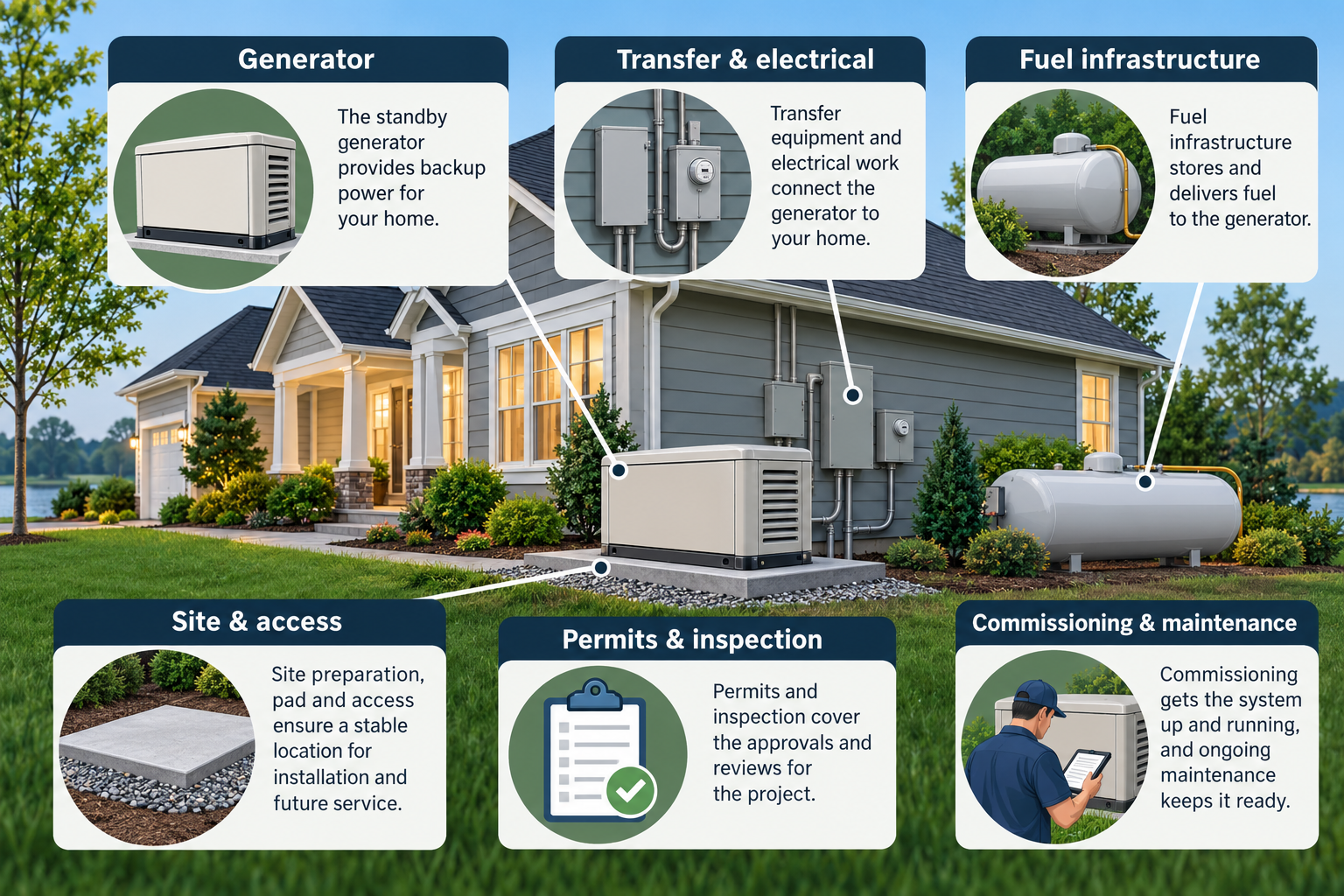
Equipment is one line item
Generator output must match the required continuous and starting loads. Central air, electric heat, well pumps, sump pumps, refrigeration, cooking, and vehicle charging create different design demands. A larger nameplate can increase equipment, fuel, pad, transfer, and maintenance costs, but it does not solve an unknown load list.
As a dated U.S. consumer reference, Consumer Reports lists equipment in its ratings at about $3,400 to nearly $7,000 and separately estimates professional installation at about $5,000 to $10,000 or more. The page does not state the installation sample, geography, or included scope, so do not add these two estimates into a promised installed-price range or apply them to a Canadian project. A local quote still needs to itemize transfer equipment, fuel, pad, permits, site work, and commissioning.
Transfer equipment isolates the backup source from the utility and controls how power reaches the home. Its configuration, grounding and bonding treatment, service arrangement, and local rules require qualified design. Ontario evidence illustrates that conductor and transfer architecture can be technically consequential; it is not a universal rule for every U.S. or Canadian property.
Fuel and site work
Natural gas may require piping, regulator or meter review, and confirmation of available capacity. Propane may require a tank, piping, delivery access, and site approval. Distance, trenching, pad, equipment location, clearances, and access can make fuel infrastructure a major part of the budget. These requirements are local and must be quoted by the appropriate qualified trades.
Three installation scenarios
Straightforward automatic backup: Service, fuel, location, load scope, and approvals are suitable. The quote should separate equipment, transfer, installation, and commissioning.
Managed whole-home system: The home has large loads or limited service capacity. Load-shedding controls and a written sequence determine which loads can operate together.
Complex site: New fuel work, trenching, service changes, difficult access, or jurisdictional review creates conditional cost. Require a written allowance and a change-order process before buying equipment.
What to include in the ownership model
Add fuel consumption, annual inspection and service, oil and filters, starter battery, exercise or testing, repairs, and eventual replacement. Ask whether maintenance plans are optional or required by warranty. Commissioning should leave operating instructions and records, but it does not remove the need for safe ongoing service.
The available evidence does not establish one current universal installed price. Use local generator and fuel quotes, keep USD and CAD markets separate, and ask what “whole house” means under simultaneous-load conditions. A lower generator price is not a saving if transfer, fuel, pad, approvals, or load management are excluded.
Define “automatic” and “whole house”
Automatic transfer describes how the system responds to an outage; it does not establish that every household load can run. Ask for the transfer sequence, startup behavior, generator output, simultaneous loads, and load-shedding priorities. A system can serve the whole service while disconnecting large loads when capacity is limited.
Treat fuel as a feasibility gate
Before choosing the generator, confirm fuel source, pressure or supply capacity, tank or piping route, delivery access, and authority requirements. A generator quote that postpones fuel review can understate both cost and schedule. Ask whether the generator location can be reached for service and whether the property has restrictions that change the design.
Commissioning and records
The closeout should identify equipment models, transfer configuration, circuits, fuel assumptions, warranties, maintenance schedule, and who handles future service. These records have economic value when a fault occurs or the property is sold. A professional installation is a system of equipment, approvals, and service—not only a machine placed beside the home.
Generator size is a system decision
Start with the loads that must operate together and their starting demands. If the home has electric heat, central air, a well, a sump pump, or other motors, ask how the design handles their overlap. Load management may reduce the generator required, but the proposal should say which loads are delayed or disconnected.
Quote the difficult case
Ask what happens if the existing service lacks capacity, the fuel connection needs an upgrade, the pad location changes, or the authority requires revised documents. Identify allowances and approval rights. A straightforward equipment quote is not a whole-house budget when its transfer, fuel, and commissioning assumptions are conditional.
Sizing is not a square-footage exercise
Ask for actual load assumptions and starting demand. A home with gas heat may have a different generator requirement from one with electric resistance heat, even at the same size. A well or sump pump may impose a brief starting demand. Air conditioning, cooking, and vehicle charging may need priority controls. Require the designer to explain which loads operate together and which are shed.
Installation versus ownership
The initial project can be appropriate while annual ownership is not. Add fuel, oil and filter service, starter battery, exercise, repairs, travel, and eventual replacement. A remote home may have higher service mobilization and fuel-delivery risk. Compare those costs with a battery or essential-load design if the generator will rarely run.
Questions at closeout
Request equipment models, transfer arrangement, approved load scope, fuel assumptions, inspection status, commissioning result, maintenance schedule, warranty, and service contact. Those records let a future technician distinguish a generator problem from a transfer or fuel problem and make a resale or later renovation less uncertain.
Distinguish required from elective scope
Ask the installer to label the generator, transfer equipment, pad, fuel connection, load management, service work, permits, and commissioning as required, recommended, or optional. A future electrical-capacity upgrade may be useful but not necessary for the generator. This classification helps compare a lean essential-load system with a broad system without letting a sales package define the need.
Plan for the first outage
Closeout should explain what starts automatically, which loads are shed, how fuel limits operation, and who responds to a failure. Include the first service visit, battery or consumables, fuel, and any monitoring or notification setup. A generator selected for rare emergencies still needs an ownership plan that works before an emergency occurs.
Model the first complete outage
Ask the installer to describe the sequence from grid failure through transfer, load pickup, load shedding, fuel use, and return to normal service. Include a short outage, a prolonged outage, and a failure-to-start case. This shows whether the system is sized for the loads that matter, whether the homeowner must intervene, and whether the promised service depends on a fuel or maintenance assumption that is easy to miss.
The first outage can also expose costs outside installation: a starter battery, service call, fuel delivery, weather protection, monitoring setup, or a circuit that was excluded from the original load list. These are not reasons to reject a generator, but they are part of the ownership model. A complete quote should make the operating boundary understandable before an emergency tests it.
Compare a smaller complete system
If whole-home coverage requires substantial service work, fuel infrastructure, or load management, compare a critical-load design using the same outage objective. A smaller generator is not automatically a complete essential-load system; it still needs transfer, circuit selection, starting-load review, commissioning, and maintenance. The comparison should show the service given up and the costs avoided, rather than presenting a smaller engine as a simple discount.
Compare automatic response with actual need
Automatic operation can have value when occupants cannot be present, pumps or heating controls must respond quickly, or outage decisions cannot be managed manually. It also adds controls, testing, notification, service, and failure-response expectations. Ask what happens if the source starts but a transfer device, fuel supply, or load-management control does not perform as intended.
For an occupied home with infrequent short outages, a properly designed essential-load or portable connection may be enough. For a vacant, remote, or high-consequence property, automatic response and local service may justify more cost. Keep those assumptions explicit so “automatic” is evaluated as a service rather than a feature label.