
“Total loss” can mean different things to an insurer, engineer, building official, or homeowner. A house can be physically repairable but economically difficult, or heavily damaged but capable of selective restoration. Do not use one percentage or one estimate to make all four decisions.
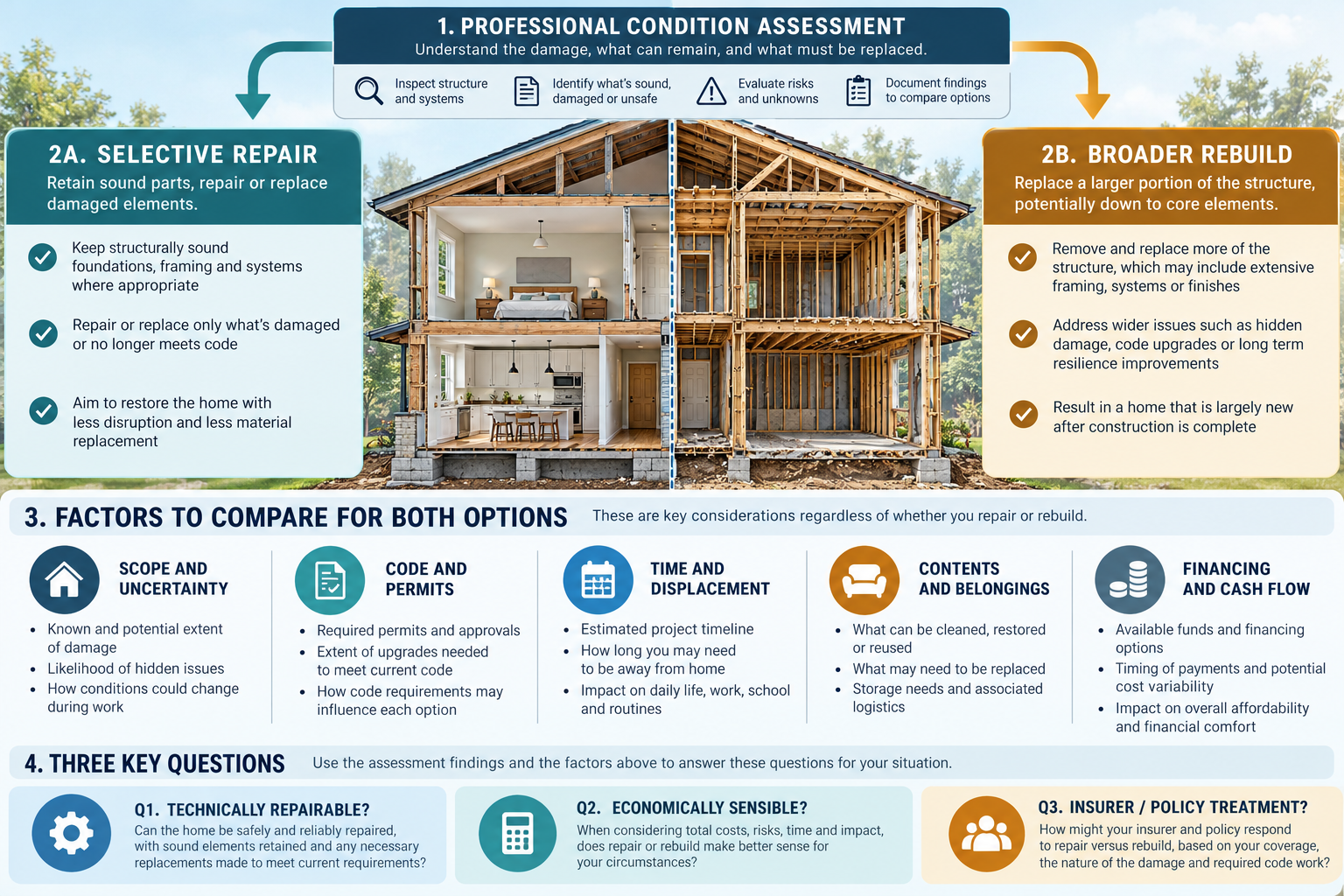
Avoid an early binary choice
The realistic options may be selective repair, major reconstruction, a redesigned rebuild, or a staged decision while more of the building is assessed. A binary “repair or rebuild” answer can hide a difference in scope. Ask which assemblies can remain, which must be removed, and which choices are still open.
If demolition is required to make the building safe or determine the condition, treat that phase as information-producing work. Its cost does not by itself decide the eventual rebuild path.
- Is the remaining structure safe and technically repairable?
- Which repair, removal, and reconstruction scope is economically sensible?
- How does the policy define and value the loss?
A qualified structural or building assessment addresses the first. A scope and cost comparison addresses the second. The policy, adjuster, and applicable authority address the third.
Compare repair and rebuild on the same basis
For each path, list structural work, contamination and demolition, salvageable assemblies, finishes, system work, design and engineering, permits, code requirements, access, temporary stabilization, temporary housing, contents, schedule, and unknown conditions. Include the condition the property will be in at the end of each option.
Repair can preserve sound assemblies, character, or a preferred location. Rebuilding may simplify coordination when damage is widespread or the existing configuration cannot be restored within current requirements. A major rebuild can also become a redesign, which creates choices beyond like-kind recovery.
Do not hide uncertainty
Ask which numbers are observed, estimated, or contingent on opening assemblies. Hidden moisture, contamination, structural movement, current-code work, floodplain restrictions, specialty materials, and labor access can change the result. Temporary housing and storage can make a slower repair more expensive even when its construction total looks lower.
Insurance and code are separate decisions
An insurer’s valuation or total-loss position does not replace a building official’s determination of permitted work. A contractor’s reconstruction estimate does not establish coverage. ACV, replacement cost, limits, deductibles, code coverage, flood mechanisms, and exclusions can all affect the budget.
There is no universal repair-to-rebuild threshold. Use a written comparison, obtain the necessary professional assessments, ask the authority about permits and code, and ask the insurer how its policy treats each path.
For NFIP-participating communities in Special Flood Hazard Areas, FEMA describes a substantial-damage baseline when repair cost reaches 50% of the pre-damage market value of the structure. That is a local floodplain-compliance determination; a community may use stricter or cumulative rules, and the baseline is not an insurer’s total-loss or claim-payment test. A property owner can ask FEMA to review an NFIP Severe Repetitive Loss designation if the record is believed inaccurate or mitigation has changed flood potential, but that administrative-status review is separate from the current repair-versus-rebuild decision. The code-upgrade guide explains these processes and their limits.
The substantial-damage process can add a decision point before ordinary reconstruction: the home may be physically repairable, yet the local authority may require a compliant scope before work proceeds. Include the likely permit and determination sequence in the repair schedule, and keep its effect on temporary living and storage visible without assuming that an insurer will pay those added costs.
For a Canadian property, Public Safety Canada’s Community Risk Index describes community-area risk context, not the damage, required work, coverage, or rebuild cost for an individual address. Use a local or site-specific assessment for the property decision.
Check whether assistance applies to the path being compared
Public recovery programs can define different options without changing the property’s private repair cost. Puerto Rico’s official R3 program page lists repair, reconstruction for eligible homes in non-hazard areas, and relocation for some eligible homes in hazard zones; its current guideline version must be checked before applying. Maui County has separate reconstruction and post-rebuild reimbursement programs for qualifying survivors of the 2023 wildfires. A separate San Luis Obispo County manufactured-home replacement program is limited to qualifying homes and a named storm period; its page describes elevation as a possible part of replacement review, not a separate grant.
These are examples of program-defined routes, not typical rebuild prices, private insurance benefits, universal repair thresholds, or guaranteed awards. Confirm the current application status, property and applicant eligibility, eligible work, payment mechanism, remaining funds, and any overlap with insurance or other aid. The post-disaster funding guide explains how to keep conditional assistance separate from confirmed project cash.
For a Canadian flood loss, a funding shortfall can also affect the practical financing decision. Canada’s 2026 climate assessment describes possible mortgage and equity constraints where flood insurance and public assistance are insufficient, including a Quebec example. It is a reported risk, not a prediction for a particular home or lender. Ask the lender or servicer how claim funds, repair plans, and any remaining borrowing need affect the actual mortgage before treating financing as settled. The separate post-disaster funding guide explains assistance and loan questions.
Start with a reliable condition assessment
Do not compare repair and rebuild using a pre-demolition guess when the structure, contamination, or concealed assemblies remain unknown. The right assessment may involve a structural professional, building designer, environmental or restoration specialist, and the local authority. Ask what was inspected, what remains inaccessible, and which conclusions are conditional.
A repair path can preserve sound framing, finishes, historic character, or a location the homeowner values. It can also be difficult when many trades must work around remaining assemblies, matching is complicated, contamination is widespread, or current requirements affect the whole project. A rebuild can simplify coordination but may introduce design, permit, demolition, financing, and schedule costs.
Three different questions must stay separate
“Can it be repaired?” may be a structural or technical question. “Is repair economically sensible?” compares cost, time, disruption, future work, and the resulting property. “Will the insurer treat it as a total loss or pay a particular amount?” is a policy and claim question. One answer does not settle the others.
A building can be physically repairable but economically unattractive because contamination, hidden damage, code work, access, or temporary housing makes the path complex. It can also be expensive to rebuild even when the insurer’s valuation or limits do not support every preferred outcome. Do not use an insurer’s label, a contractor’s preference, or a simple percentage rule as a universal answer.
What a repair path should show
A repair comparison should identify the assemblies that remain, the material that must be removed, structural or environmental assessments, source-system repairs, reconstruction, matching, permits, code work, design or engineering, access, debris, contents, temporary utilities, and temporary housing. It should state what condition the property will reach and which defects or unknowns remain.
Repair may make sense when the affected boundary is limited, the remaining structure is suitable, the finish and system work are manageable, the schedule is acceptable, and the resulting property meets the homeowner’s needs. Those are decision factors, not a guarantee that repair is the right result.
What a rebuild path should show
A rebuild comparison should describe what is being demolished or retained, the new structural and building-system scope, design and engineering, permits, inspections, code requirements, site or floodplain constraints, utilities, finish level, schedule, and temporary living. It should separate restoration from layout changes, betterment, and resilience work.
Rebuilding more of the property can simplify matching or hidden-condition risk, but it can also increase design, permit, demolition, financing, and displacement costs. A new layout may solve one problem while creating another. The comparison should explain what additional work buys the homeowner.
When to obtain another assessment
Seek the appropriate professional when the decision depends on structural stability, contamination, electrical or HVAC condition, floodplain requirements, code, historic constraints, or an unresolved hidden assembly. The professional should answer a defined question and provide a report or scope, not simply a larger number.
The responsible decision is the one that makes physical condition, economic tradeoffs, policy limits, time, and household priorities visible. “Repair” and “rebuild” are paths to compare, not labels that determine the outcome in advance.
A decision meeting that produces useful evidence
Ask the professionals to explain the same property condition using the same rooms and assemblies. Have the repair path and rebuild path identify what is retained, removed, replaced, upgraded, permitted, inspected, and unknown. Ask how each path changes schedule, temporary living, storage, financing, and the ability to remain partly occupied.
Then separate facts from preferences. A structural defect, contaminated assembly, or authority requirement is different from a preference for a new layout or higher finish level. A preference can be reasonable, but it should not be hidden inside a “rebuild necessity” subtotal. This distinction helps the homeowner decide even when the insurer’s valuation and the contractor’s preferred scope do not match.
If repair proceeds are approved but not yet available because a mortgage servicer must release them, add that timing condition to the comparison rather than treating it as proof that repair is permanently underfunded. The mortgage-proceeds guide covers the release questions.