
When a loss makes a home unsafe or unavailable, the recovery budget includes more than construction. Temporary lodging, incremental food, storage, laundry, commuting, pet arrangements, and other day-to-day differences can continue while mitigation and reconstruction proceed.
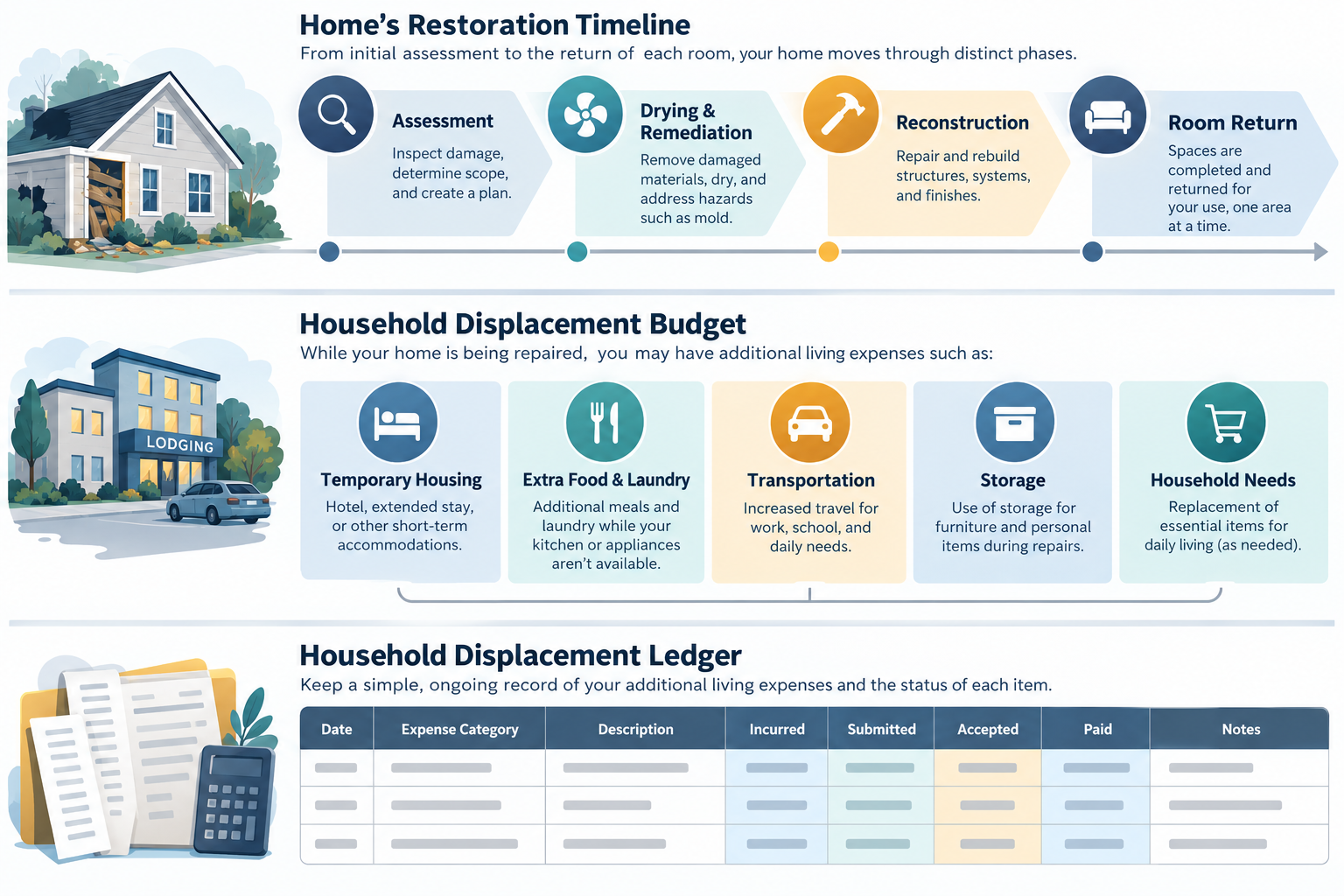
These household budget categories do not mean that an insurance policy or assistance program will cover each expense; confirm the applicable terms.
Separate household planning from claim accounting
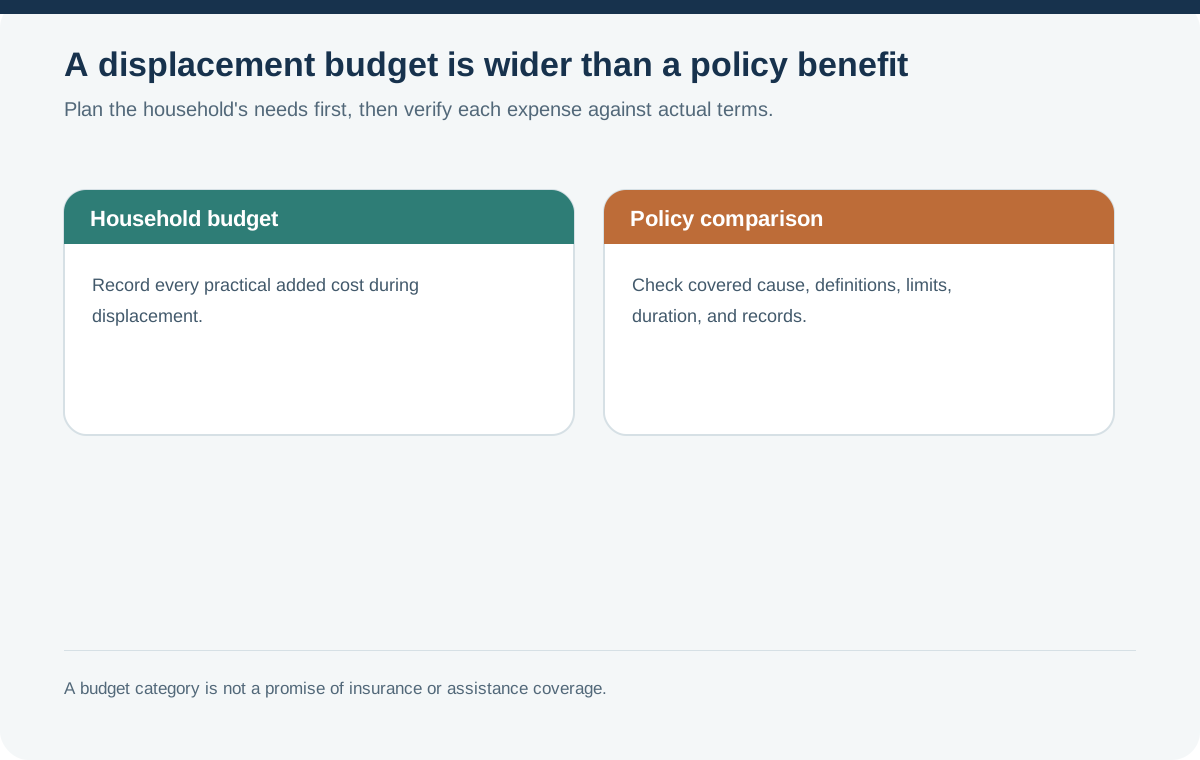
The household must pay or arrange for a place to live whether a coverage decision is finished or not. The insurer may later classify only some of those costs as additional living expense. Build the practical budget first, then compare it with the policy’s definition, limits, conditions, and documentation rules.
This distinction is especially important when a household chooses a more expensive location, needs accessibility features, has pets, or must remain near work or school. Compare temporary rent with the rent or mortgage cost that would normally continue, then list added utilities, meals, transport, laundry, storage, deposits, and accessibility needs. Explain the need and keep receipts, but do not assume the policy will accept every difference.
U.S. insurance guidance generally describes additional living expense (ALE) as the increase above normal living costs when a covered loss displaces the household, subject to policy limits and time conditions. Mortgage payments and ordinary costs do not automatically become additional living expenses. The actual policy controls.
Canadian coverage can use different wording and may treat flood, earthquake, evacuation, and other events differently. Do not assume that a U.S. ALE explanation is a Canadian coverage rule.
Build a displacement budget
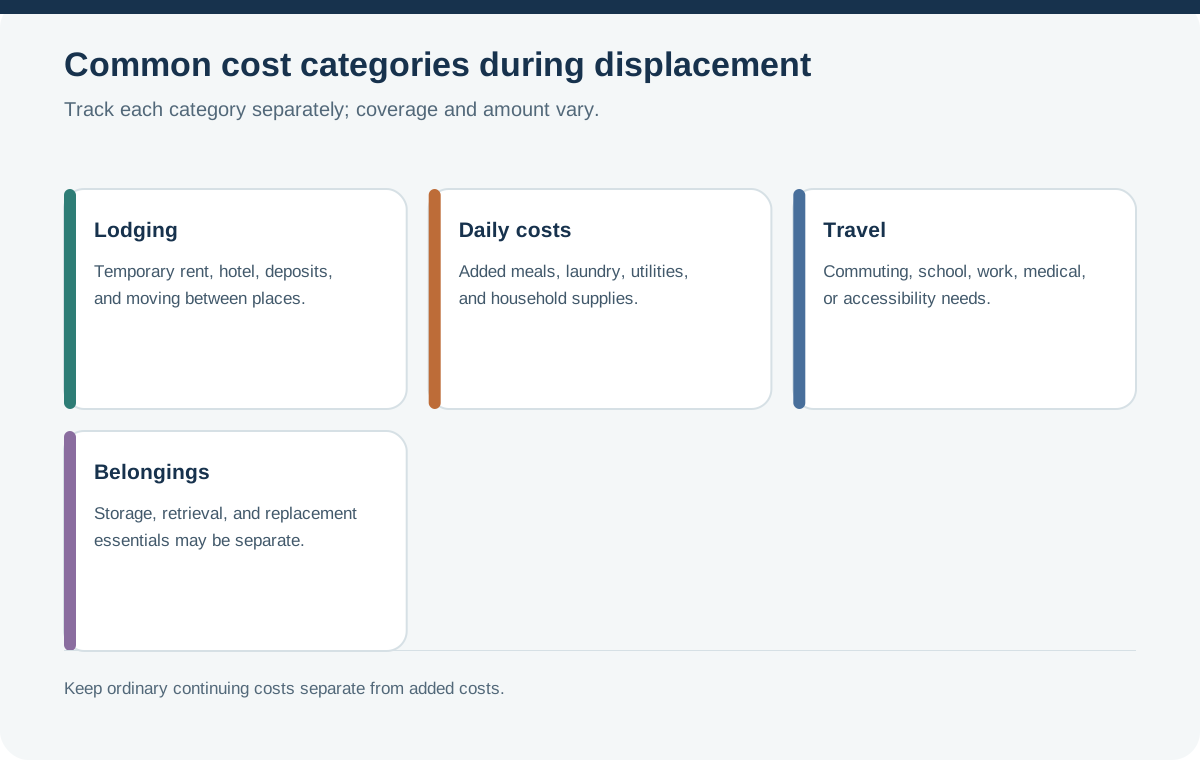
| Expense | Compare the household’s usual cost with | Keep with the record |
|---|---|---|
| Housing | Temporary rent or lodging; note which ordinary housing costs continue | Lease, lodging bills, deposits, and dates |
| Food and laundry | Meal costs above the usual home routine and paid laundry | Receipts and a reasonable normal-cost baseline |
| Transportation | Extra distance, transit, parking, or trips caused by the temporary location | Mileage or transit records and dates |
| Storage and moving | Pack-out, storage, access to stored items, and pack-back | Inventory, invoices, and storage period |
| Household needs | Pet, accessibility, work, school, or medical-related arrangements | Receipts and a short note explaining the need |
The difference is the planning signal, not a prediction of what an insurer will reimburse. Keep ordinary household spending, extra costs, amounts submitted to the insurer, and payments received in separate columns. Reconcile the record as the arrangement or repair schedule changes; do not count an expected reimbursement as money available for a deposit until its timing is confirmed.
When both an owner and renter are displaced from the same flooded property, make a separate record for each household and each policy or program inquiry. The rental-home recovery guide distinguishes those housing costs from building repairs and contents.
Reconcile the budget as the living arrangement changes
Displacement is often a sequence rather than one continuous stay. A household might leave on the loss date, stay with relatives during initial cleanup, then move to a furnished rental while reconstruction continues. Record the date and reason for each change, who paid, which ordinary housing or household costs continued, and what additional cost was actually incurred. A contractor’s target completion date can help with planning, but it is not proof that the home will be available or that a policy will recognize the projected period.
Compare arrangements by total household effect, not only the nightly or monthly rate. A lower rent may add commuting, laundry, meal, utility, deposit, or accessibility costs; a higher rate may include services that reduce other expenses. Note what is included, which occupants need the space, and when a room or essential system may return. Keep estimates separate from invoices and receipts so later changes do not become a guessed total.
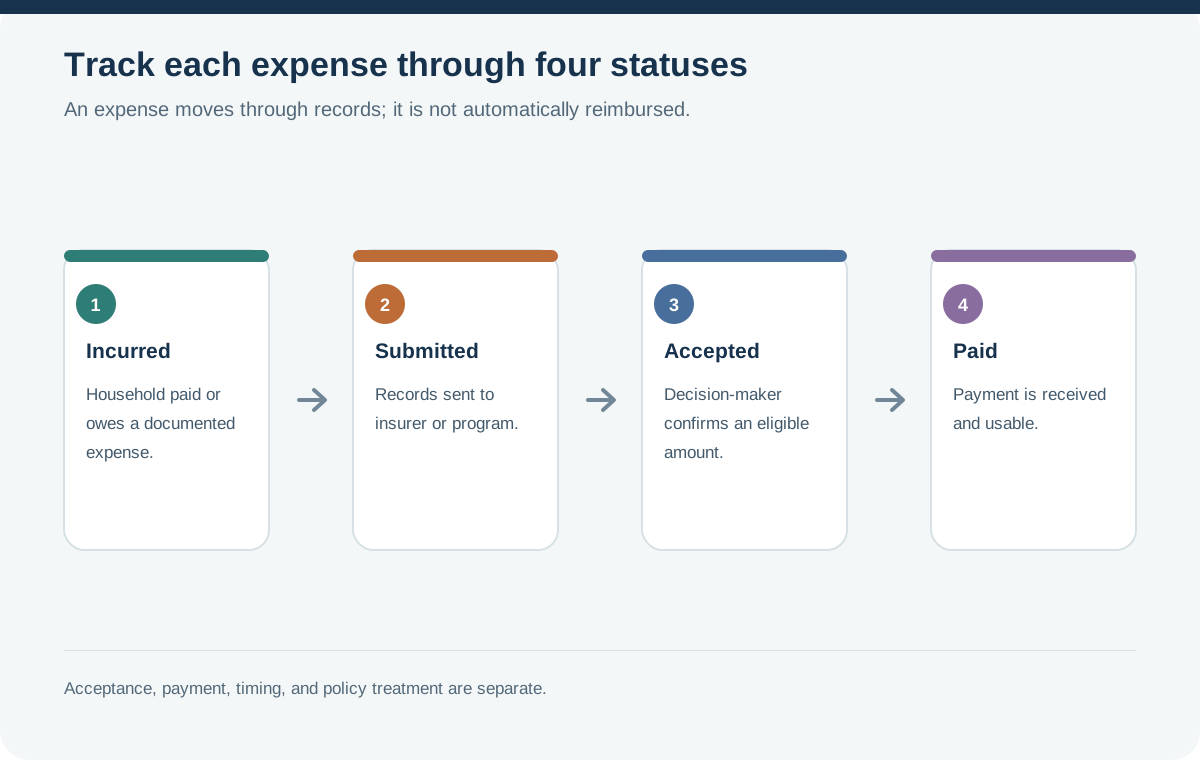
For each period, track four statuses: incurred, submitted, accepted by a payer, and paid. A pending invoice is still a household cash need; an expected benefit is not money on hand. If building-repair proceeds are issued but a mortgage servicer must process a release, record that timing separately from the temporary-living ledger and use the mortgage-proceeds guide for that question. Reconcile the displacement record when the schedule or occupied area changes.
Duration is a cost driver
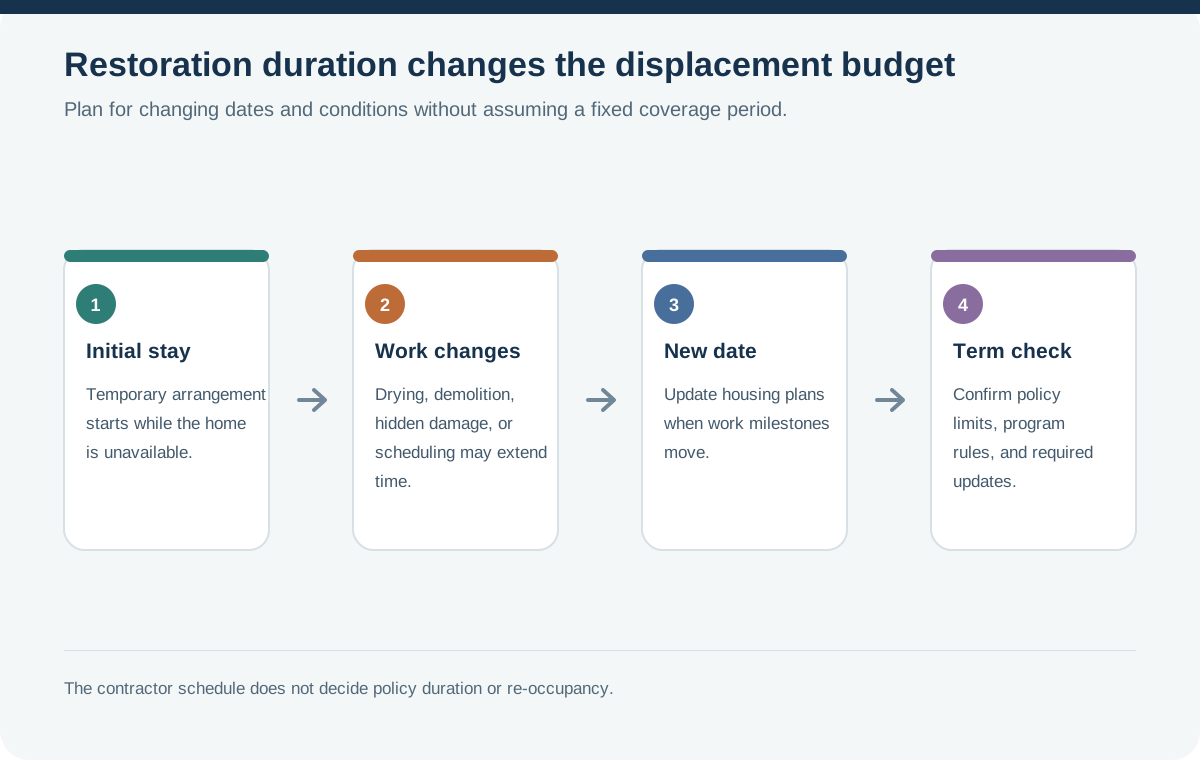
Temporary living costs may continue while the property is assessed, dried, remediated, permitted, rebuilt, inspected, or waiting for materials. Hidden damage, supplements, code requirements, contractor scheduling, and contents storage can extend the timeline. Ask the contractor for a schedule range and what conditions could extend it, then ask the insurer about time and dollar limits.
Keep receipts and a running record. Ask before committing to an unusual or long-term expense, but do not assume a lack of preapproval means an urgent safe lodging decision must wait.
Some recovery support is separate from policy-based ALE
California’s AB 1795 includes conditional protections for additional-living-expense coverage on certain wildfire-smoke claims in a defined impact zone. It and AB 1642 include an operative condition tied to taking effect by January 1, 2027; check the current AB 1642 text, claim location, and policy limits before relying on that example. Ontario’s activated Disaster Recovery Assistance program may include basic emergency expenses for eligible households in defined areas, but it is not the same as an insurer’s ALE benefit and does not apply province-wide. If a material shortfall remains, the separate post-disaster funding guide compares public assistance, loans, and tax questions.
If an insurance check for repairs is available only after a mortgage servicer processes it, that cash-flow question is separate from a household’s temporary-living budget. The mortgage-proceeds guide covers release timing and regular mortgage obligations.
Choose a temporary arrangement around household needs
Compare options using the household’s actual needs: number of occupants, bedrooms, cooking and laundry, work or school access, pets, accessibility, medical equipment, commuting, and storage. A short-term rental may add utilities, deposits, parking, or internet; a hotel may include some services but make cooking or storing belongings difficult. The cheapest nightly rate is not always the lowest total household cost over a long project.
Pack-out and storage can overlap with displacement. Contents may need to leave before reconstruction, while the household still needs clothing, documents, medication, work equipment, and essential furniture. Ask how to retrieve stored items and keep those charges separate from the insurer’s temporary-living calculation.
Track dates, delays, and limits
The schedule can expand when demolition reveals hidden damage, drying or remediation takes longer, materials are delayed, permits or inspections are pending, a code decision is unresolved, or a system cannot be safely used. Ask for the assumptions behind the completion date and the events that would change it.
Track actual dates: when the home became unavailable, when each room is returned, when contents can come back, and when the household can reasonably resume normal use. A contractor’s target date is useful for planning but does not by itself establish policy eligibility or a guaranteed payment period.
Coverage and documentation questions
NAIC guidance describes additional living expenses as increased temporary living costs subject to policy terms, limits, and conditions. Canadian guidance likewise emphasizes policy-specific coverage and limits. Do not assume that the same category, duration, or limit applies in every U.S. or Canadian policy.
Ask the insurer:
- What coverage or endorsement applies?
- What expenses are considered additional?
- Are there dollar, time, household, or property limits?
- What receipts, comparisons, or approvals are required?
- How are delays, storage, pets, accessibility, and meals treated?
Keep receipts, invoices, mileage or transportation records, lodging agreements, storage records, and communications. Documentation supports the conversation but does not guarantee reimbursement.
When costs exceed the expected allowance
If the restoration is delayed, ask the contractor for the cause, revised schedule, and work that can proceed in parallel. Ask the insurer how to handle a projected limit, changed accommodation, or continuing expense. If the household chooses a more expensive arrangement for convenience, space, or preference, keep that choice separate from the baseline additional-cost calculation.
The practical goal is a rolling budget that connects the physical schedule to household cash flow. It should show what the home project costs, what living elsewhere adds, what the policy may address, and what remains the homeowner’s choice.
Review the budget whenever a room or essential utility returns to service.