
Actual cash value (ACV) and replacement cost are valuation concepts, not two names for the physical restoration scope. They can change how an eligible loss is recognized, how depreciation appears in the calculation, and how much cash the homeowner may need while repairs or rebuilding proceed. The policy, endorsements, limits, deductible, cause of loss, and jurisdiction control the result.
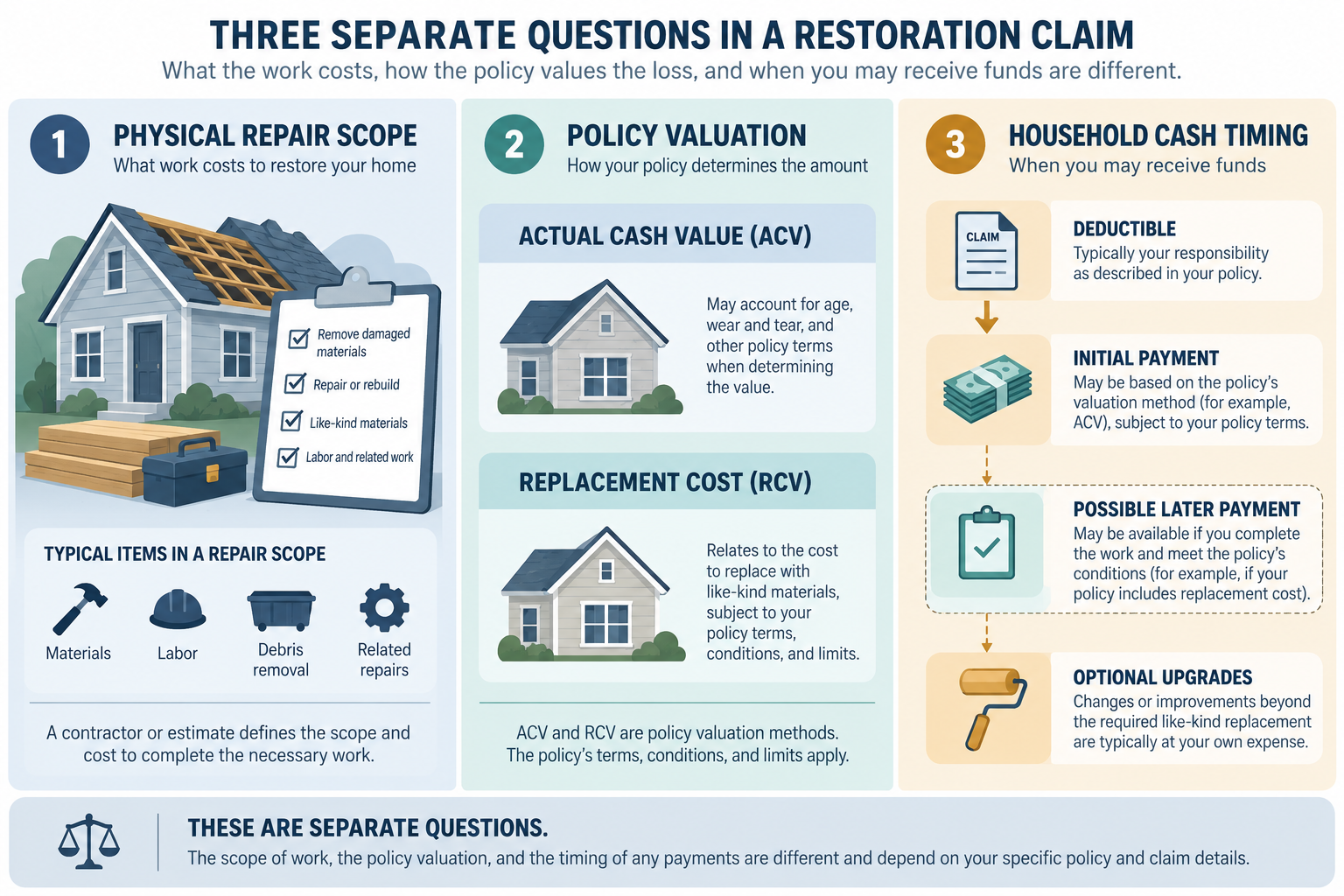
Keep the five questions separate
An estimate or settlement letter can contain several different numbers. Read them as separate questions:
- Physical repair or replacement cost: What will it cost to stabilize, remove, repair, replace, or rebuild the damaged property to the defined end condition?
- Insurer-recognized valuation: Which part of that physical scope does the policy currently recognize, and under which valuation basis?
- Initial payment: What amount, if any, is being offered or paid now, and what deductions or limits are shown?
- Later potential payment: Is another amount considered only after documentation, completion, replacement, or another policy condition? That condition is not universal.
- Deductible: Which amount remains the policyholder’s responsibility under the actual policy?
Homeowner-selected upgrades are a sixth, separate budget question. A contractor can price a larger window, higher-grade flooring, a different layout, or an efficiency improvement without that choice becoming part of the like-kind loss scope.
ACV generally considers the cost to repair or replace an item while accounting for age, wear, or depreciation. It is not the same as the home’s real-estate market value. The exact calculation depends on the policy and claim details.
Replacement cost
Replacement-cost coverage generally relates to like-kind-and-quality repair or replacement without the same deduction for depreciation, subject to the policy’s conditions, limits, deductible, and eligible work. “Replacement cost” does not automatically mean a higher-grade upgrade, a different design, or every cost needed to bring a home to a preferred modern standard.
Like-kind does not necessarily mean identical age or an obsolete product. It is a way of describing the comparable function and quality used by the applicable policy and claim process. The insurer, contractor, and homeowner may still need to resolve differences in availability, matching, code requirements, and the defined finished condition. Do not treat a contractor’s preferred upgrade as the default replacement standard.
A bounded way to read payment lines
Consider a hypothetical worksheet that lists $30,000 for a defined like-kind building scope, $5,000 as depreciation, and a $1,000 deductible. The figures are only an illustration of how separate lines can affect cash flow; they are not a universal formula. The worksheet may show a lower amount at one stage, a possible later amount tied to replacement or documentation, or a different result altogether. Whether those lines apply, when money is paid, and whether any depreciation can be considered later depend on the actual policy and claim.
The useful lesson is to reconcile the lines rather than treating one number as the total project budget. Ask the insurer to identify the physical scope behind the valuation, the reason for each deduction, the amount currently payable, and the condition for any later consideration. Compare that explanation with the contractor’s scope and the cash the household must carry.
Why the distinction matters during recovery
The valuation method can affect an initial payment, later documentation, depreciation recovery, contents decisions, and cash flow. A homeowner may need to complete eligible work or meet other policy conditions before a later amount is considered. That sequence is not universal; ask the insurer to explain the actual policy wording in writing.
Depreciation can matter even when the physical work is clear. A contractor may need the full replacement amount to complete the work while the policy calculation temporarily recognizes a different amount. That can create a cash-flow gap, but it does not establish that a later payment will be available. Building materials, personal property, temporary living costs, and code-related work may have different limits, sublimits, exclusions, or valuation rules. A contractor’s reconstruction estimate does not decide whether an item is valued at ACV or replacement cost.
Building and contents should be reviewed separately. The building may involve drywall, flooring, cabinets, or a roof; contents may involve furniture, clothing, electronics, or documents. A pack-out or contents treatment estimate is not automatically part of the building valuation, and a building-limit discussion does not settle a contents sublimit or special valuation rule.
Keep upgrades separate
Replacing like-kind work and choosing a better material are different budget lines. Code-required work may also be distinct from voluntary betterment: the first question is whether an authority actually requires the work for this project, while the second is whether the homeowner prefers it. Coverage for code work, betterment, or either valuation basis depends on the policy and jurisdiction. Ask the contractor to price each line separately and ask the authority or design professional what requirement creates any mandatory work.
Compare the physical scope, insurer-recognized valuation, deductible, limits, payment conditions, and homeowner-selected changes rather than treating one total as the final cash requirement. Keep source repair, consequential restoration, contents, displacement, and reconstruction visible as separate scopes where they apply.
Questions to ask
Ask the insurer or claim representative:
- Is this amount ACV or replacement cost, and does it apply to the building, contents, or another category?
- What item, age, condition, or method was used to calculate depreciation?
- What documentation, purchase, repair, or completion condition affects whether a later amount is considered?
- Are the building and contents subject to different limits, sublimits, exclusions, or valuation rules?
- What deductible, policy limit, endorsement, or cause-of-loss condition affects this amount?
- Does the current number include mitigation, reconstruction, temporary living, code-related work, or only one phase?
- Which work is like-kind replacement, which work is required by an authority, and which work is a homeowner-selected upgrade?
- What should the homeowner document before disposing of contents or authorizing work?
Ask the contractor to identify the end condition, quantities, assumptions, exclusions, matching work, and upgrade lines. These questions clarify the relationship between the physical work and the insurance valuation without asking a general article to interpret an individual policy.
ACV and replacement cost are not repair scopes
The physical scope answers what must be stabilized, cleaned, removed, repaired, or rebuilt. ACV and replacement cost describe how an eligible loss may be valued under a policy. A contractor can estimate a new roof, drywall, cabinet, or personal item without deciding whether the policy pays an ACV amount, a replacement-cost amount, or neither.
Keep three numbers separate: the cost of the work, the amount the policy may recognize, and the cash the homeowner must provide at each stage. A high reconstruction estimate does not automatically mean the homeowner receives that amount, and an initial payment does not prove that all work has been valued.
What ACV generally changes
Actual cash value generally reflects age, wear, and depreciation in the valuation of covered property. The exact calculation, covered item, policy limit, deductible, and exclusions still come from the contract. ACV is not the same as the home’s market value, and neither number is automatically the cost to rebuild a damaged assembly.
For a building item, ask what the insurer is valuing, what condition or like-kind assumption applies, and whether the estimate includes demolition, labor, materials, permits, or only a valuation component. For contents, identify the item, age, condition, replacement availability, and documentation. Do not assume that a contractor’s replacement price is the same amount used to calculate ACV.
What replacement-cost coverage generally changes
Replacement-cost coverage is intended to address the cost of like kind and quality under the policy’s terms, rather than only an amount reduced for age and wear. It does not necessarily pay for a larger layout, premium materials, betterment, unrelated code work, or every cost a contractor proposes. Limits, conditions, documentation, completion requirements, and policy language remain decisive.
Some policies or claim processes may involve an initial valuation and a later payment after repair or replacement documentation. That pattern is not universal. Ask the insurer to explain the applicable payment conditions, deadlines, holdbacks, depreciation treatment, and what happens if the homeowner repairs differently from the initial estimate.
An insurer’s conditional payment of recoverable depreciation is different from a claim check that has already been issued but awaits a mortgage servicer’s release process. Identify who currently holds each amount and why before treating it as available cash. The separate mortgage-proceeds guide covers that timing question.
Building, contents, and code work are different questions
The building scope may include framing, drywall, flooring, cabinets, roofing, or systems. Contents include items inside the building. Code-required work may be a separate authority or coverage question. Voluntary upgrades are homeowner choices. A single claim can contain all four categories, each with different limits or valuation rules.
Keep a written list of like-kind restoration, required compliance, contents, and optional improvement. Ask which evidence supports each amount. A new cabinet may restore a damaged cabinet; a different layout or higher-grade material may be betterment. An authority-required electrical or floodplain measure may not be the same as ordinary replacement-cost work.
A bounded cash-flow example
Suppose a reconstruction estimate is $40,000, the policy applies a $2,000 deductible, and the insurer’s initial valuation uses a lower amount because depreciation or incomplete documentation is being considered. The homeowner may need to fund part of the work before later policy payments, and a selected upgrade may remain entirely out of pocket. The example shows why the project price, recognized amount, and timing of cash are different variables; it does not predict a particular settlement.
Ask for the actual policy explanation rather than assuming the example applies. Keep invoices, completion records, photographs, receipts, inventory, and change orders. If work changes from the insurer’s scope, ask how that change affects valuation before authorizing it.
Questions to ask the insurer
Ask:
- Is the item or phase being evaluated under ACV, replacement cost, or another term?
- How are depreciation and recoverable depreciation handled, if applicable?
- What must be repaired or replaced before a later payment is considered?
- Which limits, deductibles, endorsements, or exclusions apply?
- Are contents treated differently from building work?
- How are code-required work and voluntary upgrades separated?
- What records and deadlines apply?
The physical work should still be priced and assessed by the appropriate contractor or specialist. ACV and replacement cost help explain the insurance valuation conversation, but they do not replace the technical scope or guarantee the final amount paid.