
One company may respond to the emergency, while another handles mould, contents, structural work, or reconstruction. The same company may offer several services, but a homeowner still needs to know which scope it is accepting responsibility for.
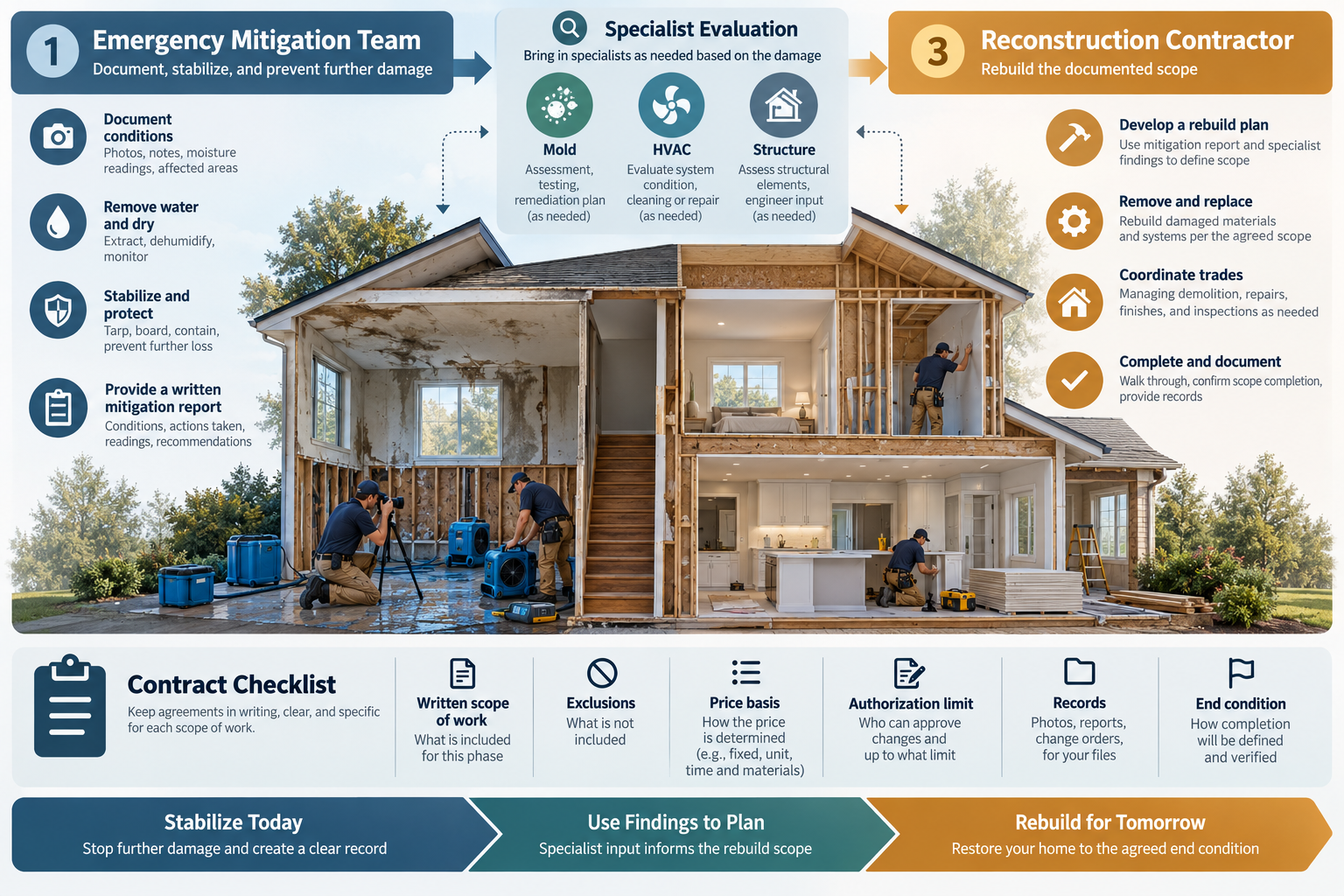
Match expertise to the loss
A water-mitigation firm may be equipped for extraction and drying but not structural repair. A contents specialist may treat belongings but not rebuild a wall. A reconstruction contractor may coordinate trades but not decide whether a contaminated HVAC system or hidden mould is safe. Ask what the company does itself and what it refers to another professional.
This distinction matters more than a broad “full-service” label. It also helps explain why several contracts can be appropriate for one loss.
Ask who performs emergency stabilization, water extraction, drying, smoke or soot cleaning, contaminated-water cleanup, contents restoration, demolition, and permanent reconstruction. A source-system trade may still be needed for the failed pipe, sewer, roof, electrical system, or appliance.
Request a written scope with affected areas, assumptions, equipment or monitoring, demolition, disposal, cleaning, contents, reconstruction, permits, exclusions, price basis, change-order process, payment terms, and the handoff condition.
Check credentials without overreading them
Licensing, insurance, and contracting requirements vary by state, province, territory, and municipality. Check the applicable local requirements. IICRC standards and certifications can provide professional context, but the standards are voluntary consensus standards and certification is not automatically a legal requirement.
For mould or contaminated-water work, ask about experience with that condition and references. Do not accept a generic cleaning credential as proof that a company has assessed structural, electrical, HVAC, health, or reoccupation issues.
Insurance-network and independent choices
An insurer may offer a preferred or network contractor, but the homeowner should understand the contract, scope, and payment arrangement. NAIC guidance says a homeowner need not feel rushed and that a contractor and adjuster may coordinate. Ask who is your contractual counterparty, who approves supplements, and who decides what work is technically necessary.
Warning signs in an emergency authorization
Be cautious about pressure to sign a broad assignment without reading it, demands for unexplained cash, a promise of guaranteed coverage, an estimate with no exclusions, refusal to document conditions, or a claim that one treatment guarantees safe occupancy. Emergency authorization should be limited to the urgent scope the property needs.
The best contractor comparison is phase-specific: response capability now, documentation and assessment, mitigation quality, and a clearly defined transition to rebuilding.
Decide what you need first
Start with the current condition and urgency. A roof opening or broken window may need temporary protection. Standing water may need safe extraction and drying. Sewage, fire residue, mould, smoke, ash, damaged HVAC, structural movement, and flooded utilities may require specialists with different experience. A company that can respond quickly is not automatically the right company for every later phase.
Ask whether the firm performs emergency stabilization, water mitigation, contents handling, specialty remediation, reconstruction, or only some of these. If it performs several phases, ask whether the contracts, supervisors, estimates, and warranties are separate. A single point of coordination may be convenient, but it should not make the scope less transparent.
Compare capability and contract scope
Request a written description of affected areas, proposed work, assumptions, exclusions, equipment and monitoring, demolition, disposal, contents, reconstruction, permits, payment terms, and change-order rules. Ask who has authority to approve additional work and whether emergency authorization is limited to urgent mitigation. Identify the expected end condition: protected, dry, cleaned, demolished, or rebuilt are not the same.
Check local licensing, registration, insurance, and contracting requirements yourself because they differ by state, province, territory, and municipality. Ask for references relevant to the loss type. IICRC certification or standards knowledge can be useful context, but professional standards are not automatically law and a credential does not prove that a property is safe to occupy.
Match the company to the phase
An emergency restoration firm may respond to water removal, drying, smoke, contents, or temporary protection. A specialty environmental or remediation firm may address a defined contamination or hazardous-material question. A reconstruction contractor may rebuild finishes and coordinate trades. A plumber, roofer, electrician, HVAC professional, structural professional, designer, or engineer may own a source or system decision.
One company can offer several services, but the homeowner should still ask whether the same firm is acting under one combined contract or several phase-specific scopes. A single coordinator can reduce handoff friction. Separate estimates and end conditions can make the economic and technical boundaries easier to review.
What to verify before an emergency authorization
Ask who is responding, what urgent condition the authorization addresses, the maximum amount authorized, the rooms and work included, the equipment and monitoring, the expected end condition, and what is excluded. Limit an emergency authorization to the work needed to stabilize or mitigate the immediate condition when the permanent scope is not yet understood.
Ask how photographs, moisture records, contents inventories, removed-material records, and discoveries will be shared. If an item must be discarded for safety or sanitation, ask how the condition will be documented. A professional response should not require the homeowner to leave a dangerous condition in place merely to wait for a later inspection.
Compare contractors by capability and documentation
Ask whether the firm has experience with the actual peril: clean water, floodwater, sewage, fire, smoke, wildfire ash, contents, structural damage, or multi-trade reconstruction. Ask whether it can provide a written scope, itemized estimate, change-order process, insurance information, references, and a named contact. Review the contract’s payment terms, cancellation rules, warranties, dispute process, and responsibility for subcontractors.
If a mortgage lender or servicer must release insurance proceeds, do not promise a deposit or milestone payment from an assumed release date. Ask the servicer for its written process and compare it with the contractor’s due dates; see the mortgage-proceeds cash-flow guide.
Check local licensing, registration, insurance, and contracting requirements yourself because they vary by jurisdiction. Do not treat an insurer’s preferred-vendor relationship as a guarantee that the company is the only permitted choice or that its estimate is complete. Ask how you can obtain an independent estimate or change contractor if the policy allows it.
Warning signs when choosing a company
Be cautious when a company pressures you to sign a broad assignment before explaining the work, promises that the insurer will pay a specific amount, refuses to state exclusions, combines urgent work with an unexplained full rebuild, or cannot identify who owns a safety or technical question. A large deposit, vague “as needed” pricing, or a request to approve demolition without documentation deserves clarification.
The lowest bid is not automatically the best value, and a higher bid is not automatically more complete. Compare affected areas, phases, end condition, equipment, monitoring, contents, reconstruction, permits, and change-order rules. Ask what you will receive at handoff and what decision remains after the firm finishes.
The transition between mitigation and rebuilding
Before reconstruction starts, request the mitigation completion record, moisture or condition documentation, photographs, removed-material list, unresolved issues, and proposed rebuild scope. Confirm that the source is controlled and that structural, electrical, HVAC, environmental, or local-authority questions have the appropriate owner.
Hiring well is less about finding one company that promises everything than about making each responsibility visible. The right contractor is the one whose capability, contract, records, and end condition match the phase the property actually needs.
A short selection record
Keep the companies considered, the phase each proposed, the scope and exclusions, the response time, the credentials or licensing checks, the estimate basis, and the questions that remain unanswered. If a loss is urgent, the record can begin with the first firm that is available and be expanded before permanent reconstruction. Availability matters, but it should not erase the homeowner’s right to understand the authorization.
The record is also useful when the same firm proposes mitigation and rebuilding. Ask whether the later scope will be re-estimated after drying or demolition, whether the homeowner can compare that phase independently, and who is responsible for warranty or correction work. A transparent handoff is more important than a label such as “full service.”
Read the authorization before the emergency arrives
An authorization should identify the client, property, phase, work permitted, price basis, access, payment terms, cancellation or termination rules, records to be provided, and any assignment or direction of payment. If the document covers work that cannot yet be scoped, ask how the limit is controlled and how additional work is approved. An urgent signature should not erase the distinction between protecting the property and committing to permanent reconstruction.
Ask how the firm handles disagreements about condition, scope, or coverage. The process should allow the homeowner to request the underlying photographs, readings, inventory, estimate, and change order. A company can be responsive and still need to explain why a proposed line is necessary. Clear records make that conversation possible without treating every question as a refusal to proceed.