
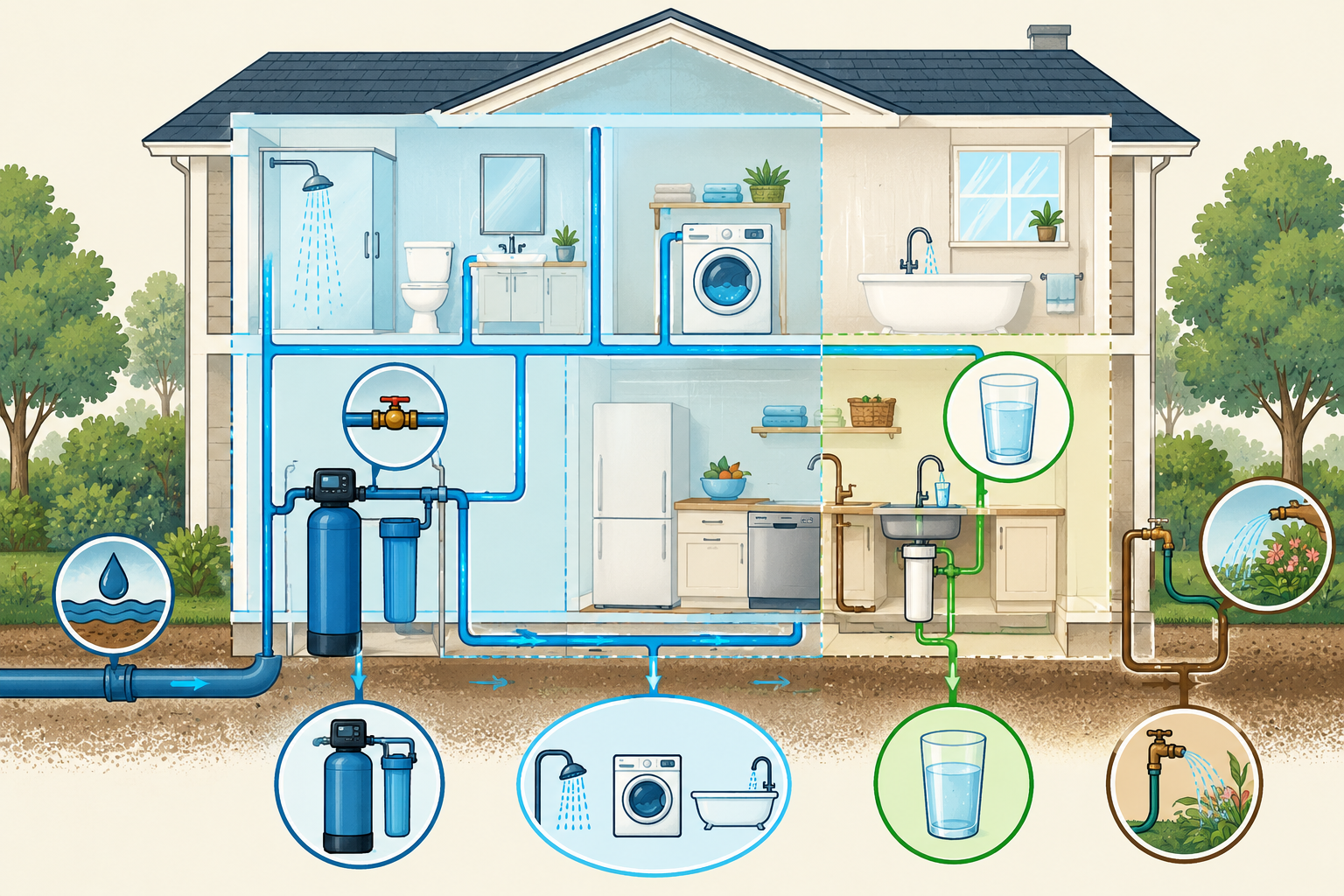
Point-of-use (POU) treatment works at selected taps or outlets. Point-of-entry (POE), often called whole-house treatment, treats water as it enters the home. The cheaper option is not always the right one because the two scopes solve different exposure, plumbing, appliance, flow, and convenience problems. Choose after testing identifies the contaminant and the treatment objective.
The economic difference
A current US specialist orientation places installed reverse-osmosis systems around $1,000–$4,800, with POU systems generally below whole-house applications. That is technology-specific market context, not a universal POU/POE price. Whole-home treatment usually needs higher flow capacity, larger equipment, more plumbing, pretreatment, a drain or backwash path, and more media or service.
POU can keep the treated volume small and the installation focused. POE can treat every fixture but pays to process water used for bathing, laundry, toilets, and outdoor uses as well as drinking and cooking. The value depends on what the tested problem affects and what exposure or operational objective the household has.
When POU may fit
POU can be reasonable when the decision concerns drinking and cooking water at a defined outlet, the treatment is certified for the specific contaminant, and untreated water does not create a separate whole-home problem. It can be especially economical when the water issue is limited to a small volume and the household can maintain the device and use the treated tap consistently.
POU does not automatically protect other fixtures, a refrigerator line, an ice maker, or every person who may use another tap. Count the outlets and include dedicated plumbing, storage, filters, membranes, drain connections, and verification.
When whole-house treatment solves a different problem
POE is more relevant when the issue affects bathing or other household uses, damages plumbing or appliances, creates a system-wide operational problem, or requires treatment at the incoming flow. Hardness, iron, manganese, sediment, low pH, odor, and some microbial treatment strategies may require a whole-home design, but the specific result and equipment claim still control.
Whole-house does not make an unsuitable device suitable. It increases the consequence of wrong sizing, pressure loss, exhausted media, bypass mistakes, and installation errors. The raw-water result, flow, peak demand, and chemistry must support the design.
Compare the systems
| Decision dimension | Point of use | Whole house / point of entry |
|---|---|---|
| Treated water | Selected outlet or outlets | Water entering the home |
| Equipment scale | Often smaller | Higher flow and capacity |
| Installation | Faucet, storage, drain, or short plumbing | Main-line plumbing, bypass, drain, power, space |
| Consumables | Limited volume, but may need frequent attention | Larger media, filters, salt, lamps, or service |
| Best value | Defined drinking-water objective | Whole-home exposure or operational objective |
| Main risk | Untreated taps may still be used | Higher upfront and lifecycle cost if over-scoped |
Mixed strategies
A mixed design can treat the whole home for one problem and use POU RO or another technology for a contaminant that requires a narrower, certified application. It can also avoid processing large volumes when only drinking water needs additional treatment. But each stage needs a reason, a maintenance plan, and a clear boundary.
Radon from well water is a special boundary case: EPA describes point-of-entry aeration or GAC for a demonstrated water contribution because radon can be released to indoor air during household water use. A point-of-use tap treats only a small portion of the water and does not address that inhalation pathway across other uses. Test indoor air and well water as separate questions, and keep indoor-air mitigation work separate from the well-treatment quote. EPA’s comparison is U.S.-specific and does not establish a current price or Canadian rule.
Installation and maintenance
POU projects may require a dedicated faucet, storage tank, drain connection, pressure check, and filter or membrane replacements. POE projects may require a loop, bypass, backwash or reject drain, electrical circuit, floor protection, overflow, chemical or media storage, and service access. Freeze exposure and water shutoff planning matter for either.
Health Canada recommends testing water entering and leaving treatment and matching certification to the specific contaminant. NSF emphasizes that standards cover different treatment categories and that certification does not mean a device reduces every contaminant. Budget verification and replacement, not only installation.
Three scenarios
One tested drinking-water concern: A certified POU device may be the lowest total-cost path if the household can use the treated outlets reliably and untreated water has no separate issue.
System-wide staining or scale: POE treatment may justify the larger installation because the value lies in protecting fixtures and appliances as well as improving a tap.
Multiple results: A mixed treatment train may be more rational than forcing one technology to do everything. The installer should show which stage addresses which result and what each adds to cost and maintenance.
Questions before choosing
- What contaminant, concentration, and exposure objective are being addressed?
- Which taps and uses must receive treated water?
- What flow, pressure, and peak demand must the system handle?
- What certified reduction claim applies to this exact device?
- What pretreatment, drain, power, plumbing, and space are required?
- What will filters, media, membranes, electricity, service, and testing cost?
- Would a source repair or different treatment reduce the total?
US and Canadian prices, laboratory requirements, and local guidance differ. Obtain local pricing rather than converting a US estimate. The right scope is the smallest one that responsibly addresses the tested problem and the household’s actual use; the wrong scope is simply the one with the lower sticker price.
The exposure boundary is the key question
List every use that matters: drinking, cooking, ice, brushing teeth, bathing, laundry, fixtures, and appliances. Then ask which uses the contaminant or operational problem actually affects. A POU plan can be economical only if the household consistently uses the treated outlets for the intended uses. A POE plan can be wasteful if it treats high volumes for a narrow objective without a reason.
Count installation changes as well as equipment. POU may require a faucet, storage tank, drain, and replacement access. POE may require a main-line cut, bypass, higher-flow equipment, backwash or reject handling, electrical work, floor protection, and treatment space. These are project costs, not optional details.
A quote comparison example
Do not compare a POU product price with a POE installed total. Compare POU equipment plus additional outlets, filters, membranes, testing, and user behavior against POE equipment plus plumbing, pretreatment, flow capacity, service, and the water processed for every use. If the two scopes solve different problems, put them beside the untreated alternative and a mixed strategy rather than forcing a single winner.
Revisit the choice when the household changes, a new fixture is added, raw-water chemistry changes, or a source repair occurs. The cheapest suitable scope today may not be the cheapest over the ownership horizon, but the largest scope is not automatically the safest.
Make user behavior part of the economics
POU treatment can have a lower installation cost, but the household must consistently use the treated tap for every covered purpose. Replacement filters, storage tanks, reject water, and service visits remain real costs even when the equipment is under a sink. A POE system spreads treatment across all outlets and may protect plumbing or fixtures, but it processes water for uses that do not require drinking-water quality and may need more pretreatment and service.
For a rental, seasonal property, or home with several users, the value of automatic coverage may justify POE even when its installed total is higher. For a small household with one clearly defined exposure, POU may avoid unnecessary whole-house flow and maintenance. State that assumption in competing quotes so the apparent price difference reflects a choice about coverage rather than an apples-to-oranges equipment comparison.
Price the coverage failure
The lower-cost option can become expensive when it fails to cover the use the household actually relies on. List every drinking and cooking outlet, identify who will use each one, and decide how the household will respond during filter changes, power loss, an alarm, or a questionable test result. A POU system may require consistent behavior; a POE system may create a whole-house outage when one stage needs service. Those failure modes belong in the ownership comparison.
Also compare what the untreated water is allowed to do. If the concern affects fixtures, bathing, appliances, or exposure beyond drinking and cooking, a POU design may leave a separate problem in place. If the concern is limited to a certified drinking-water objective, POE may process and maintain far more water than necessary. The responsible scope is the one whose covered outlets, maintenance, verification, and temporary-use plan match the actual decision.