
The installed price of a private-well treatment system is only the beginning. Filters, media, salt, lamps, sleeves, membranes, electricity, water sent to drain, service calls, and treated-water testing determine the ownership cost. Maintenance intervals vary with raw-water chemistry, contaminant concentration, household demand, flow, equipment design, and manufacturer instructions. Use a five- or ten-year model instead of one generic annual average.
Cartridge and sediment filters
Cartridges are simple to understand but can be frequent and expensive when sediment loads are high. Cost depends on the rating, housing size, pressure drop, particle load, replacement interval, labor, and disposal. A fine filter that clogs often may cost more in cartridges and service than a higher-capacity or source-correction approach.
Include a pressure gauge or monitoring method, bypass, replacement access, spare cartridges, and the effect of a clogged filter on fixtures and downstream equipment. If sediment is new or worsening, investigate the well before budgeting an indefinite filter subscription.
Softeners and media systems
Water softeners consume salt or potassium and regeneration water according to hardness, household use, capacity, controls, and efficiency. Backwashing iron, manganese, sulfur, or other media systems can consume water, electricity, chemicals, and service. Media may need replenishment or replacement, and control valves may fail before the tank.
Price consumables from the actual system and raw-water result. Health Canada and NSF identify certification categories such as NSF/ANSI 44 for softeners, but certification does not make a softener a treatment for every well contaminant. Keep the treatment objective and certified claim in the maintenance record.
UV lamps and sleeves
UV maintenance can include lamp replacement, quartz-sleeve cleaning or replacement, sensor or alarm checks, pretreatment cartridges, electricity, and verification testing. A lamp can be illuminated without the system meeting its intended performance if water clarity, flow, sleeve condition, or monitoring is wrong.
The Pentair PUV7/PUV14 manual is one model-specific example: it describes about 9,000 hours (roughly one year) for a continuously used lamp and allows biennial replacement for seasonal-home use. It also specifies sleeve cleaning and a sanitation/flush step after service. Do not transfer that schedule or procedure to another model; the manual does not establish current lamp or service prices.
UV is a continuous treatment barrier, so outage planning matters. A backup-power decision belongs with the power system, but the treatment budget should identify the equipment that must remain energized and the service consequences of an outage.
RO filters and membranes
RO systems use prefilters, postfilters, a membrane, storage or controls, and a reject stream. Replacement intervals depend on feed water and use. Whole-house RO can add booster energy, larger media, plumbing, reject-water handling, and much higher consumable volume than a POU system.
For the Pentair PRF-RO point-of-use model, the manufacturer gives a six-to-twelve-month prefilter interval based on use and impurities, changes the postfilter with the prefilter, and gives a two-to-four-year membrane range for most POU applications while noting feed-water dependence. It calls for periodic product-water testing and sanitation during element replacement. These are not universal RO intervals, and the manual supplies no part or labor prices.
Current US specialist orientation places installed RO around $1,000–$4,800, but that does not predict maintenance or Canadian cost. Include filters, membrane, storage service, drain or reject water, electricity, booster service, and periodic inlet/outlet testing.
Professional service and verification
Some owners replace cartridges themselves; treatment trains, chemical feed, UV, RO, and health-sensitive results may justify professional service. A service plan can include inspection, cleaning, media, calibration, lamp or membrane replacement, and testing—or it may cover only a visit. Read the exclusions.
Health Canada recommends testing water entering and leaving treatment and matching certification to the specific contaminant. Verification is a maintenance cost when the consequence of failure is material. A pleasant taste or clean cartridge is not proof of contaminant reduction.
Health Canada’s residential premise-plumbing guidance remains a draft for public consultation through November 24, 2026. It proposes periodic accredited-laboratory tests of influent and treated water and general testing every two years. Treat that as draft Canadian guidance, not a finalized schedule; use the installed manufacturer’s requirements and applicable provincial or territorial advice.
Five- and ten-year model
Build a table with:
- replacement filters and cartridges;
- salt, potassium, chemicals, or media;
- UV lamps, sleeves, sensors, and alarms;
- RO membranes and pre/post filters;
- electricity for treatment, backwash, or booster pumping;
- water used or sent to drain;
- service visits and emergency work;
- inlet/outlet laboratory testing;
- eventual control, tank, pump, or whole-system replacement;
- disposal or residual-handling costs.
Use actual replacement prices and manufacturer intervals where available. When an interval is unknown, show a low and high planning case instead of a precise annual number. Raw-water change, higher demand, a new household, or a well repair can shift the model.
Three ownership cases
Simple sediment or softener system: Consumables and occasional service are predictable. The main risk is underestimating use or treating the wrong chemistry.
UV or RO-dependent system: Continuous operation, power, pretreatment, testing, and specialized parts make maintenance a larger part of the decision.
Multi-stage system: Every stage has a reason, but every stage also has a failure and replacement cost. A lower installation price may be a poor value if the quote omits the maintenance needed to meet the treatment objective.
Compare quotes by lifecycle cost
Ask each provider for the exact model, stages, certified claims, inlet conditions, flow, replacement schedule, current consumable prices, labor, testing, electricity, drain or reject assumptions, warranty, and service availability. Separate required treatment from taste, convenience, or appearance upgrades.
If one quote is lower because it omits pretreatment, a bypass, testing, or future media, it is not a lower-cost equivalent. If a system needs frequent replacement because the raw water was never tested, the installation savings are illusory.
Questions to ask
- What maintenance does the manufacturer require for this water and demand?
- Which parts are homeowner-serviceable and which need a professional?
- How is exhaustion or failure detected?
- What testing verifies the treated water?
- What are the five- and ten-year consumable, service, energy, water, and replacement costs?
- What happens during a power outage or a treatment bypass?
- How are spent media, reject water, or backwash handled?
US price observations should not be converted to CAD. Obtain local pricing and use the actual system’s maintenance data. The lowest ownership cost is the one that keeps the treatment working and verifiable, not the one that merely wins the installation quote.
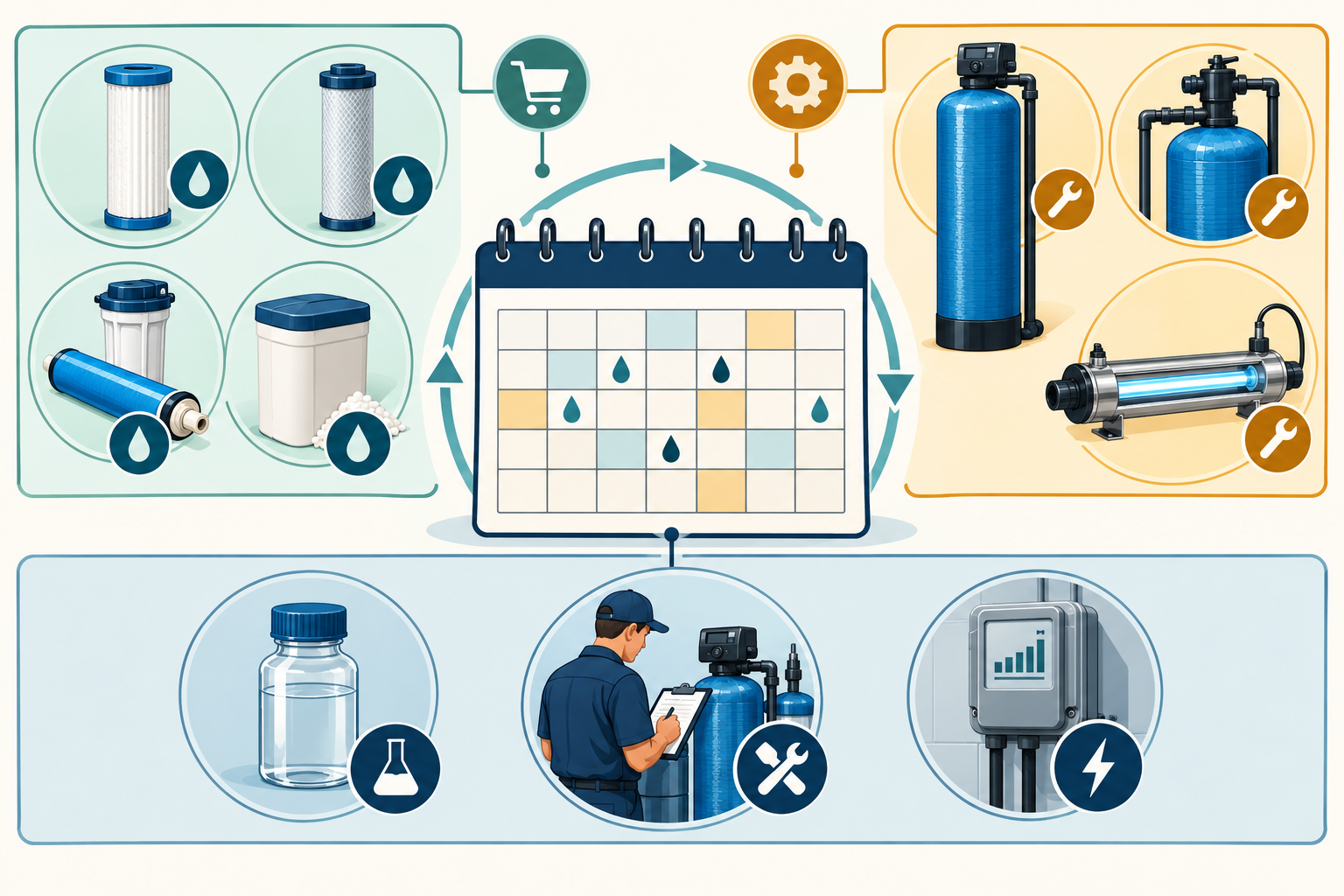
Build a maintenance calendar from the equipment
Record each stage, its purpose, its model, its consumable, its replacement signal, its service requirement, and its test point. A cartridge may be changed by pressure drop, a UV lamp by the manufacturer’s interval or alarm, an RO membrane by performance or service schedule, and a media tank by a chemistry- and use-dependent plan. Do not substitute one generic annual interval for all systems.
Keep a reserve for the failure that interrupts the most important use. A low-cost cartridge is not the main risk if a controller, booster, pressure tank, or dedicated circuit can stop the treatment train. Ask whether parts are locally available, whether a bypass is safe for the actual water result, and what temporary supply is needed during service.
Recalculate after the water changes
A new well, rehabilitation, flood, casing repair, pump change, household addition, irrigation demand, or land-use change can alter raw-water chemistry and flow. Re-test and review the treatment design rather than assuming the old maintenance calendar still fits. The cost of a verification sample can be small compared with replacing a membrane or media that was selected for the wrong water.
Turn service records into a replacement decision
Service history is useful when it shows a pattern, not just a list of purchases. Track which stage was serviced, the raw-water or treated-water result, pressure or flow symptoms, reason for replacement, labor, and the next failure or replacement signal. Frequent cartridge changes may point to sediment or source conditions; repeated controller, booster, or alarm problems may justify pricing a component replacement or redesign. Do not treat a single service event as proof that the whole train needs replacement.
Compare the cost and reliability of replacing the exhausted stage with replacing adjacent components that are already near the end of their serviceable life. Include access, shutdown time, temporary water, testing, and whether parts remain available. A complete system replacement may be justified when the treatment objective, water chemistry, or equipment has changed, but a narrower repair may preserve useful equipment. The maintenance record lets the provider explain that boundary instead of defaulting to either the cheapest part or the largest package.
Before authorizing a replacement, ask for the evidence that the proposed scope changes: an altered water result, repeated failures, unavailable parts, declining treated performance, or an ownership cost that no longer makes sense. If the treatment objective has not changed and one stage is exhausted, replacement of that stage may be enough. If the source or household demand has changed, redesign and fresh testing may matter more than like-for-like equipment.
Make ownership cost visible before installation
Ask for a five- and ten-year schedule that separates consumables, professional labor, testing, electricity, water use, disposal, and major component replacement. Show low, expected, and difficult cases when the interval depends on raw-water chemistry or household demand. The purpose is not to predict a precise annual total; it is to expose the cost that can make an inexpensive installation unaffordable to operate.
Tie every recurring item to a measurable signal: a pressure change, lamp alarm, media exhaustion, treated-water result, manufacturer interval, or service inspection. If the system has no practical way to show that it is still performing, include a design or verification step before accepting the equipment. A treatment system is economically complete only when the owner can maintain and check it over time.
Track the date, part or media changed, reason for service, water result, pressure or flow symptom, provider, and next due date. A calendar that records only purchases cannot show whether maintenance is preventing failures. Repeated emergency visits, declining performance between scheduled changes, or unavailable parts may justify comparing a different technology or a source correction.
When comparing a replacement, include the remaining life of adjacent equipment. Replacing a cartridge housing while a controller, booster, or pressure tank is already unreliable can create repeat labor. Conversely, replacing a complete train may be wasteful if one exhausted stage is the only problem. The maintenance history supports a narrower and more defensible scope.