
A water softener is a treatment system for hardness, not a universal well-water filter. Current US specialist pricing places installed softener projects in a broad market range that varies with capacity, plumbing, controls, drain, labor, and equipment; the available evidence does not establish a Canada-wide price. The right budget includes the softener, loop and bypass, drain and power, salt or potassium, service, testing, and eventual control or resin replacement.
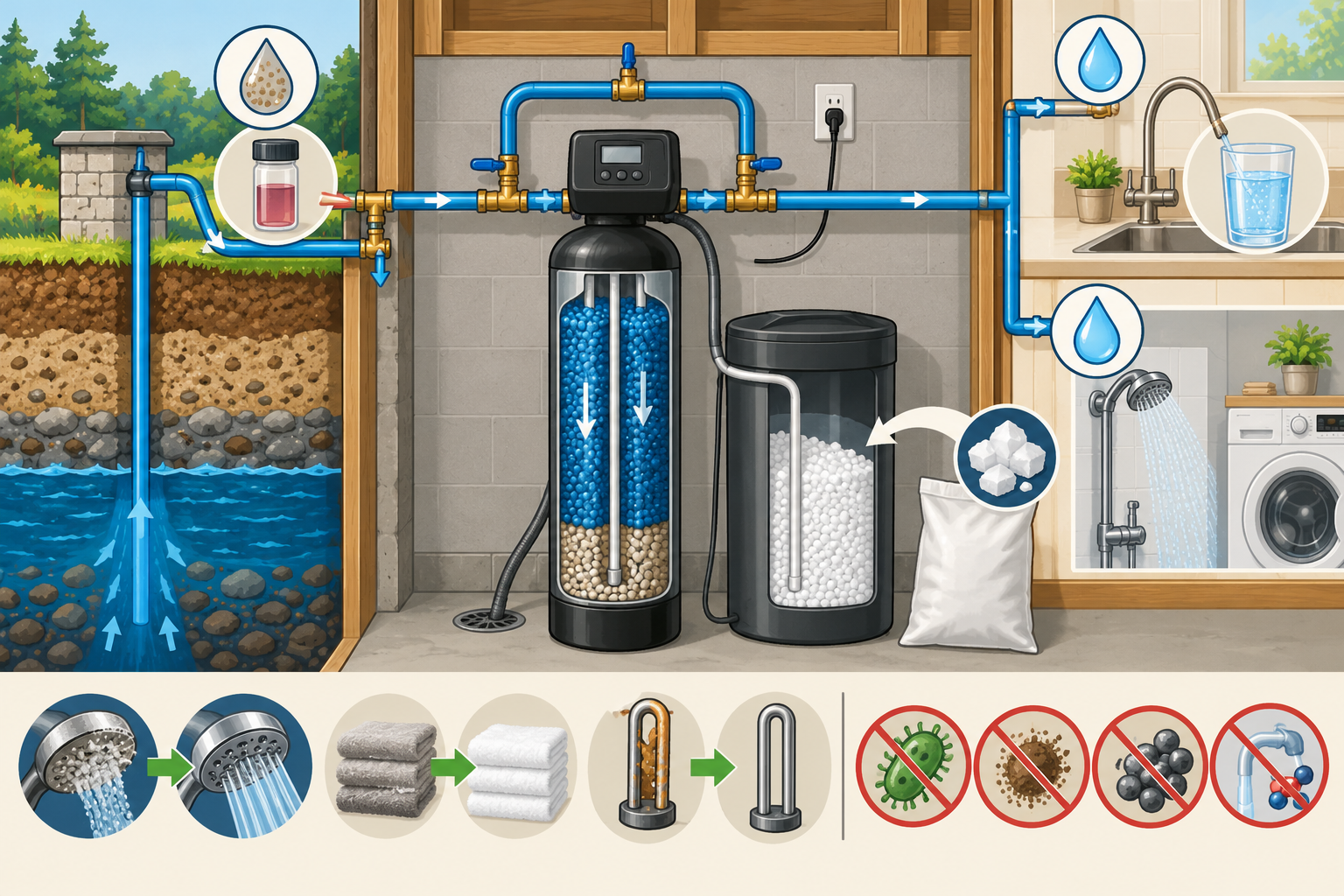
Test hardness before buying
Hardness should be measured rather than inferred from scale alone. Iron, manganese, sediment, low pH, sulfur, and other chemistry can create overlapping symptoms but require different treatment. Health Canada lists NSF/ANSI 44 softeners as a certification category for hardness from calcium and magnesium and notes the sodium implication; NSF also emphasizes that certification is claim-specific.
A sales recommendation based only on household size or a stained fixture can oversize, undersize, or misapply the equipment. Test the raw water and state the target: reduce scale, protect appliances, improve laundry, or address another documented problem.
What controls the installed cost
Capacity and flow rate must match the hardness load and household demand. Higher capacity can mean a larger tank, control valve, resin volume, and price, but it does not automatically solve every pressure or water-quality issue. Installation may require a bypass loop, drain, electrical outlet, shutoffs, brine tank, floor protection, and changes to the main line.
Access, distance to the entry point, unfinished versus finished space, freeze exposure, and relocation of plumbing can matter as much as the equipment label. A quote should show whether the kitchen cold tap or another drinking-water outlet bypasses the softener when sodium or taste is a concern.
Salt and operating cost
Ion-exchange softeners regenerate, using salt or an alternative regenerant and water to rinse the media. Consumption depends on hardness, household use, capacity, control settings, and equipment efficiency. Price the consumable from actual expected use rather than one generic annual number. Include electricity and any drain or wastewater arrangement where relevant.
Salt-free conditioning products are not automatically equivalent to a softener. Compare the treatment claim and intended outcome rather than treating all products under the word “softener.”
Maintenance and replacement
Maintenance can include replenishing salt or potassium, checking controls and brine equipment, cleaning or servicing, correcting leaks, and replacing resin or valves when the equipment reaches the end of its useful service. The intervals and parts depend on the specific model and raw water.
If the water has iron or manganese, the softener may be a limited or conditional solution. A dedicated oxidation or filtration stage may be needed, increasing upfront and lifecycle cost. If low-pH water is attacking plumbing, the corrosion problem may need a separate neutralization and plumbing-repair decision.
Three project cases
Hardness-only installation: The test confirms hardness, flow and capacity are clear, plumbing and drain are nearby, and the quote includes bypass, commissioning, and a maintenance plan.
Hardness plus chemistry: Iron, manganese, sediment, or low pH requires pretreatment or another system. Compare the treatment train and verify what the softener is—and is not—expected to do.
Replacement: An old control valve, brine tank, resin bed, or leak fails. Compare the repair with a new system using future salt, service, efficiency, and compatibility, not only the replacement part.
Quote checklist
- What measured hardness and water use support the capacity?
- What flow rate and pressure assumptions apply?
- Is the bypass, drain, electrical supply, plumbing loop, and disposal included?
- Which taps bypass treatment and why?
- What salt or potassium use is expected under stated demand?
- What happens if iron, manganese, sediment, sulfur, or low pH is also present?
- Which certification and contaminant claim applies to the exact equipment?
- What are the service, resin, control, and replacement costs?
US specialist price orientation should not be converted into CAD. Canadian installation, salt, plumbing, and local water guidance vary. A softener is worth paying for when tested hardness makes scale reduction valuable and the full ownership cost is acceptable; it is not a substitute for diagnosing every well-water symptom.
Price the capacity decision honestly
The useful comparison is hardness load and peak flow against the proposed capacity and regeneration settings. A unit that is too small may regenerate often, use more consumable, and create pressure or service complaints. A unit that is too large may cost more without improving the household’s result. Ask the installer to show the assumptions rather than accepting a capacity label as proof of correct sizing.
If the system is replacing an old softener, compare the repair, resin or control replacement, and new-equipment options. Include removal, disposal, plumbing changes, brine-tank condition, and the value of a newer control strategy. If a household has changed demand or added treatment, the old size may no longer be appropriate.
Protect the drinking-water decision
A softener’s sodium and regeneration discharge need to be considered with the household, plumbing, and local wastewater context. A bypass for selected drinking-water outlets may be part of the design, but the correct arrangement is property- and guidance-specific. Do not use a softener to solve a health-sensitive contaminant unless the exact certified claim supports that use.
Compare the installed system, not the tank
Two softener quotes can differ because one includes a plumbing loop, bypass, drain, electrical work, startup settings, removal, and disposal while the other prices only a tank and control valve. Ask where the system sits relative to the pressure tank and treatment train, whether it can be serviced without shutting down the home, and what happens to untreated water during regeneration or maintenance.
For a long-term owner, calculate salt or potassium, regeneration water, electricity, service, resin, control-valve repair, and eventual replacement. For a household with changing demand, ask whether the controls measure use or rely on a fixed schedule. These details affect operating cost without proving that one brand is universally better.
If hardness is accompanied by iron, manganese, sediment, sulfur, or low pH, compare a treatment train with source investigation. A softener may improve one symptom while leaving the cause or another contaminant untouched.
Set the result before accepting an upgrade
The quote should state whether the goal is scale reduction, appliance protection, laundry performance, or another defined outcome. If the proposed system also claims to address iron, manganese, sediment, or taste, require a separate explanation and matching evidence for each claim. This keeps a softener upgrade from becoming an unpriced substitute for a treatment train.
Include the household’s operating burden
Capacity is an operating decision, not just a tank-size choice. Ask how the system responds to peak demand, regeneration, power loss, salt delivery, drain requirements, and a household that is vacant for part of the year. A lower equipment price may be offset by frequent salt purchases, difficult access, or pressure loss if the design load is wrong. A larger unit may reduce service frequency but can be wasteful if the water use is low.
If the owner is comparing a softener with a broader treatment system, separate hardness reduction from contaminant removal. Confirm what will be tested at the inlet and outlet and what the system does when it is bypassed. The result should be a quote tied to a water problem and a service routine, not a generic promise that “softened” means safe or fully treated.
Price the maintenance boundary
Ask who supplies salt or potassium, who services the control valve, how regeneration water is routed, and what happens when the system is bypassed or the home is vacant. A seasonal property may need a different operating and restart plan from a full-time home. A treatment quote should state whether routine cleaning, settings checks, resin or valve work, and verification are included or left to the owner.
The softener should also be priced alongside the water problems it does not solve. Iron, manganese, sulfur odor, sediment, low pH, and health-sensitive contaminants may require other testing or treatment. If those conditions are present, the cheapest softener can be the wrong first purchase. The useful comparison is hardness result → certified or otherwise supported treatment objective → installation boundary → recurring operating work, not tank price alone.