
Current US specialist pricing places installed residential RO around $1,000–$4,800, with point-of-use systems generally below whole-house applications. That range is broad because an under-sink drinking-water system and a whole-house point-of-entry system are materially different projects. RO is not automatically the best solution for every well result; testing, pretreatment, pressure, certification, plumbing, reject water, and maintenance decide the economics.
What RO does
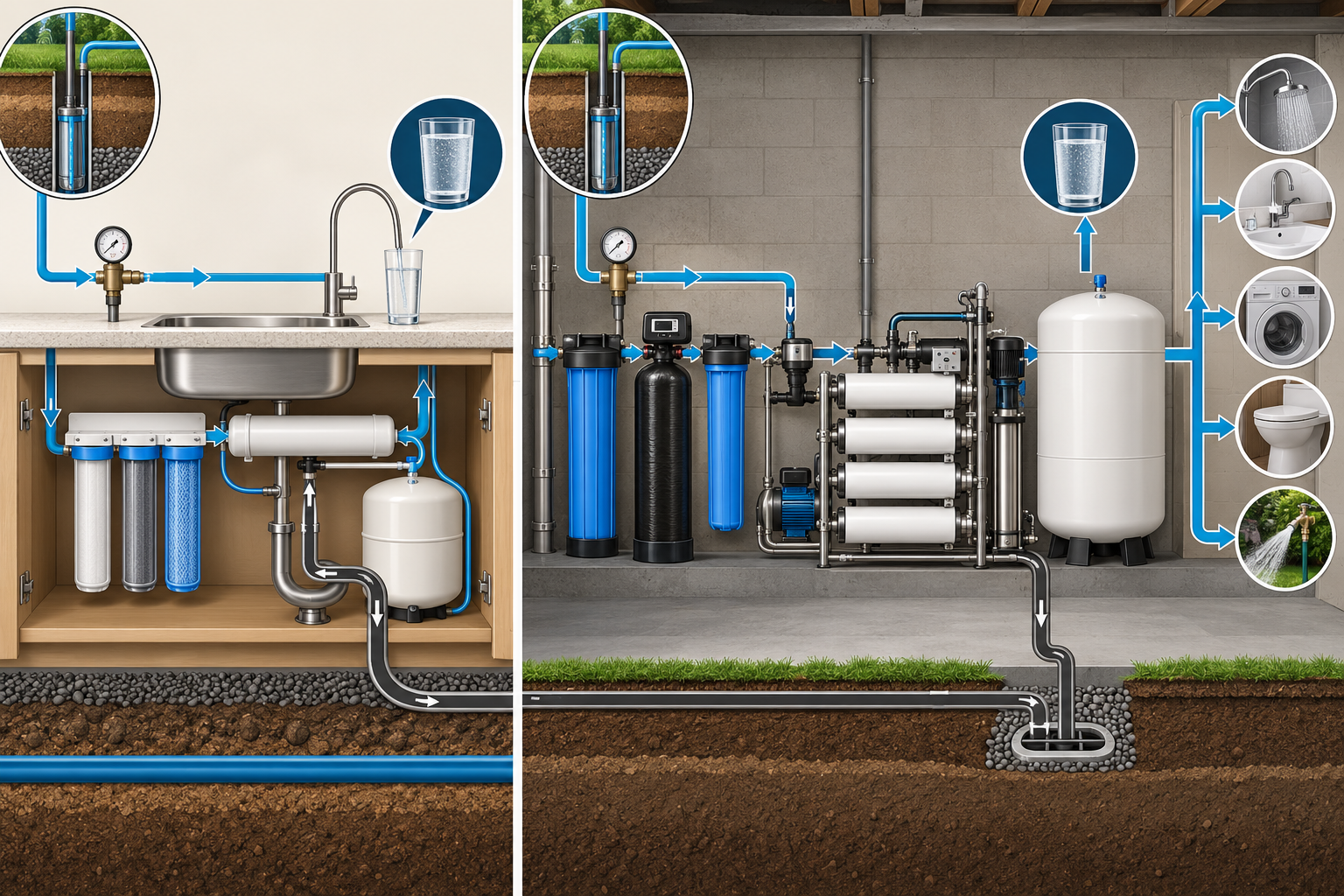
Reverse osmosis uses a membrane and pressure to separate part of the dissolved material from a feed stream. A typical system also uses prefilters, a storage tank or controlled delivery, a treated-water outlet, and a reject or concentrate stream. The exact reduction claim must be checked against the contaminant and the equipment’s certification.
NSF identifies NSF/ANSI 58 as the relevant RO certification context but warns that certification is claim-specific. A product described as “RO” is not proof of reduction for arsenic, nitrate, PFAS, or another target. Test the raw water first.
Under-sink versus whole-house
An under-sink or other POU system treats a limited flow for drinking or cooking. It may need a dedicated faucet, storage tank, drain connection, filters, membrane, and sufficient pressure. The lower water volume can make it economical when the objective is confined to selected outlets.
Whole-house RO treats incoming water and can require substantially larger membrane capacity, pretreatment, pumps, storage, plumbing, drains, and maintenance. It also processes water for uses that may not need RO. A whole-house system can be justified for a system-wide objective, but it should not be chosen merely because the label sounds more complete.
Main cost drivers
- contaminant and required certified reduction;
- feed-water chemistry and pretreatment;
- flow rate and peak demand;
- membrane capacity and recovery;
- feed pressure and booster requirements;
- storage tank, controls, and distribution;
- prefilters, postfilters, remineralization if specifically justified;
- drain or reject-water connection;
- plumbing, electrical, access, and installation;
- filter, membrane, electricity, water-use, service, and verification costs.
Pretreatment is often the difference between a simple product installation and a well-water project. Sediment, hardness, iron, manganese, low pH, or other chemistry can shorten membrane life or reduce performance. The quote should state which stage protects the membrane and how often it is serviced.
Reject water and operating cost
RO produces a treated stream and a reject stream. The ratio depends on the equipment and operating conditions. Ask how reject water is routed, whether the drain can accept it, and what the water and energy cost is. Whole-house systems can make this issue much more material than a POU unit.
Filters and membranes need replacement. Actual intervals depend on the raw water and use, not only the calendar. Include prefilters, membrane, storage sanitation or service, electricity, booster-pump service, and treated-water testing in the ownership comparison.
Pentair’s PRF-RO manual provides one point-of-use example: it recommends changing the prefilter every six to twelve months depending on water use and impurities, changing the postfilter with it, and replacing the membrane every two to four years for most point-of-use applications, with life dependent on feed-water quality. The manual also calls for periodic product-water testing and model-specific sanitation when elements are replaced. These intervals and service requirements apply to the named PRF-RO, not all RO systems, and the manual does not provide current parts or labor prices.
When another technology may fit better
A softener addresses hardness, not every dissolved contaminant. A sediment filter addresses particles, not dissolved health contaminants. UV addresses a microbial treatment objective, not dissolved chemicals. Carbon, ion exchange, or other systems may be more appropriate for specific results. The point-of-use versus whole-house decision should be made with the contaminant, exposure, flow, and certified claim in view.
Three scenarios
One drinking-water result: A certified POU RO system with appropriate pretreatment, faucet, drain, and verification may be the lowest total-cost path.
Multiple whole-home problems: RO may be only one stage in a treatment train, with pretreatment and a separate system for hardness, sediment, or microbes.
Over-scoped proposal: A whole-house RO system is proposed without a test result, flow analysis, reject-water plan, or certified target. Obtain a second design and keep the untreated uses and lifecycle cost visible.
Quote checklist
- Which measured contaminant and concentration support RO?
- What exact NSF/ANSI 58 or other claim applies?
- Is the system POU or POE, and which outlets receive treated water?
- What feed pressure, booster, storage, drain, and reject assumptions apply?
- What pretreatment is required?
- What are the filter, membrane, electricity, water-use, service, and testing costs?
- How will treated water be verified?
The US range is context, not a CAD conversion. A responsible RO quote buys a specific certified treatment objective and describes its pressure, plumbing, waste, and maintenance consequences. It does not treat “well water” as one contaminant.
Compare RO against the water problem
RO is often attractive because it is familiar, but familiarity is not a treatment match. If the result is hardness, a softener may address the operating goal with less reject water. If the result is particles, a sediment system may be the relevant stage. If the result is microbial, UV or source correction may belong in the decision. A mixed system can use RO for a narrow dissolved-contaminant objective while using another stage for the rest of the water.
Ask how pretreatment changes the economics. Sediment, iron, manganese, hardness, and low pH can shorten filter or membrane life or require another system. Include the cost of the inlet test, pretreatment, storage, faucet or main-line plumbing, drain, booster, filters, membrane, and outlet testing. A product-only quote is not a complete well-water RO budget.
A useful ownership threshold
POU RO can make sense when the household uses a defined treated outlet consistently and replacement is easy. Whole-house RO needs a stronger reason because it treats high volumes and creates a larger pressure, reject, service, and energy obligation. Revisit the scope when demand, water chemistry, or household use changes. The best design minimizes untreated exposure or operating damage without paying to process water that does not need RO.
Put the maintenance burden in the comparison
Ask who will change prefilters, monitor pressure and storage, service the membrane, and handle the reject stream. A POU system may be easy to access but still fail to protect another drinking-water outlet. A POE system may simplify outlet coverage while making a clogged prefilter, booster failure, or drain problem a whole-house event. These are ownership tradeoffs, not just installation details.
Separate the purchase from the water-system work
Have the quote identify the raw-water result, membrane and prefilter stages, feed pressure, storage, drain, reject route, treated outlets, and verification sample. A whole-house system may need a booster and a larger treatment train; a POU system may need a faucet and user discipline. If the proposal does not state those boundaries, the equipment price cannot be compared with an installed total.
The decision is ready when the RO claim matches the test, the pressure and reject-water plan works, and the filters and membrane can be replaced at a known cost. If one of those conditions is unresolved, spend on testing or design rather than buying a generic unit.
Compare water use with treatment coverage
Point-of-use and whole-house systems differ both in where treated water is available and in how much feed water is processed. A point-of-use system concentrates treatment at selected outlets, while a point-of-entry system treats the incoming supply. The quote should state the treated outlets, expected use, reject-water handling, and the water or energy assumptions behind the design. Do not compare a point-of-use equipment price with a whole-house installed scope as if they deliver the same coverage.
A household may choose point-of-use RO for a defined drinking or cooking objective, but only if the relevant outlets are identified and used consistently. Whole-house RO may provide broader coverage but can add flow capacity, pretreatment, storage, a booster, drainage, and larger consumable exposure. Ask whether the system’s recovery and reject assumptions are based on the actual model and operating conditions, then put that ongoing cost beside the coverage it buys.
This distinction matters during service as well as installation. A point-of-use failure may leave other household outlets available while the treated tap is offline; a point-of-entry failure can affect the entire supply. Include shutoffs, bypass conditions, temporary water, service access, and verification in the ownership comparison. The appropriate scope is the one that addresses the tested water problem and can be maintained at the outlets that matter.
Make the RO result verifiable
The handoff should state the raw-water result, the certified reduction claim, treated outlets, feed pressure, recovery or reject assumptions, pretreatment, sample points, and replacement signals. A product’s general RO label does not answer whether the installed system performs for the contaminant in this well. Testing the inlet and outlet is part of the economic scope when the treatment objective is consequential.
The design should also say what happens when the membrane, prefilter, booster, storage tank, or drain is unavailable. A POU system may leave one outlet protected while another remains untreated; a POE system may interrupt every outlet during a service event. Comparing those failure boundaries helps the homeowner choose coverage that can actually be maintained.
POU RO usually limits treated water to a defined faucet, which can reduce equipment and operating cost but depends on household behavior. Whole-house RO treats a much larger flow and may require pretreatment, storage, a booster, drainage, and a downstream conditioning or remineralization decision. A proposal that uses the word “RO” without identifying the treated outlets is not yet a comparable scope.
Include the cost of rejected water, filter and membrane changes, service access, leaks or shutoff protection, and temporary use during maintenance. If the raw-water issue affects only drinking and cooking, a POU system may be the more proportionate choice. If the concern is broader, price the added coverage explicitly rather than assuming the largest system is automatically better.