
A low-yield well does not necessarily need a new pump or a new hole. First establish that the source cannot sustainably meet demand, rather than confusing low yield with low pressure, a leaking pipe, a failed control, or a damaged pump. Penn State Extension describes yield as the maximum sustainable pumping rate without drawing water below the pump intake and notes that a well may produce enough daily volume yet fail during peak demand.
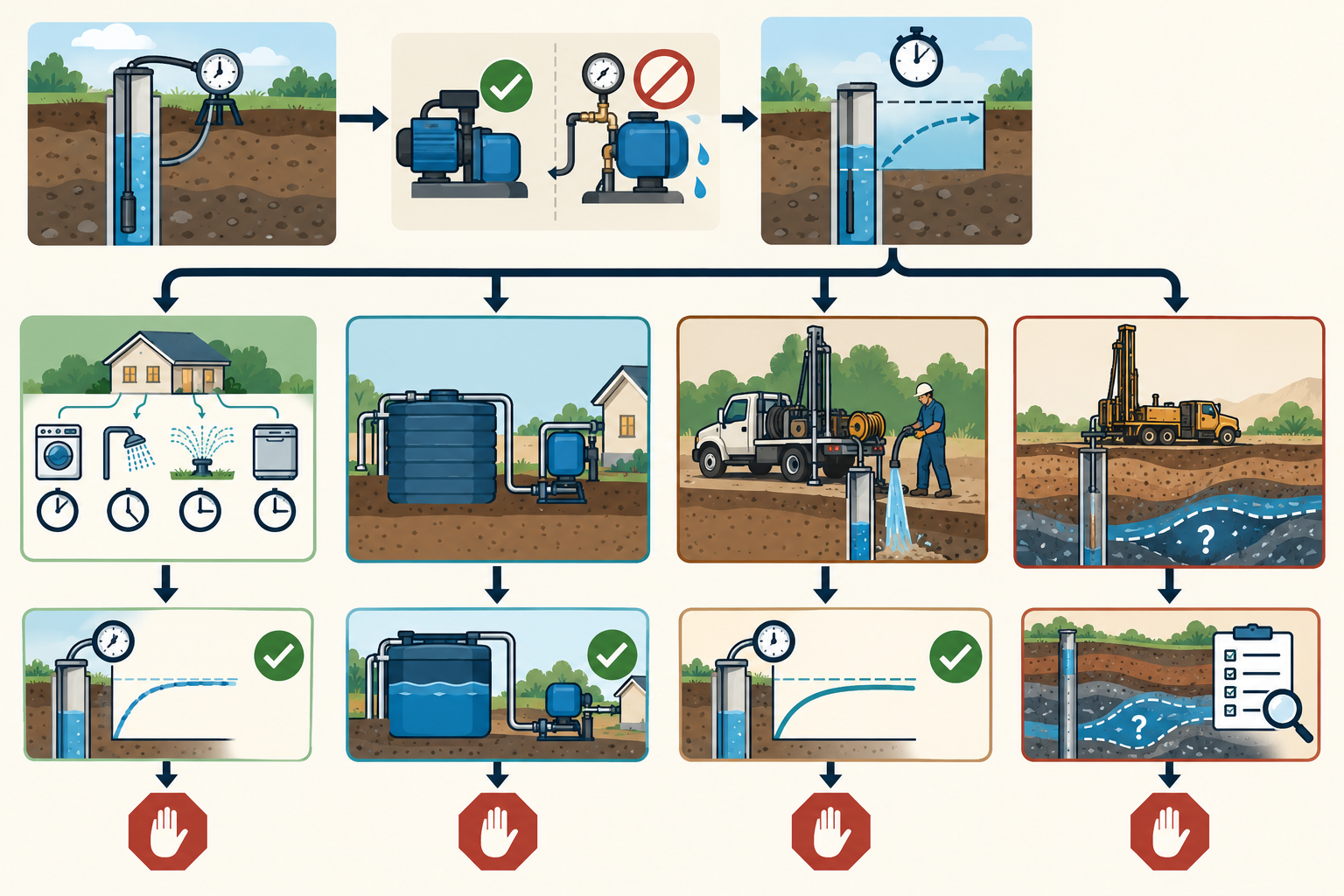
Confirm the problem
Compare the household’s demand pattern with the well’s measured production and recovery. A drought or seasonal water-level change can make a previously adequate source appear to fail. A restriction or pump problem can imitate low yield. A professional inspection, flow or yield assessment, and review of records are more useful than choosing an intervention from a single dry tap.
Do not use one universal gallons-per-minute pass/fail rule. Adequacy depends on the well, storage, pump design, household demand, local practice, and the duration of the test. A theoretical one gallon per minute can produce 1,440 gallons in a day, but that does not make peak showers and laundry available at the same moment.
The main options
Manage demand and controls
Low-cost changes can include reducing simultaneous demand, correcting leaks, adjusting schedules, or improving controls where professionally appropriate. This does not improve the source, but it can avoid a capital project when the shortage is mostly a timing problem. Do not let demand management hide a worsening well or contamination concern.
Add storage
A reservoir or cistern can collect water at the well’s slower production rate and feed a booster or pressure system during peak use. It is often the clearest response when the source produces enough over time but not enough at the moment of demand. Cost includes a potable tank, controls, pump, plumbing, site work, freeze protection, electrical supply, sanitation, and maintenance.
Storage adds equipment and a second pumping stage. It needs space, monitoring, overflow and drainage planning, and a design that protects water quality. Compare the installed and ownership cost with the value of avoiding a new well.
Rehabilitate the existing well
Mineral incrustation, biofouling, sediment plugging, sand pumping, casing or screen corrosion, pump damage, drought, and over-pumping can contribute to declining performance. Rehabilitation is a professional attempt to restore or maximize flow after diagnosis. Penn State guidance identifies a yield decline of about 25% or more as a signal to consider rehabilitation, but that is guidance, not a universal threshold.
Rehabilitation can be sensible when the cause is correctable and the well construction is suitable. It can be poor value when the source formation is inadequate, casing damage is extensive, or the work merely delays a replacement decision. The outcome is not guaranteed; price the diagnosis and post-work verification.
Deepen or enhance the well
Deepening or regionally applicable enhancement methods attempt to reach or open a different water-bearing path. Geology, existing casing, borehole condition, access, local rules, and equipment determine whether the work is feasible. A deeper source may improve production, do nothing, or change water chemistry. Do not present hydrofracturing or deepening as a guaranteed fix.
Drill a replacement well
A new well can change the siting and construction choices, but it carries depth, geology, access, mobilization, yield, testing, pump, connection, and potential abandonment costs. A new location may improve the design options, or it may encounter the same formation constraints. The driller should state how dry or low-yield outcomes are handled.
Compare total decision cost
Use the same time horizon for each option:
- diagnosis and testing;
- construction or equipment;
- electrical, trenching, access, and restoration;
- treatment or storage created by the option;
- annual energy, service, and consumables;
- future pump or tank replacement;
- failure, repeat-work, and contingency exposure;
- old-well closure where applicable.
The cheapest upfront path can be expensive if it repeatedly fails during drought. The most expensive path can be wasteful if storage solves a peak-demand mismatch. The right comparison may be a staged plan: measure, manage demand temporarily, add storage, and preserve the option of a new source if results remain poor.
Water quality can change with the solution
Rehabilitation, deepening, and a new well can change the raw water that reaches the home. Test after a source intervention and before selecting treatment. A treatment system designed for the old water may not fit the new chemistry, flow, or contaminant profile. Source correction and downstream treatment are different economic paths.
If a drought or shortage has left the well partly or fully dry, separate recovery of production from the decision to drink the water. Nova Scotia advises owners to test before resuming drinking after a dry-well event and identifies bacteria as a minimum in that jurisdiction; Health Canada gives national Canadian emergency context. These are not a universal US or Canadian panel. Include temporary water and locally directed follow-up testing as separate costs, then measure yield and recovery before comparing storage, rehabilitation, deepening, or a new source. A regional drought map cannot predict an individual well’s recovery.
Decision checklist
- Is the shortage measured under conditions relevant to the household?
- Have pump, pressure, leak, and electrical causes been separated from yield?
- Is the issue seasonal or persistent?
- Can storage bridge production and peak demand?
- Does diagnosis identify a correctable well-condition problem?
- Is deepening technically feasible and what happens if yield does not improve?
- What is included in a replacement-well and old-well-closure quote?
- What water testing and treatment may follow each option?
US and Canadian economics cannot be combined through currency conversion. Remote travel, geology, local rules, and equipment markets matter. Obtain a local professional comparison with visible assumptions and no promised success rate. A low-yield decision is resolved when the source problem, timing problem, intervention risk, and ownership horizon are all on the same page.
Stage the decision instead of betting on one remedy
The safest economic sequence is often to pay first for measurements that separate pressure failure from source failure, then choose a reversible response while the larger options are priced. Demand management or storage can preserve service while the owner investigates rehabilitation or drilling. A staged plan is not indecision if each stage has a result that determines the next authorization.
Compare the options using the same service objective. “Enough water” may mean domestic use only, domestic use plus irrigation, or seasonal occupancy. If irrigation, livestock, or multiple dwellings shares the source, remove that demand from the household comparison or identify it explicitly. Otherwise a source may appear to fail because the quote is solving a larger use case than the homeowner realized.
What to put in competing proposals
Ask for measured yield and recovery, the demand assumption, the source and equipment diagnosis, access and mobilization, installation, testing, water-quality changes, treatment consequences, and failure handling. For storage, show the buffer and booster. For rehabilitation, show the pre- and post-work measurement. For deepening or new drilling, show the stop point and old-well closure. A proposal that cannot state its uncertainty is not a true alternative.
Define the service level before sizing a remedy
“Adequate supply” should be written in terms of the use the project must serve. A full-time household with ordinary domestic demand has a different objective from a seasonal cabin, a property with irrigation, livestock, or more than one dwelling. Identify which uses are essential, which can be scheduled, and which should be excluded from the source comparison. Otherwise every option can look inadequate because the proposal is quietly solving a larger problem than the household intended.
Separate source capacity from equipment capacity in the proposal. A larger pump can move water faster only when the well, water level, pipework, and pressure system support that operation. Storage can bridge timing but adds a vessel, controls, a booster, space, sanitation, and another maintenance exposure. Rehabilitation can restore a correctable well condition but cannot create a water-bearing formation. A new well changes the construction opportunity but not the uncertainty of geology or yield.
Set a decision point for each option: the measured result, the follow-up test, the maximum spend, and the next path if the result is not achieved. That approach turns an uncertain source problem into a sequence of bounded purchases and preserves the owner’s ability to stop before a weak remedy consumes the replacement budget.
Treat demand changes as part of the source decision
The correct solution can change when the household adds bedrooms, irrigation, livestock, or a second dwelling. Ask the provider to model the use that exists now and the use that is likely within the ownership horizon. Storage or scheduling may solve a domestic peak while leaving irrigation unsatisfied; a new source may be unnecessary if the larger demand can be isolated or reduced.
Keep water quality in the comparison as well. A source intervention can change chemistry, and storage adds a vessel and another maintenance point. Before authorizing a capital remedy, identify the follow-up test, the useful result, the failure exposure, and the temporary-water plan. That makes the decision measurable even when no provider can promise a yield outcome.