
“Pump repair” can mean a small pressure-side service, a control replacement, an electrical or pipework interface, or work that requires pulling a deep pump from the well. That is why a service-call estimate is more useful when it explains the access threshold and the replacement alternative. Current US specialist pricing treats pump repairs as a broad range shaped by the fault, labor, depth, and whether the pump must be removed; it is not a fixed fee schedule or a Canadian benchmark.
What counts as a repair
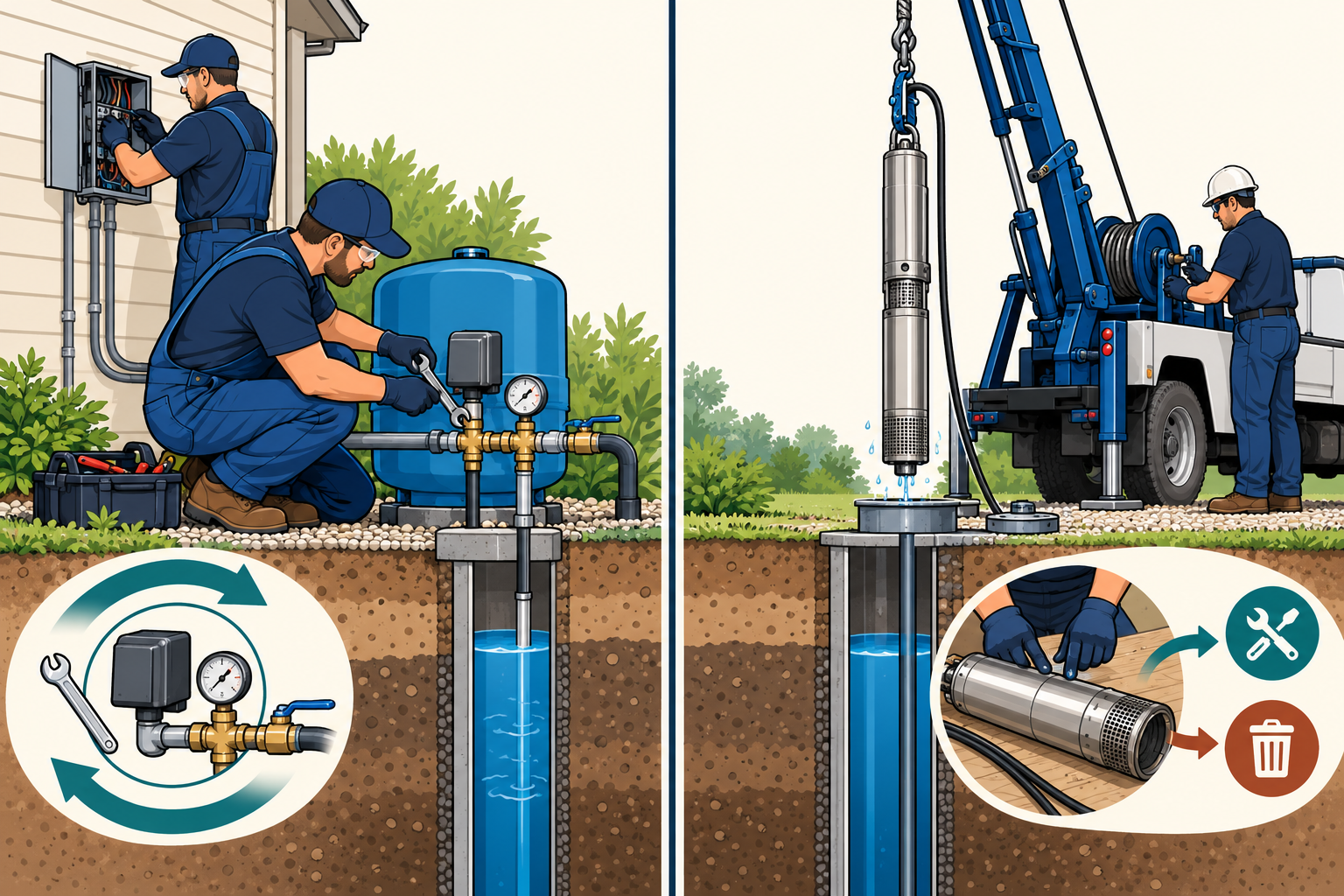
Repair is most clearly defined when the intervention leaves the main pump in place or replaces a repairable associated component. Examples can include a pressure switch, controller, gauge, valve, accessible connection, or a diagnosed wiring interface. The exact components depend on the pump type and system design.
The line becomes less clear when the pump must be pulled. A technician may inspect and repair a submersible pump, but the labor, risk, age, parts availability, and warranty implications can make a new pump a better economic comparison. Ask the provider to price the diagnosis and the pull separately if that point is uncertain.
Typical cost structure
A repair invoice may contain a call-out or emergency fee, diagnostic labor, replacement components, pump-system labor, electrical work by a separate trade, pipe or fitting work, testing, and disposal. Travel is material for rural and remote properties. The most useful quote shows what is known before opening the system and what remains conditional.
The equipment price is often not the main uncertainty. A low-cost control part is not a low-cost repair if the technician must make a second trip or if a hidden pump fault remains. Conversely, a high-quality component does not justify replacing the entire system when the diagnosis identifies a focused, accessible fault.
Main repair categories
Controls and pressure switch: A switch or controller can affect pump starting and stopping. Settings and compatibility should be handled by a qualified technician because incorrect pressure behavior can damage equipment or create unsafe conditions.
Accessible valves, gauges, and fittings: Leaks, restrictions, failed gauges, or corroded manifolds can mimic a pump problem. Replacing them can be a focused job, although poor access, frozen fittings, and adjacent pipework can expand the scope.
Electrical interface: A damaged cable, connection, breaker, or control component may require both well-system and electrical expertise. The well-pump article can describe the cost boundary; it is not a substitute for safe line-voltage diagnosis.
Pump-side repair: A motor or pump fault may require removal, bench diagnosis, repair, and reinstallation. Compare the full labor and risk against a new pump, especially where the well is deep or the equipment is difficult to service.
Pipework or leak: A break in the drop pipe or a leak on the pressurized side can reduce pressure while the pump continues to operate. The affected location and access determine whether this is a small plumbing repair or a pump-pull project.
Why depth changes the decision
Shallow and accessible equipment is easier to diagnose and remove. A deep submersible pump carries more labor for pulling, more drop pipe and cable to handle, and more consequence if the repair fails and the system must be opened again. Remote access, landscaping, frozen ground, a buried wellhead, or a narrow mechanical room can add staging and restoration.
This creates a practical threshold: compare repair with replacement using the total installed scope, not the price of the part. If a repair uses much of the labor required for replacement and leaves old components in service, the cheaper invoice may have the higher repeat-work risk.
Repair or replace?
Repair tends to be easier to justify when the fault is verified, the main pump remains accessible, compatible parts are available, the system has a good performance history, and the work does not require a costly pump pull. Replacement deserves a closer comparison when the pump is already removed, failure has repeated, the equipment is obsolete, the source or pressure design has changed, or warranty and future service favor a new system.
Do not use age alone as a universal replacement rule. Ask what failed, what remains original, whether the proposed repair restores the same capacity, and what labor would be repeated if another component fails. If low yield, contamination, or casing damage is involved, pump repair is not the full decision.
Three scenarios
Focused service: A technician confirms an accessible control, valve, gauge, or connection issue. The bill is diagnostic labor, a defined component, installation, and a system test.
Pull-versus-replace decision: The pump must be removed to establish the fault. Compare repair bench work, reinstallation, new components, testing, and the risk of a second pull with a complete replacement quote.
Wrong problem: The pump operates, but the source recovers slowly or the household demand exceeds production. A pump repair may not improve the supply. Move to yield testing and low-yield options instead.
Questions for a repair quote
- What observation supports the diagnosis?
- Is the pump staying in place, or is a pull required?
- Which components are being replaced and which remain in service?
- Are electrical, pipe, access, travel, and disposal costs included?
- What is the total if the pump cannot be economically repaired?
- Does the repair change capacity, pressure, controls, or treatment compatibility?
- What testing confirms the system after work?
Emergency work may cost more because of mobilization, temporary water needs, and parts availability. A scheduled visit can improve diagnosis but may not be appropriate when a leak, flood, contamination concern, or property-damage risk is active.
US and Canadian context
The available repair observations are US specialist market data. Canada may differ in labor, travel, equipment, and seasonal access. Request a local CAD quote and have the provider identify whether the figure is a service-call allowance, a repair total, or a complete pump-system intervention. A defensible repair decision is one where the fault, access, repeat-work exposure, and replacement alternative are visible.
Use a staged authorization
When the cause is not visible, authorize diagnosis and safe access first, then set a limit for repair or replacement. Ask how the provider bills if the fault is found in the controls rather than the pump, or if a component cannot be removed without a pump pull. This prevents a service call from turning into an open-ended sequence while still allowing the technician to respond to the actual failure.
The quote should distinguish parts that are being replaced because they failed from parts being upgraded for compatibility or convenience. Replacing a corroded fitting while the system is open may be sensible; replacing every pressure component without explaining its condition makes the repair impossible to compare. Request the expected post-repair pressure, flow, and operating test rather than a promise that the symptom will disappear.
Separate accessible repairs from pump-pull exposure
The largest economic boundary is often whether the provider can reach the failed part without pulling the pump. A switch, gauge, controller, valve, or visible connection may be a contained service scope. A fault that requires removing a deep pump can add lifting equipment, labor, cable or pipe risk, access work, and a second decision about whether the pump should be repaired or replaced. Ask for those as separate branches rather than accepting one blended “repair” allowance.
The quote should identify the evidence behind the repair, the parts being reused, and the test that will confirm the result. If a control replacement changes pressure settings, verify that the tank, pump, treatment equipment, wiring, and backup-power interfaces remain compatible. If the pump is pulled, request a record of the condition found and the equipment returned or replaced. That record can prevent the next provider from repeating the same diagnostic work.
Repair is also an ownership decision. A lower-cost part may be sensible for a documented, serviceable system with available support. It may be false economy when the same labor is difficult to repeat, the component is obsolete, or the repair leaves an unresolved source or low-yield condition. Compare the repair total, expected service result, warranty, and repeat-visit exposure with a complete replacement quote on the same system boundary.
Repeat-work economics
The relevant comparison is repair total plus the chance of another pull or service visit versus a complete replacement total. A repair can be the right choice when it preserves a well-documented, serviceable system. It can be the wrong choice when the pump is already out, the fault is uncertain, parts are obsolete, or a second failure would repeat the most expensive labor. Do not turn this into a rigid age rule; use the provider’s diagnosis, access, records, and warranty.