
Current US specialist pricing places a common pressure-tank replacement around $300–$700, with an average near $500. The useful budget depends on what the provider means by replacement. Tank capacity, type, location, access, labor, pressure switch, gauge, manifold, valves, and related pump work can all change the final total. These figures are US market orientation, not a Canadian benchmark.
What the pressure tank does
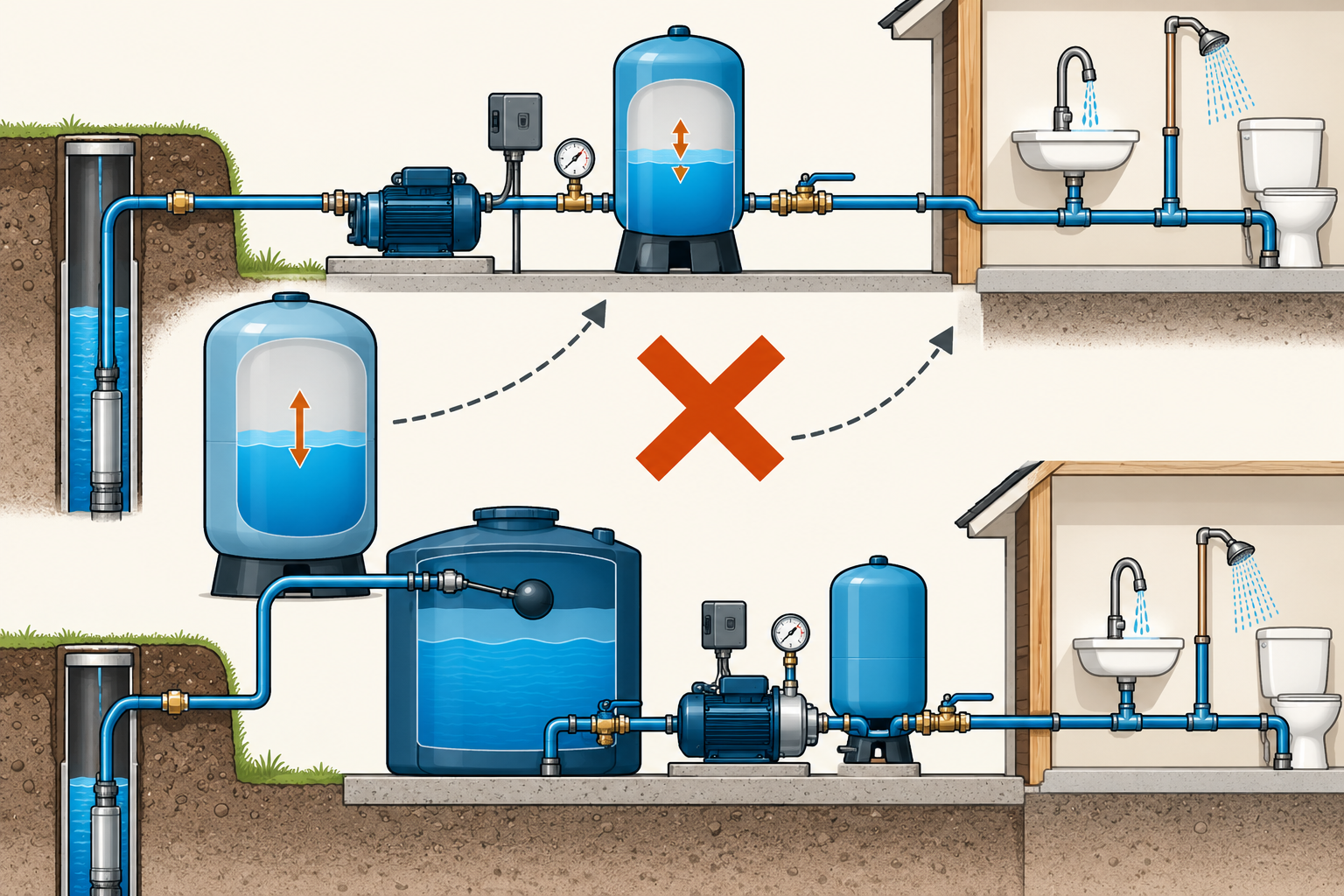
The pressure tank stores a pressurized supply and lets the pump remain off between demand events. Its usable drawdown is not the same as the tank’s advertised total gallons. The tank works with the pump, pressure switch or controller, gauge, and plumbing manifold as one pressure-side arrangement.
A failed tank can cause rapid cycling, unstable pressure, leaks, corrosion, or a pump that starts and stops too often. Those symptoms can also arise from controls, a leak, a restriction, or a pump problem. A service visit should identify the fault before a tank is sold as the universal answer.
What replacement may cost
The simplest job has an accessible tank, a known compatible replacement, reusable fittings, and no difficult water or electrical condition. Labor and the tank dominate. A typical job may also include a new gauge, pressure switch, shutoff, relief component, union, drain, or short section of corroded pipe.
An awkward mechanical room, a buried or remote pressure system, seized fittings, water damage, a second visit, or a tank that requires a different connection can raise the price. If the tank is integrated with a treatment train, booster, or constant-pressure controller, the installer should explain the system boundary rather than replacing one vessel in isolation.
Capacity and drawdown
A larger nominal tank can provide more usable drawdown when correctly selected, which can reduce pump cycling. It does not create more well yield and does not itself increase household pressure. Pressure comes from the pump and system design; a tank is storage within the pressure system.
Sizing should consider the pump’s output, pressure-switch settings, actual demand, available space, and manufacturer or professional design guidance. Do not choose a tank from a generic house-size table without checking the existing system. An oversized or poorly configured tank can consume space without solving the actual problem.
Related components
Ask whether the quote includes testing or replacement of the pressure switch, controller, gauge, manifold, valves, check valve, drain, and connecting pipe. If the tank has leaked, inspect the surrounding floor, insulation, wiring, and treatment equipment for consequential damage. If the pump cycles because the source or plumbing is abnormal, tank replacement may mask rather than correct the cause.
The pressure-tank scope is distinct from a bulk water-storage tank. A bulk tank buffers low well production over time and generally needs fill controls and a booster or pressure system. It is a larger supply-design decision.
Three scenarios
Focused replacement: Accessible failed tank, sound pump and controls, standard fittings, and a clear test after installation.
Pressure-side refresh: Tank replacement plus switch, gauge, manifold, corroded valves, and short pipe repairs. This may be good value if the work would otherwise require another service call.
Wrong component or broader upgrade: The tank is not the cause, the source is low yield, or the owner wants steady pressure. The next decision may be diagnosis, pump replacement, storage, or a constant-pressure system rather than a larger conventional tank.
Conventional tank versus constant pressure
A conventional tank replacement preserves the existing pump-cycle architecture. A constant-pressure upgrade adds different controls and may use a smaller tank configuration, depending on the system. It can address a preference for steadier pressure, but it also introduces compatibility, power-quality, and future-service considerations. Compare the complete installed system and ownership cost, not the tank price with the upgrade price.
How to compare quotes
- Name the tank type, manufacturer, model, nominal capacity, and pressure assumptions.
- State the included labor and access conditions.
- List the fittings and controls being reused or replaced.
- Show whether disposal, travel, electrical work, treatment bypass, and testing are included.
- Explain how the installer confirms correct operation.
- Ask what symptom the replacement is expected to correct and what evidence would point elsewhere.
If the household has no water, low pressure, or a contaminated system, restore safe service according to professional and local guidance. Do not open pressurized or electrically connected equipment as a homeowner experiment.
US and Canadian cost context
The available price orientation is US-only. Canadian quotes can differ with labor, travel, equipment, and local installation practice. Request a local CAD quote and avoid converting the US average. The economically sound choice is the smallest compatible scope that resolves the diagnosed pressure problem, with related components and a larger system change shown as explicit alternatives.
Drawdown is not household storage
The tank’s advertised capacity does not equal the water available between pump cycles. Usable drawdown depends on tank design and the system’s operating pressures. That is why a technician should state the pressure assumptions and expected cycling rather than selling a nominally large tank as a guaranteed comfort improvement.
If the symptom is rapid cycling, ask what evidence shows the tank is the cause and whether a leak, switch, check valve, pump, or source issue was excluded. If the symptom is low pressure, ask whether the pump and pressure settings produce the problem. A tank replacement can be correct and still fail to solve the homeowner’s complaint when diagnosis is incomplete.
Installation details that affect ownership
Place the tank where future service, draining, and inspection are possible. Protect nearby treatment equipment and finished surfaces from leaks. Record the model, nominal capacity, pressure settings, fittings, and final test. Those records make the next repair more efficient and help distinguish a tank failure from a pump or source problem.
For a household considering constant pressure, compare the conventional replacement against the complete controller, pump, wiring, and service model. The decision is not between two tank sizes; it is between two pressure-system architectures.
Before signing, ask for the post-installation pressure and cycling test, the condition of the pump and check valve, and the parts that remain original. That record establishes whether the tank solved the diagnosed fault and gives the next technician a baseline. If the complaint remains, the owner can move to pump, leak, source-yield, or control diagnosis without paying for another blind replacement.
Include the cost of losing water during the work, protecting nearby treatment equipment, draining or disposing of the old tank, and correcting corroded fittings. For a remote property, ask whether the provider carries the correct tank and controls or whether a second trip is likely. These small logistics can move a “$500 tank” job into a larger service event.
Price the pressure-side handoff
Before work starts, ask the installer to document the pressure settings, pump condition, tank type, visible piping, and symptom that led to the recommendation. A replacement tank should be sized and configured for the pump and controls, not chosen only from nominal gallons. The useful result is a pressure system that cycles appropriately and meets the home’s intended demand, not simply a new vessel in the same location.
Include the cost of draining and moving the old tank, protecting nearby treatment equipment, correcting corroded connections, and testing the system after it is pressurized. If access is tight or the equipment room is finished, removal and restoration may be a material part of the job. A quote that lists only the tank and a generic labor line may be accurate for a simple case but incomplete for a remote, buried, or integrated system.
Record what remains original. If the pump, check valve, switch, gauge, wiring, or treatment train is near the end of its service life, the owner should know that a tank replacement has not reset the life of the whole system. This makes a repair-versus-upgrade decision more honest and prevents a later symptom from being treated as proof that the new tank was defective.
Check whether the tank is the diagnosed failure
A replacement quote should state the symptom, the test that points to the tank, and the condition of the pump, pressure switch, check valve, wiring, and visible plumbing. A tank with the wrong precharge, a leaking fitting, or a failing control may produce similar cycling or pressure complaints. Replacing the vessel without separating those causes can leave the original problem in place.
Ask for the expected pressure range, cycling behavior, and post-work test. If the home has treatment equipment, confirm that the new pressure and flow remain within its design conditions. The economic comparison is strongest when it includes the tank’s useful capacity, related repairs, and the consequence of a second service visit—not just the vessel price.