
A high water bill after a plumbing leak creates two separate financial questions: what it costs to find and repair the source, and whether the water utility will adjust any part of the bill. An adjustment is not automatic, may not cover the full increase, and does not reimburse the plumber. The useful budget keeps the repair invoice, possible credit, and remaining utility balance separate until the utility makes a decision.
Confirm what the bill is measuring
Start with the account and bill, not an assumed leak credit. Confirm that the bill is for the correct service address and account holder, whether the meter reading is actual or estimated, the dates in the billing period, and the recorded consumption. Compare the same number of days with prior bills when available. A bill can rise because of an estimated reading followed by an actual one, more occupants, seasonal outdoor use, a filled pool, or a longer billing period as well as a plumbing failure.
If the meter data suggests unusual use, treat it as a reason to investigate rather than proof of a particular leak. A concealed supply leak, a running toilet, a failed fixture connection, outdoor piping, or a water heater can produce different repair scopes. A utility may have a separate meter test or account review process. Keep its diagnosis distinct from the plumber’s source-finding and repair work. For concealed plumbing, see Hidden Water Leak Detection and Repair Cost; for a toilet or faucet, use the corresponding fixture guide.
Separate the four amounts
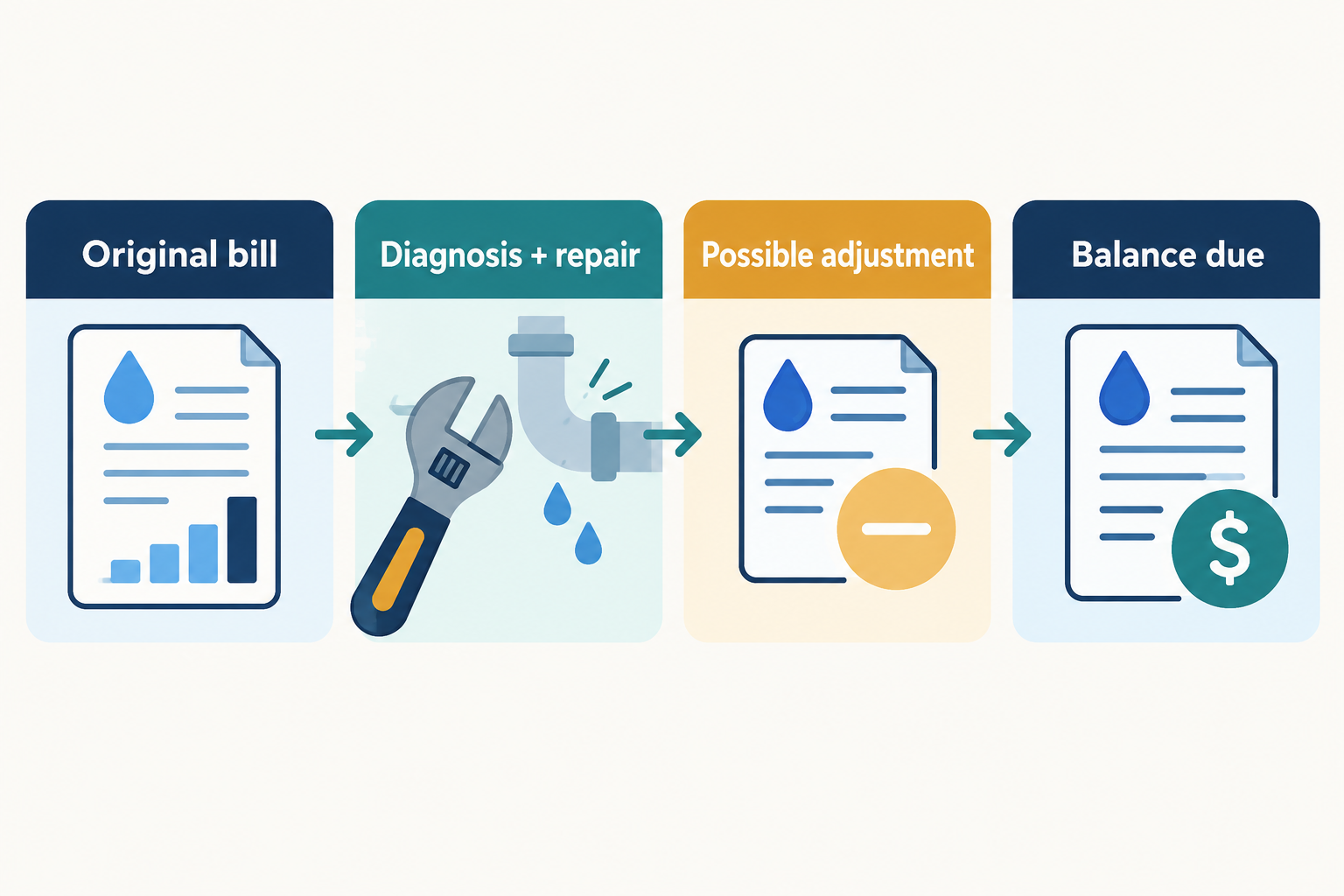
Write down each amount before estimating a net cost:
- Original bill: the amount charged for the billing period, including water and any sewer or wastewater component.
- Diagnosis and repair: the plumber’s visit, leak location, repair, verification, and any emergency or access work.
- Possible adjustment: the amount the utility may consider under its current local rules. Until approved, keep it unknown rather than subtracting a hoped-for credit.
- Remaining balance: the amount due after the utility applies a confirmed adjustment and any other account correction.
Plumbing repair and utility bill relief are different services. A water-bill adjustment generally changes a billed consumption amount under a program; it does not pay the repair invoice, drywall opening, drying, floor work, or other restoration. Include those costs in the household budget without treating them as part of a utility credit.
Check the policy before closing access
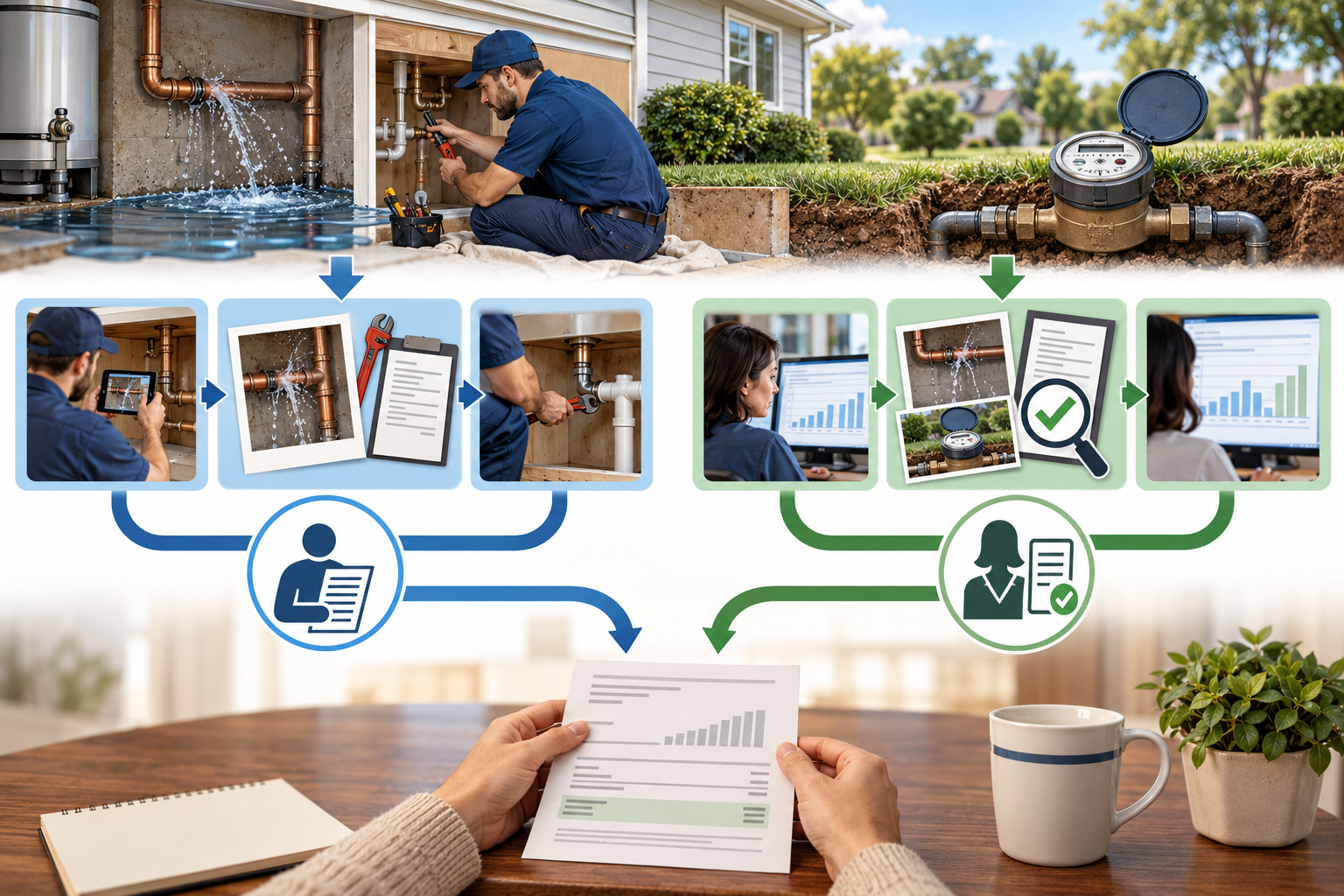
Look up the program for the utility that bills the property. A municipal water provider, regional district, private utility, or landlord account may have different rules. Ask the utility to identify the policy category before work is complete, particularly when the leak is underground, the line may be on a utility easement, or inspection could be required before a repair is covered or buried.
Check these items in the current written instructions:
- whether the account must be metered and which property or account types qualify;
- which leak causes are covered, and whether fixtures, underground service lines, irrigation, pools, or tenant-caused use are treated differently;
- when the utility must be notified, when work must be completed, and when the application is due;
- whether a utility inspection, meter test, plumber’s invoice, photographs, or post-repair reading is required;
- which bill periods and charges can be adjusted, how the normal-use baseline is chosen, and whether a cap or prior-use limit applies; and
- how to pay, dispute, or request review while the application is being considered.
If the utility needs to inspect an exposed repair, coordinate that visit before backfilling or closing the access. Do not leave an active leak or unsafe condition in place just to preserve a possible adjustment. Contact the utility promptly, document the condition, and proceed with the repair needed to protect the home.
Local examples show why a national rule does not work
Policies vary even among large utilities in the United States and Canada. These examples describe only the named service area; they are not eligibility rules for another address.
| Utility example | Conditions that change the decision |
|---|---|
| New York City DEP | The program is for metered accounts. The leak charge generally must be at least 200% of a normal representative-period bill (with a lower threshold in some cases where meter data is unavailable); the repair and request are generally due within 120 days of the original high bill. DEP describes forgiveness as one half of the high bill, subject to a floor that leaves at least 150% of the property’s typical bill owed. A working automated meter reader can change what repair proof is required. |
| Portland Water Bureau | The posted policy separates leaks whose water enters the sewer from those that do not. It calls for reasonable efforts to locate and begin repair within 30 days of the initial high-use notice and completion within 90 days. The City verifies repair with meter checks, and its water and sewer calculations use different baselines and conditions. |
| Toronto Revenue Services | Toronto separates an “unexplained” increase from an “uncontrollable” increase. A known plumbing leak is excluded from the unexplained category; the known-leak path has additional conditions, including a financial-hardship and income test. Its page uses the phrase “three times greater” for the consumption comparison, so use the City’s current wording rather than translating it into a different multiplier. |
The contrast matters. A Toronto account holder with a documented leak may not qualify under the same category as someone whose high use has no identified cause, while an eligible New York City account can include maintainable fixtures such as toilets. The City of Portland also distinguishes where the water went because that can change the sewer portion. None of these examples predicts whether a particular application will be accepted or how much a specific bill will change.
Preserve useful proof while the job is underway
Save the bill that first shows the increase, prior bills used for comparison, meter or usage records, the utility’s notice, and the date each contact occurred. Ask the plumber for an itemized invoice with the location and cause found, repair date, work completed, and any follow-up test or verification. Take dated photographs before a concealed repair is closed when doing so is safe and permitted. Keep the original documents even if the application portal accepts only uploads.
Some utilities want proof that the leak was corrected; others may inspect, check meter data, or accept a plumber’s written statement. Do not assume that a paid invoice alone proves the utility’s policy conditions. If the line is on a public/private boundary, ask who must authorize repair and who can confirm the affected segment. The evidence needed to obtain a bill adjustment may be different from the records needed for an insurance claim or property repair.
Water and wastewater charges may follow different rules
Read the bill’s separate line items. A meter records water that passed through the service even if it escaped before reaching a drain. A leak into soil may affect the water charge without creating the same sewer volume as a toilet or indoor fixture leak. Some utilities adjust sewer or wastewater charges separately; others use a historical winter average, a previous billing period, or another formula.
Do not multiply excess gallons by a single combined rate and call that the expected credit. Ask the utility which charge can change, which prior period is the baseline, and whether the adjustment covers one bill or multiple periods. The formula may account for a portion of the extra use, exclude a fee, or leave a threshold amount payable. If the notice does not explain the calculation, request a written estimate or an account-specific explanation.
Build a cautious remaining-bill estimate
For planning, use a simple table rather than a guessed reimbursement percentage:
| Budget line | Amount to record |
|---|---|
| Original high bill | The full amount shown, with water and sewer components separated where possible |
| Ordinary-use reference | The historical period or baseline the utility says it will use |
| Plumbing diagnosis and repair | Written quote and final invoice, separated from restoration |
| Adjustment requested | The utility program and application date; amount may remain unknown |
| Adjustment approved | Enter only the amount shown on the utility’s decision or account |
| Balance still due | The utility’s revised account statement, not a homeowner estimate |
Until the utility approves an adjustment, plan for the original amount or the payment arrangement it confirms. Ask whether a review changes the due date or collection steps; do not assume that submitting a request pauses payment. If the bill appears to include an incorrect reading or account charge, ask about that dispute process separately from leak relief.
Coordinate repair without delaying necessary work
Utility deadlines can affect scheduling, but they should not become a reason to leave water running or postpone urgent protection. Contact the utility as soon as a bill or notice suggests an eligible issue, ask whether it needs to inspect before an underground repair is covered, and record the answer. If a contractor must make an emergency repair first, preserve photographs, invoices, meter readings, and the reason the work could not wait.
The plumbing quote should identify whether it covers only diagnosis, the source correction, or access and restoration. For a fixture leak, compare the repair with the fixture replacement scope. For an underground or concealed leak, ask what testing and proof can be provided without promising that the utility will approve an adjustment. A careful repair record makes the application easier to evaluate and helps the next contractor understand what was corrected.
Questions to ask before treating a credit as savings
- Which exact account and bill period are being reviewed?
- Is the application for a leak adjustment, an unexplained-use review, a meter test, or a billing error?
- What is the repair, inspection, and filing deadline, and which event starts each clock?
- Does the utility need to inspect before the line is buried or an opening is closed?
- Does it adjust water, sewer, or both, and what baseline will it use?
- Which proof is accepted, and does the plumber’s invoice need specific details?
- Is a credit capped, limited by prior adjustments, or dependent on household income or property type?
- What payment is due while the request is pending, and how will the final decision appear on the account?
The cost comparison is complete only when it shows the utility’s actual decision, the repair invoice, and the remaining account balance. Local programs can help with an unusually high bill, but eligibility and timing are part of the project—not a guaranteed discount to subtract from a plumbing quote.