
A dripping or stiff faucet can be a small parts repair, a fixture replacement, or evidence of a connection problem below the counter. The useful comparison is not the cost of a cartridge alone. It is the complete service-call, parts, access, compatibility, and future-use decision.
Repairable problems
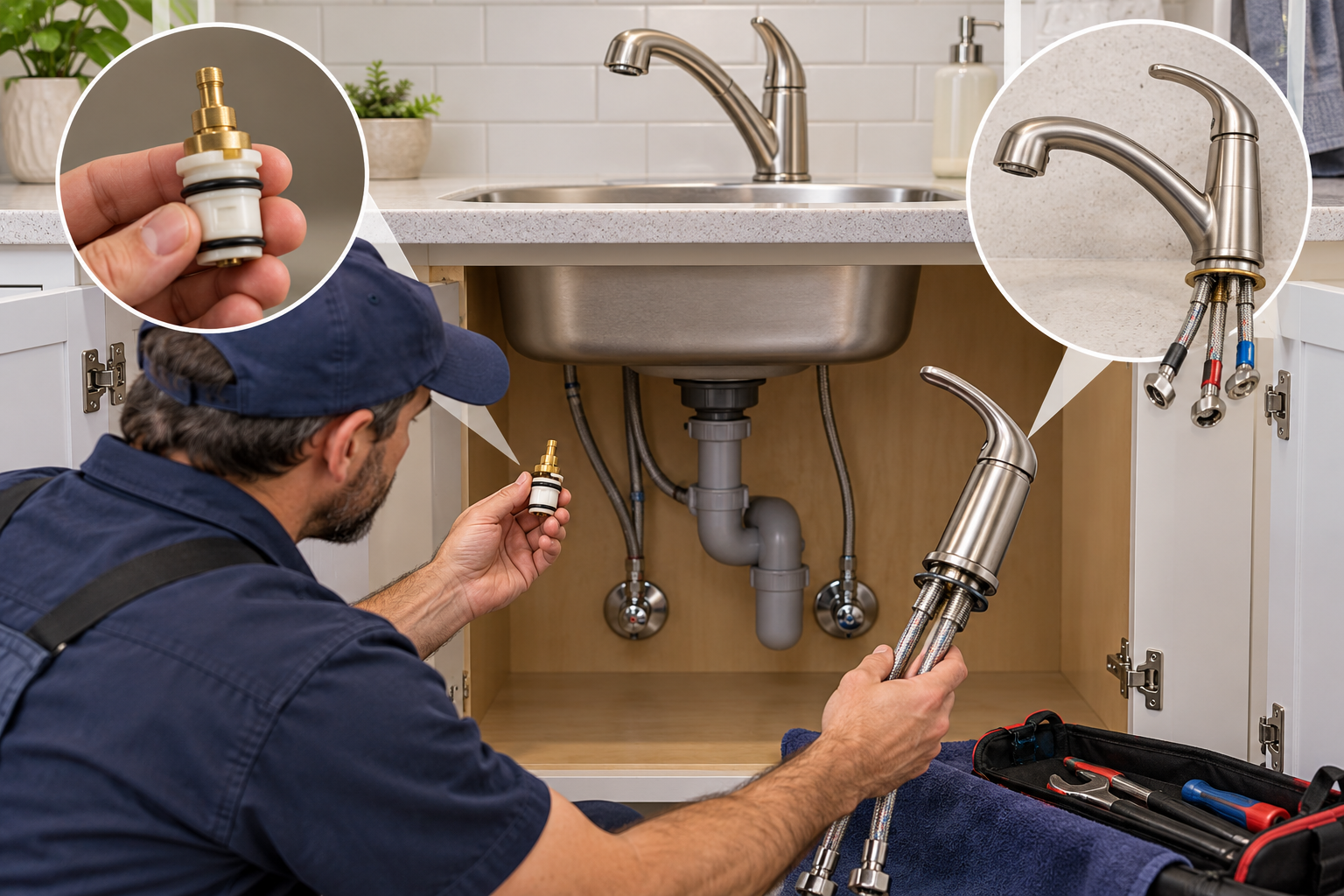
Worn seals, a cartridge, aerator buildup, a loose handle, or a damaged supply connection may be repairable. EPA WaterSense identifies dripping faucets as common household leaks and discusses faucet maintenance and water-efficiency labeling. A repair is more attractive when the faucet body is sound, parts are available, the shutoffs work, and the fixture still meets the homeowner’s needs.
Do not assume that a drip proves the cartridge is the cause. A plumber may need to distinguish the spout, handle, valve body, connection, shutoff, or a leak below the counter. If the fixture is in a cabinet with stored contents or the connection is corroded, access and cleanup can be part of the job.
Replacement economics
Replacement adds the new fixture, removal and disposal, installation labor, supply connections, shutoff condition, mounting configuration, testing, and cleanup. HomeStars reports an illustrative Canadian faucet-installation range of about $195–$455, but it does not establish a universal repair price or a normalized national bid. Angi’s 2026 U.S.-oriented guides report $100–$400 for a leaky-faucet repair and $170–$360 for bathroom-faucet replacement; both report a $270 average. They are separate source estimates, not matched prices for the same faucet or scope. A fixture price from a retailer should not be compared with an installed replacement quote unless both scopes are aligned.
If choosing a new bathroom faucet, WaterSense labeling can provide an efficiency and performance reference for covered private lavatory faucets. The label does not cover every faucet type or solve compatibility. Check the mounting holes, deck thickness, supply connections, spout reach, controls, and manufacturer instructions for the selected product.
Cost drivers
- the service minimum and whether the repair is part of another call;
- parts availability and the age or brand of the fixture;
- one-hole, centerset, widespread, wall-mounted, pull-out, or other configuration;
- seized shutoffs or corroded supply connections;
- countertop, sink, cabinet, or wall access;
- removal, disposal, and cleanup; and
- whether a leak has damaged the cabinet or finish.
Three decision cases
Focused repair: The faucet is a quality or preferred fixture, the fault is confirmed, parts are available, and connections are sound. Repair avoids the fixture purchase and may be proportionate.
Practical replacement: The repair requires hard-to-find parts, the body or finish is failing, the faucet has repeated problems, or a replacement better fits the sink. Price the fixture and plumbing installation together.
Expanded scope: The shutoff, supply line, sink, countertop opening, or cabinet is damaged. A faucet-only quote understates the job. Separate plumbing, fixture, cabinet, countertop, and finish work so the total is clear.
Repair versus replace over time
One inexpensive repair is not automatically wasteful, and an expensive faucet is not automatically worth saving. Consider the remaining life of the fixture, the chance of a repeat service minimum, water use, user needs, and the cost of accessing it again. If the faucet is being replaced as part of a kitchen or bathroom remodel, coordinate with that room-level project rather than paying twice for removal and installation.
Quote questions
- What component is believed to have failed, and what was checked?
- Is the price labor-only, parts-only, or complete repair?
- Are shutoffs, supply lines, access, removal, disposal, and cleanup included?
- Does the replacement fit the existing sink and connections?
- Are cabinet, countertop, or water-damage repairs excluded?
- What warranty applies to labor and the new or repaired fixture?
The best choice is the one that resolves the leak and leaves a reliable, compatible connection. Compare the finished scope, not only the price of a cartridge or a boxed faucet.
How to compare a repair quote
Ask for the exact part or failure assumption. “Repair faucet” can mean a cartridge, seal, aerator, handle, shutoff, supply line, or connection. If the part is not identified, ask whether diagnosis is included and what happens if the body is damaged once disassembled. A service minimum can make a repair less attractive when a replacement is already planned, but it can also be wasteful to replace a sound specialty fixture without checking parts availability.
Plan around the fixture and the room
Measure the existing mounting holes, deck thickness, spout reach, handle clearance, and supply locations before buying a replacement. A faucet that fits the sink may still conflict with a backsplash, cabinet, or user. If the cabinet has water damage, the plumbing job may need to wait for drying or restoration. If a kitchen or bathroom renovation is planned soon, coordinate removal and installation so the same connection is not paid for twice.
Ownership scenarios
Repair is usually strongest for an accessible, preferred, serviceable fixture with a confirmed failure. Replacement is stronger when repeated service calls, obsolete parts, corrosion, user needs, or water use change the value. For a rental or sale, documentation of the repair and leak test may matter more than upgrading the style. For a long-term owner, the cost of another call and the risk of a hidden connection leak deserve a place beside the fixture price.
Make the replacement comparable
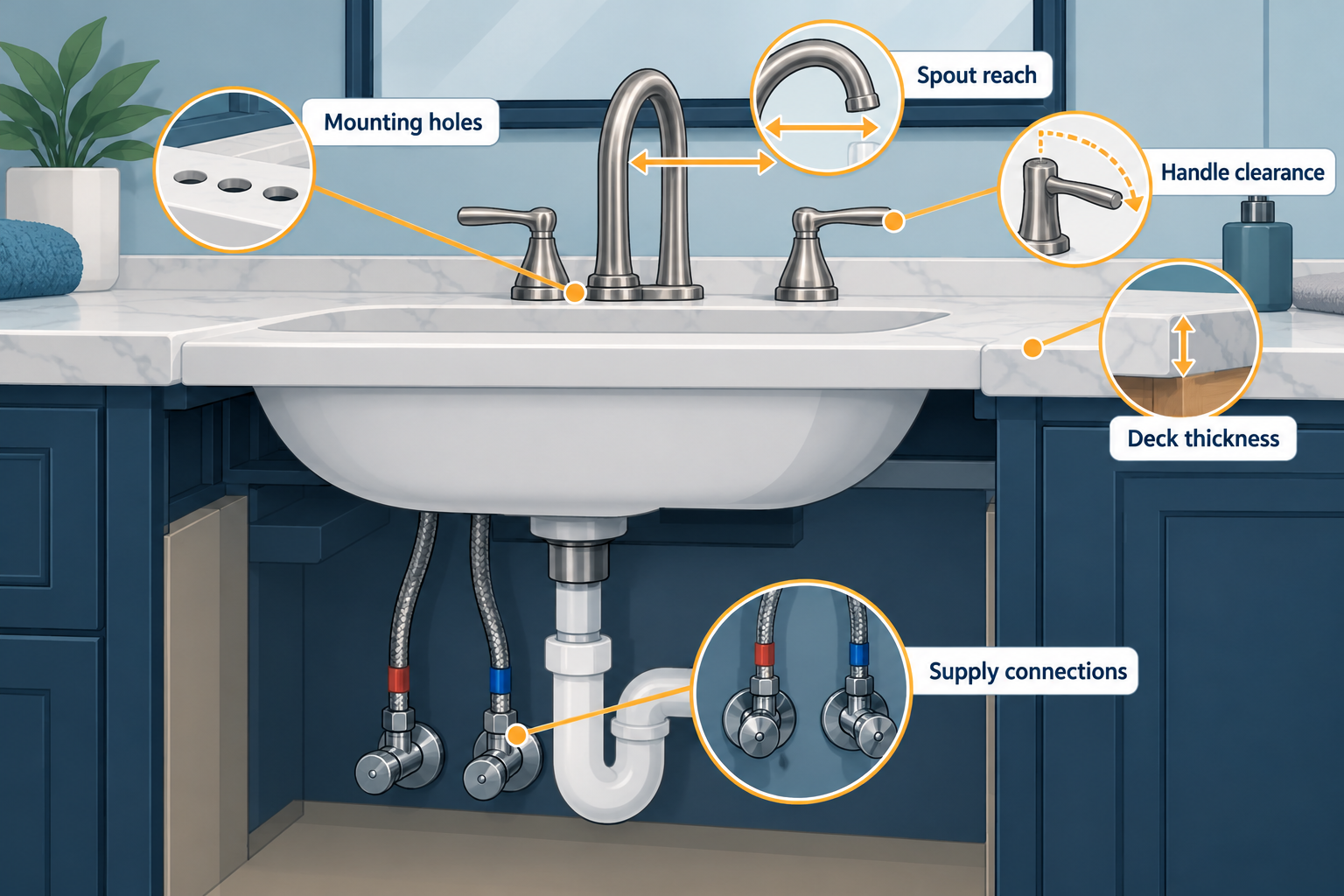
Select the fixture before requesting a final installation quote. Mounting holes, deck thickness, spout reach, handle clearance, supply connections, and cabinet access can change labor. If you are supplying the faucet, ask who carries the risk if it is incompatible or defective and whether installation includes removal of packaging and the old fixture.
For a planned remodel, coordinate faucet work with the counter, sink, cabinet, and finish schedule. For a rental or sale, a documented repair and leak test may be more valuable than a style upgrade. The right decision is the smallest complete scope that leaves a reliable connection and a fixture suited to the home’s actual use.
Confirm the failure before buying a fixture
A dripping spout, loose handle, slow flow, and water under the cabinet do not identify the same failed part. The cause may be a cartridge, aerator, supply stop, hose, drain connection, or the faucet body. Ask the plumber to identify the observed failure and to separate diagnostic labor from a replacement allowance. A replacement faucet cannot correct a restricted shutoff or a leaking connection hidden below it.
If repair is possible, confirm whether the replacement cartridge is available, whether the model can be identified, and whether the repair restores the intended temperature and flow. An inexpensive repair can be poor value if the part is obsolete or the faucet has several deteriorated connections. Conversely, a style upgrade can be unnecessary when the existing body is sound and parts are readily available.
Price the conditions below the sink
Cabinet contents, a cramped basin, corroded stops, brittle supply tubes, and a sink that moves can turn a simple faucet swap into access and reconnection work. Have the quote identify removal, supply stops, flexible connectors, drain protection, shutoff testing, leak testing, and cleanup. If the stops do not close, include the plan for isolating the line before work begins.
For an occupied home, ask how long the sink will be unavailable and whether the water can be restored if the new fixture does not fit. If a cabinet or countertop must be altered, establish who performs that work and who is responsible for an imperfect opening. Plumbing labor should not quietly include finish risk it cannot control.
Compare the installed fixture, not the box price
When comparing fixtures, verify mounting holes, deck thickness, spout reach, handle clearance, spray-hose routing, supply connections, and warranty support. Features such as touch controls or pull-down sprays can add batteries, controls, or service parts. A lower retail price may not remain lower after incompatible connections, new shutoffs, or cabinet access are included.
At handoff, operate every control, inspect the base and connections, run hot and cold water, and check for leaks after the cabinet has been dry for a short observation period. Retain the model information and installation instructions. The useful result is a faucet that fits the space, can be isolated in an emergency, and has a documented completed connection.
Keep water quality and use in the choice
If the faucet has low flow or recurring aerator blockage, identify whether the symptom is local or reflects sediment, treatment, pressure, or a broader piping issue. A new fixture does not correct an upstream condition. If the faucet serves a child, older adult, rental, or high-use kitchen, consider reach, handle effort, spray control, splash, and access as part of the installed value rather than as style details.
For a remodel, coordinate the fixture with the sink, counter, backsplash, cabinet, and shutoff plan. For a simple repair, protect the cabinet and avoid opening a larger scope without evidence. At handoff, record what was reused, what was replaced, and any limitation on the supply or drain. That creates a useful baseline if the fixture later develops a drip or flow complaint.
Make the final scope easy to service
Include the location and operation of the shutoff, the supply connection, any filter or control, and the access needed to remove the fixture later. If the faucet is part of a rental, sale, or shared property, retain the model and warranty record. If a countertop, cabinet, or sink condition was excluded, state that limitation so a future repair does not assume a complete room renovation.
The best comparison is between a tested repair and a complete installed replacement. It accounts for access, compatible parts, removal, disposal, testing, cleanup, and future service—not only the price of the faucet in the box.