
The cost of a hidden-leak project has two distinct stages: finding the source and correcting it. A technician may locate a wet wall, ceiling stain, unusual meter movement, or damp floor without knowing whether the source is a supply pipe, fixture connection, heating appliance, or a problem outside this category. Repair and finish restoration cannot be priced responsibly until the location and access path are clearer.
When a leak is probably concealed
Unexplained meter movement when the home is not using water, a persistent musty area, staining that returns after drying, a warm or damp floor, peeling paint, or a ceiling mark below plumbing can justify investigation. EPA WaterSense identifies old piping, fixture wear, corrosion, cold temperatures, irregular pressure, malfunction, and incorrect installation among conditions associated with leaks. None of these signs alone identifies the failed component.
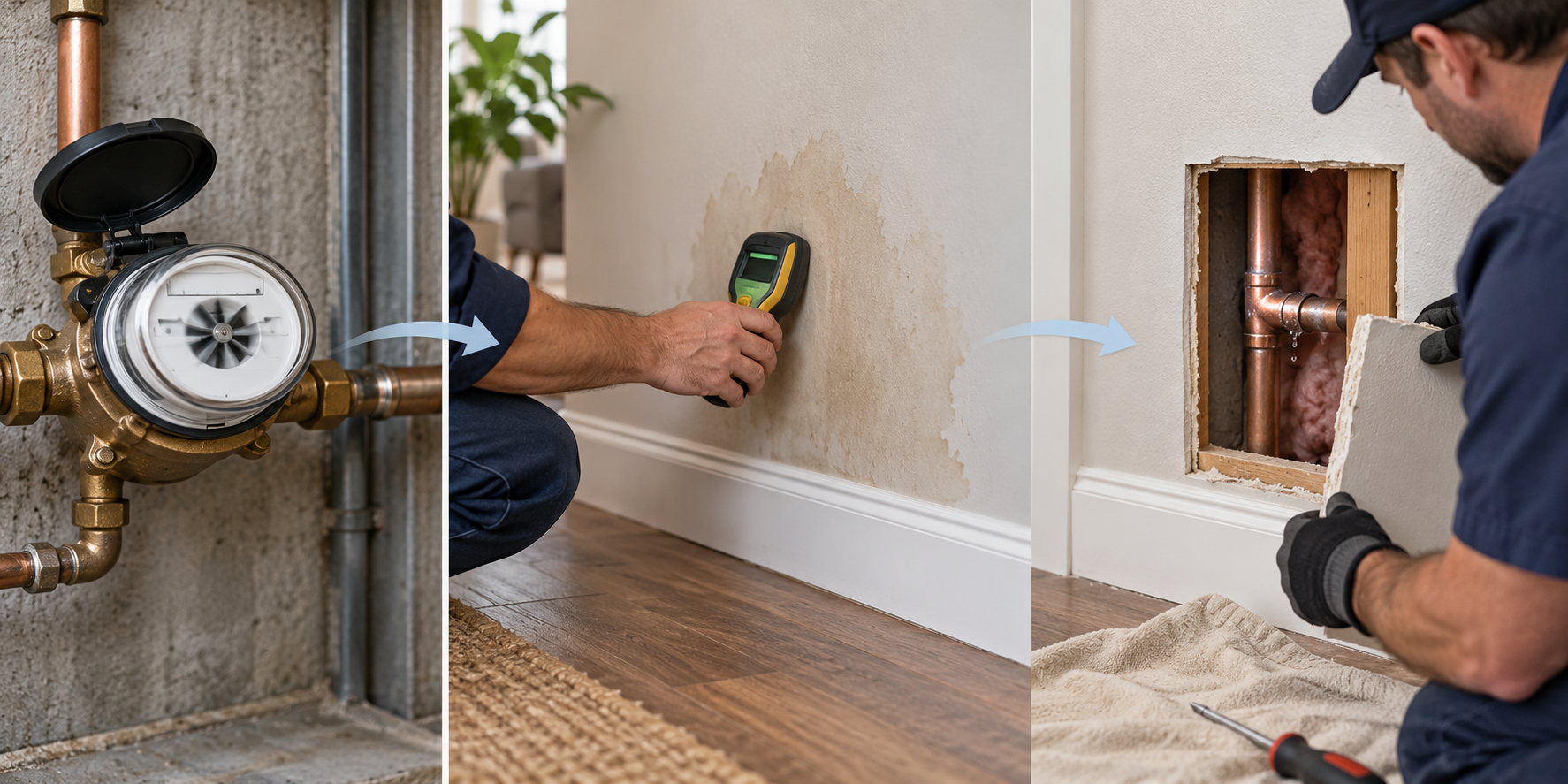
The first step is to separate a leak from normal use. A meter check with all water use stopped can indicate that water is moving, but it does not locate the source. A professional may use visual inspection, moisture readings, pressure observations, flow monitoring, or a targeted opening. The method depends on the symptom and the building.
What the detection price pays for
A detection visit may include travel, an initial survey, meter or pressure observations, moisture mapping, equipment use, and a report or recommendation. Non-destructive work can reduce unnecessary openings but does not guarantee a precise location. Invasive access may be faster or more conclusive when the pipe is behind a finished wall, ceiling, slab, or cabinet, but it introduces patching and finish costs.
Available market research does not establish a reliable universal detection price. Ask for a diagnostic fee, the areas included, the equipment or method proposed, the expected confidence of the result, and the price or authorization limit for openings. A quote that promises a final repair before the source is found may be assuming favorable access.
Three cost scenarios
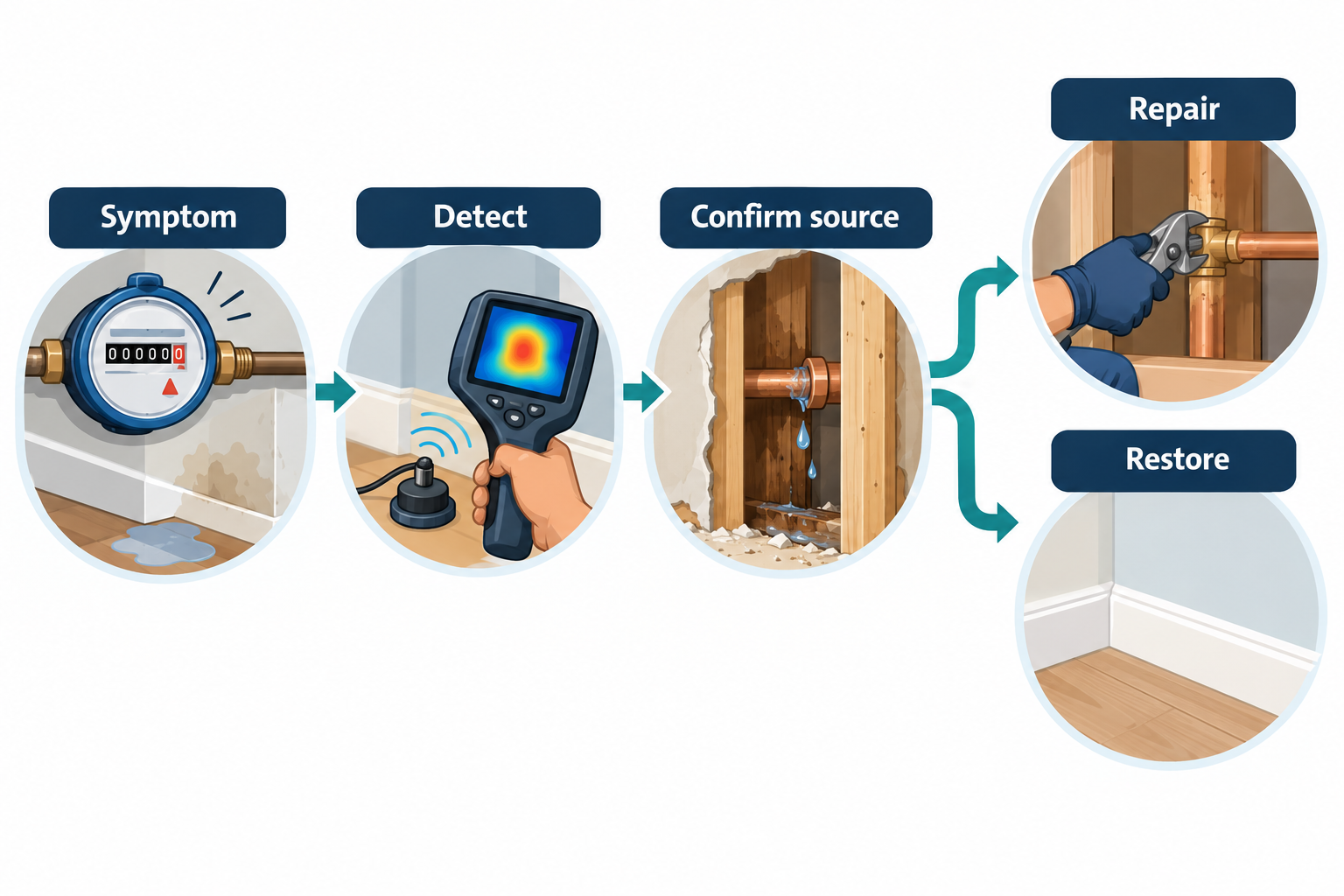
Accessible connection: The source is a visible supply connection or fixture shutoff. Detection is short, and the repair may be a fitting, valve, or fixture component. The plumbing work can still carry a service minimum.
Concealed but localized pipe: The source is narrowed to a wall, ceiling, cabinet, or floor area. The budget should separate locating, opening, pipe repair, drying or protection, and finish closure. A plumber may stop after making the water system sound while a finisher completes the surface.
Uncertain or widespread moisture: The leak is intermittent, below a slab, near multiple lines, or associated with significant damage. More investigation, controlled access, temporary isolation, or a restoration contractor may be needed. Do not compare this project with a fixture replacement simply because both are described as “a leak.”
Repair versus access and restoration
The pipe repair is only one line on many concealed-leak quotes. Access may require removing a cabinet, opening drywall or plaster, lifting flooring, or creating a ceiling opening. Restoration may include drying, damaged-material removal, mold assessment, painting, flooring, or insurance documentation. Those consequences belong in the budget but may not belong in the plumber’s scope.
Ask whether the plumbing quote includes making the opening, temporary protection, cleanup, and a rough closure. Ask the restoration contractor whether the source correction must be complete before drying or reconstruction. A good boundary prevents a homeowner from treating an unfinished opening as a hidden extra or paying two trades for the same work.
When a local repair is not the whole answer
One confirmed leak does not prove the entire system should be repiped. But repeated leaks, visibly deteriorated piping, pressure-related failures, or an inspection finding about legacy plumbing can change the economics. Compare a local repair with a systematic repipe when the home is already open, access is unusually difficult, or another failure would repeat the same disruption.
Conversely, do not turn an uncertain moisture symptom into a whole-house replacement recommendation without a diagnosis. The decision should distinguish confirmed damage, probable risk, and optional prevention.
Prevention as a separate decision
EPA distinguishes moisture sensors from flow-monitoring systems. A point sensor can detect dampness at a selected location; a flow monitor can identify irregular water use or flow, and some systems can activate an in-line shutoff. This equipment can reduce the time before a leak is noticed, but it does not repair the pipe or guarantee that every leak is detected. See the whole-home detection article for equipment and installation tradeoffs.
Quote questions
- What evidence shows there is an active leak rather than old damage or condensation?
- Is the price for finding, opening, repairing, or restoring?
- Which diagnostic method is included, and what confidence or limitation does it have?
- What happens if the first opening does not reveal the source?
- Are slab, cabinet, wall, ceiling, or finish costs included or excluded?
- Does the repair address a confirmed cause, and is repeat failure a concern?
- When should a restoration contractor or insurance representative be involved?
The lowest first-visit price is not necessarily the lowest project cost. A useful proposal makes the uncertainty visible and gives the homeowner a controlled way to authorize the next step.
What changes the next decision
Detection is useful only when it changes what the homeowner does next. If a moisture reading points to a supply line, the next quote may be a localized pipe repair. If the result only shows a wet area with no source, the homeowner may need a controlled opening or a second diagnostic method. Ask what level of location accuracy the proposed method normally supports in the stated building condition, without treating a sales promise as a guarantee.
Meter movement can also be intermittent. A quiet reading does not prove that a leak has stopped, and a flow alarm does not identify whether the water is in a fixture, appliance connection, or concealed pipe. Keep a record of when the symptom appears, which fixtures were used, weather conditions, and any change after valves are closed. That information can reduce repeated diagnostic time without pretending to diagnose the system remotely.
Model the total project
For budgeting, create separate allowances for detection, access, plumbing repair, drying, finish restoration, and possible follow-up. A favorable project may stop at a visible connection. A difficult project may involve two visits and an opening before repair. If the source is under a slab or in a shared wall, ask whether exploratory work, engineering, association approval, or another specialist is needed.
Avoid paying for broad restoration before the plumbing source is controlled. Conversely, do not assume the plumber’s patch or cleanup restores a wet wall or floor. A quote that clearly ends at “water system tested and leak-free” can be compared with a restoration quote that begins at drying and reconstruction.
Prepare information that shortens diagnosis without guessing
Before the visit, record when the symptom appears, which fixtures were recently used, whether the meter moves when all water use stops, and whether weather or occupancy changes the pattern. Note staining, sound, odor, pressure changes, and any previous opening or repair. These observations help the technician choose where to start, but they do not prove the source. A quiet meter during one test does not rule out an intermittent leak.
Give the technician access to likely shutoffs, mechanical rooms, cabinets, crawlspaces, and the area below a stain when it is safe. Do not remove finishes or enter unsafe spaces solely to make the visit cheaper. The cost of a controlled opening may be lower than repeated inconclusive visits, while an unnecessary opening can add restoration cost without improving the diagnosis.
Compare detection methods by the decision they enable
A moisture reading can establish that an area is wet, while flow monitoring or pressure observation can show that water is moving through the system. Visual inspection may identify a connection, but it may not locate a pipe hidden behind a finish. A targeted opening can confirm the repair location, yet it does not replace a broader assessment when moisture has traveled away from the source.
Ask what the proposed method is expected to answer: whether an active leak exists, which zone contains it, the likely opening location, or the exact failed component. A method that answers only the first question should not be priced as though it includes a completed repair. The value of detection is the quality of the next decision, not the appearance of specialized equipment.
Decide when to stop looking and repair
Investigation can become uneconomic when the source is already sufficiently localized for a controlled repair, when additional precision would not change the access plan, or when a restoration contractor must begin protecting the property. Conversely, stopping too early can lead to a repair that treats a wet spot instead of the source. Ask the contractor to explain what new information another test would provide and what action would follow it.
For a slab, shared wall, or inaccessible service, include the possibility that the first visit narrows the area without producing a final point location. A responsible quote can use a defined exploratory allowance, an authorization limit, and a change-order basis. It should not promise certainty that the building condition cannot support.
Use the leak result to choose the next scope
If the source is a fixture or visible connection, the next decision may be a repair or replacement article in this category. If the source is deteriorated distribution piping, compare a local repair with partial or whole-house repiping. If finishes or contents are wet, coordinate drying and reconstruction separately. If the evidence points to a private-well or drain problem, move the work to the system that owns that diagnosis.
If a confirmed leak has already produced an unusually high metered bill, contact the utility about its separate adjustment policy and proof requirements. A possible bill credit does not cover the plumber’s diagnosis or repair; see Water Bill Leak Adjustments.
This routing prevents a homeowner from paying for the wrong specialist merely because the first visible symptom was “water.” It also keeps the plumbing quote honest: the plumber can own source correction without promising to restore every material the leak affected.