
A thermostatic mixing valve blends hot and cold water to control delivery temperature. It may be proposed as a replacement for a failed valve, as part of a water-heater installation, or as a way to manage delivery and usable capacity. The cost depends on the valve, location, piping changes, access, testing, and the requirements of the heater and jurisdiction. There is no universal setpoint or installation rule.
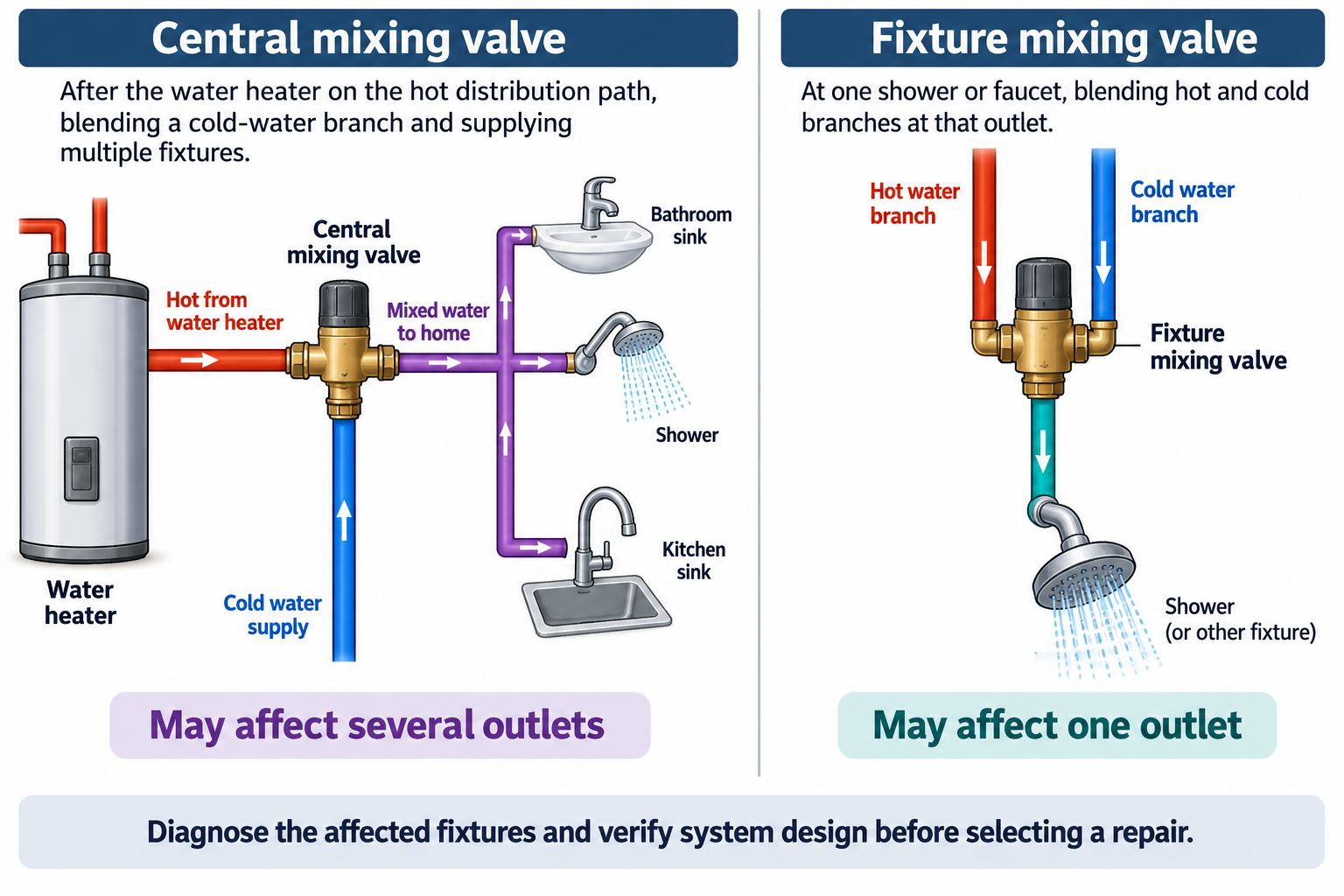
What the valve changes
The valve can affect how hot water is delivered from the heater to fixtures and how a system manages temperature. In a heat-pump-water-heater design, ENERGY STAR identifies a mixing valve as a possible installation and capacity-management consideration. That does not make one mandatory for every HPWH or storage replacement.
Do not advise a homeowner to raise a water-heater setting or change a valve setting without the necessary model, code, and safety context. Scald protection and temperature control are high-consequence concerns; use qualified service and current local and manufacturer guidance.
Health guidance shows why there is no one setting for every household. For homes with up to six units, Health Canada advises a minimum heater setting of 60°C to reduce waterborne-germ risk. U.S. CDC guidance discusses 130–140°F for killing germs while warning that higher temperatures increase burn risk; for settings above 120°F, it advises thermostatic valves that mix hot and cold water at the tap, especially where people have elevated burn risk. CDC advises discussing individual Legionella risk with a health-care provider. CPSC’s 1996 examples illustrate how quickly hotter tap water can cause severe burns, but they are historical examples, not safe exposure limits. These are health recommendations from different jurisdictions, not a universal code or setpoint. A central valve recommendation also does not establish that one valve controls every outlet; a qualified professional must assess the system and local requirements.
Replacement versus new installation
A replacement may reuse the existing location and piping if the valve model and connections fit. A new installation can require hot and cold connections, isolation, supports, access, adjustment, and testing. If the valve is behind a finished wall or near a water heater with restricted access, labor and restoration can dominate the component cost.
Available market research does not establish a reliable national installed price. Specialist plumbing market data can orient labor, but the quote must identify the actual valve and system scope. Price any access opening or finish closure separately.
Cost drivers
- valve type, capacity, and product compatibility;
- new installation versus replacement;
- heater type and operating strategy;
- accessible or concealed location;
- piping, fittings, isolation, and supports;
- adjustment and temperature testing;
- water-heater replacement or relocation occurring at the same time; and
- local code, inspection, and manufacturer requirements.
Scenarios
Like-for-like replacement: The valve is confirmed as faulty, the location is accessible, and compatible connections exist. Include removal, valve, fittings, adjustment, testing, and cleanup.
New valve during heater replacement: The quote ties the component to a documented design need and identifies whether it changes capacity or delivery. Compare it with the complete heater scope rather than accepting an unexplained add-on.
Access or temperature problem: The valve is concealed, cannot hold a stable delivery temperature, or is only one part of a distribution complaint. Price access, diagnosis, and any mixing or recirculation correction separately.
Quote questions
- Why is the valve being proposed, and what symptom or design need supports it?
- Is the valve compatible with the heater, pipe arrangement, flow, and intended use?
- Is this a replacement or a new installation?
- Does the price include fittings, isolation, access, adjustment, testing, and finish restoration?
- Which setpoint and safety requirements are verified locally and in the manual?
- Could the issue instead be a heater, local fixture valve, pressure, or distribution problem?
The right mixing-valve budget is a system quote with a clear safety basis. A part number and a confident temperature promise are not enough.
Temperature complaints need a broader view
If one shower is too hot or too cool, the local fixture valve or cartridge may be the relevant repair. If every fixture changes temperature, the heater, pressure, mixing valve, or distribution may be involved. A quote should identify the pattern, the measured or observed condition, and the result expected after installation. Replacing a central valve does not automatically cure a local fixture problem.
Installation timing and access
Adding a valve during a water-heater replacement may reduce duplicate access, but it should not be bundled without a documented design reason. A concealed valve can require wall openings and finish restoration. An accessible mechanical-room location may be easier to maintain. Ask for the valve model, flow capacity, connections, access, testing, and who restores any opening.
Safe decision boundary
Public-health, manufacturer, and local code guidance should inform the setpoint and delivery-temperature decision. Avoid generic instructions to turn a heater up or down, bypass a valve, or adjust a control without qualified review. The homeowner-facing economic question is which safe, compatible design solves the delivery problem—not which setting produces the cheapest initial invoice.
A useful scope boundary
The valve’s price should be compared with the problem it solves. If the homeowner wants more hot water, the quote should explain how mixing changes usable delivery and whether the heater has enough recovery. If the complaint is temperature variation at one fixture, the local valve may be the better investigation. If a HPWH installation is involved, the valve may be one part of a model-specific design rather than an independent upgrade.
Ask for the final test condition, the fixtures tested, and any operating guidance. A quote that includes only installation leaves the homeowner unable to tell whether the system was commissioned or whether the new valve merely fits the pipe. For a concealed location, include future service access and the cost of opening finishes again.
Identify the function before choosing the valve
A thermostatic mixing valve can serve different purposes: tempering a hot-water distribution system, managing storage temperature, stabilizing a fixture, or supporting a particular heater design. Ask the contractor to state which function applies and which other components are part of the control path. A valve selected for one arrangement may not be a substitute for a local shower valve, a failed heater control, or a pressure problem.
Record the symptom, the fixtures affected, the observed hot and cold conditions, and whether the temperature changes with flow or simultaneous use. This helps separate a central mixing issue from a local cartridge or distribution problem. The proposed valve should be sized and selected from the actual piping and equipment arrangement, not only from the connection size.
Price access, checks, and interactions
The installed scope may include isolation, unions, checks, sensors, supports, insulation, access openings, electrical control, and commissioning. Ask whether a water heater, recirculation loop, expansion control, or tempering device must be adjusted at the same time. Keep adjacent work visible: replacing the valve does not automatically correct a failed pump, restricted line, or inadequate source recovery.
If the valve is concealed, identify how it will be serviced and what finish work is included. If it is near a heater or mechanical room, confirm drain protection and safe access. A simple component price can be misleading when the installer must isolate a whole house or coordinate with another trade.
Document the temperature result
At handoff, test the affected fixtures under the use condition that caused the complaint and record the control setting, observed behavior, and any remaining limitation. Retain the model, installation instructions, warranty, and photographs before closure. If the homeowner must adjust a setting or clean a strainer, explain the procedure.
The completed decision should state whether the valve improved stability, changed usable delivery, protected a distribution arrangement, or only corrected a confirmed failed part. That distinction keeps a successful component installation from being sold as a general capacity upgrade.
Avoid making a central valve carry every complaint
If only one shower or faucet has unstable temperature, test that fixture before changing the central system. If all fixtures show the same behavior, compare the heater, distribution, pressure, recirculation, and central mixing path. A valve may be working within its design while another component creates the symptom. Ask which observation would move the recommendation from local repair to central replacement.
The quote should state whether the valve is intended to protect a distribution temperature, improve comfort, support a heater setting, or satisfy a documented installation requirement. Those are different benefits. They also lead to different tests: a comfort complaint may require fixture testing, while a central design may require observation at multiple outlets and operating conditions. Keep the decision tied to the stated function rather than to the presence of a new component.
If a new heater, recirculation loop, or expansion-control component is being installed at the same time, identify what is being commissioned together and what is not. A coordinated scope can be efficient, but it should not make an unresolved temperature complaint disappear into a larger invoice. Record the baseline, the completed test, and any remaining limitation.
Keep the replacement serviceable
Include strainers, checks, isolation points, unions, supports, insulation, sensors, and access when they are part of the selected design. Ask how the valve can be isolated and serviced without draining or opening more of the building than necessary. If a cabinet, wall, or ceiling will conceal it, agree on the access opening and finish responsibility before installation.
At handoff, retain the model, setting, installation instructions, and photographs. State whether the valve is central or local and which fixtures were tested. This prevents a future technician from treating the component as an unexplained upgrade and keeps the next temperature complaint connected to the original design intent.
Compare the valve with the alternative diagnosis
If the complaint is limited to one outlet, price local cartridge or fixture testing alongside a central valve proposal. If the complaint follows the whole distribution system, include heater recovery, pressure, recirculation, and control observations. The selected scope should explain what a valve can change and what it cannot establish about the rest of the home.
At completion, leave the access panel, isolation points, and instructions usable. Record the conditions under which temperature was tested and any remaining uncertainty. This makes the component’s value concrete without promising that it increases capacity or resolves every hot-water complaint.