
A backflow notice or failed test can create several costs that are easy to mistake for one service call: identifying the covered assembly, completing a certified test and report, repairing a failed part, retesting, or replacing the assembly and completing the required permit or commissioning steps. The first cost question is whether the actual device and property are covered by a local utility or authority requirement. There is no universal rule that every detached house needs a testable backflow assembly or an annual test.
Start with the notice and the actual device
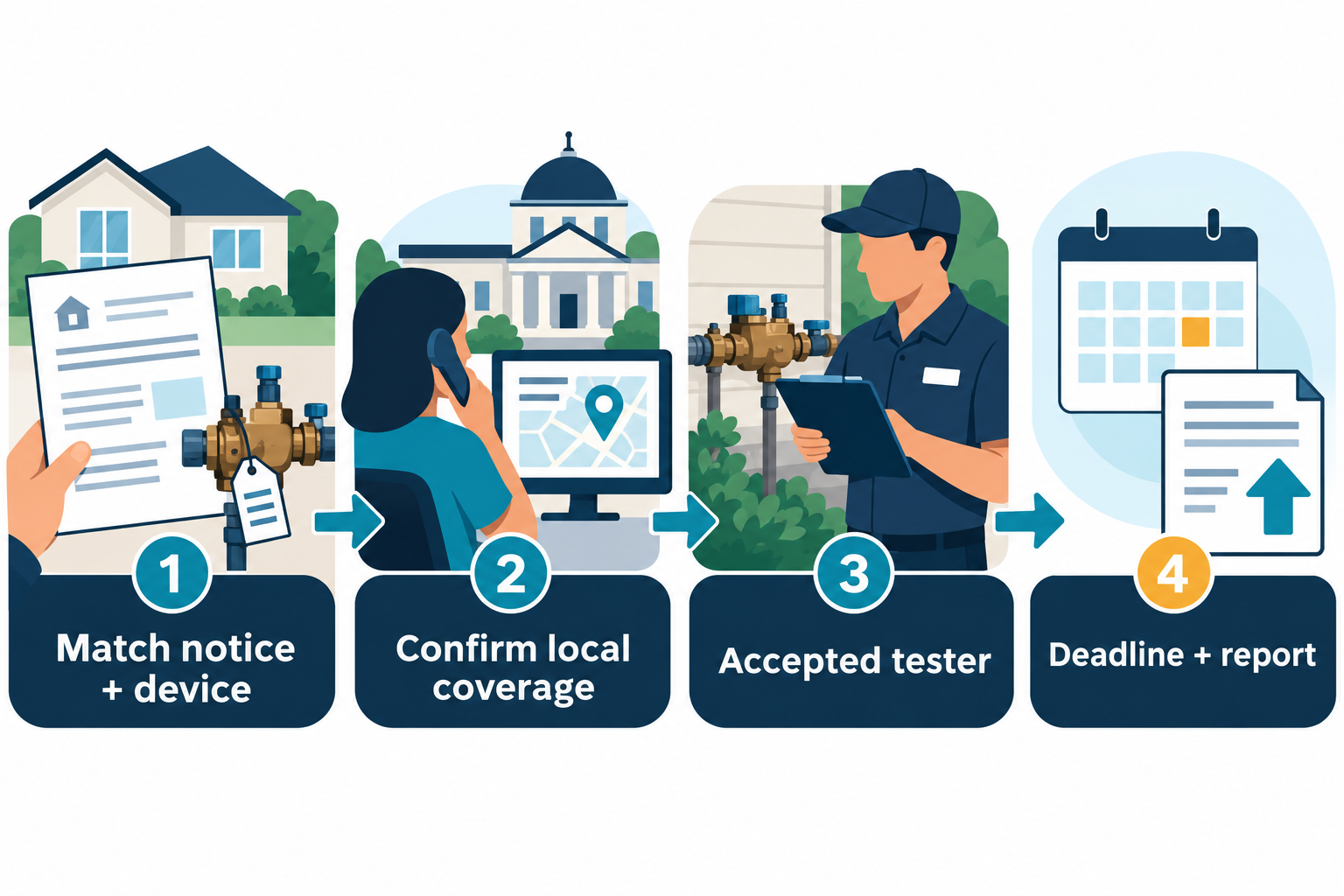
Read the utility, water authority, or inspector’s notice and confirm the property address, assembly identification, deadline, required tester credentials, report method, and person responsible for payment. If the letter mentions a survey, inspection, or hazard assessment, ask whether that is separate from the routine assembly test and what qualifications the authority accepts for each service.
Find the device’s location and label using the notice, prior invoice, or property records. Do not choose a device or infer its test interval from a product photo. A small hose-bib vacuum-breaker accessory and an ordinary shutoff valve are different scopes from a testable premises assembly listed in a utility’s compliance record. If the paperwork and physical tag do not match, ask the authority or a qualified professional to reconcile them before commissioning replacement work.
Backflow protection concerns a connection that could allow water to move in an unintended direction under certain pressure conditions. The required protection depends on the actual connection and hazard assessment. For example, Seattle Public Utilities says actual or potential cross-connections need to be eliminated or properly protected and states that its specialists determine the required protection for specific installations. That does not establish that a particular residential irrigation line, pool, boiler, or household needs the same assembly—or that another utility follows Seattle’s approach.
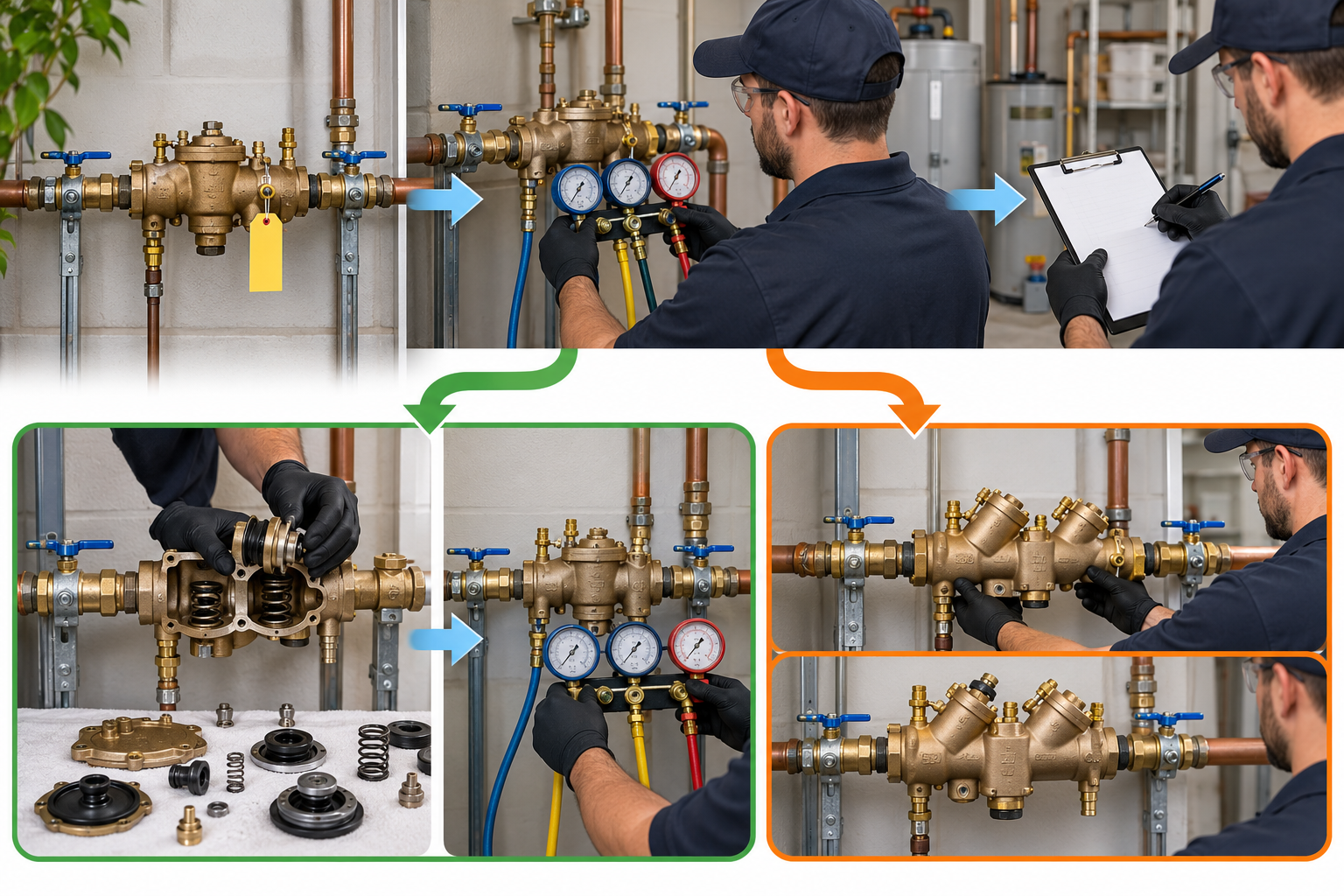
Separate testing, survey, and repair
A routine test checks a named assembly under the authority’s accepted procedure and creates a result or report. It is not a whole-home plumbing inspection and does not automatically include a cross-connection survey, installation check, repairs, permit, or reinspection. A survey may identify unrecorded connections and can require a qualified surveyor; it is a separate scope when requested.
Before approving a test visit, ask whether the price includes locating and identifying each assembly, the test, the report filing, and the utility’s required documentation. Clarify whether the tester will submit the results directly or expects the owner to file them, and whether a failed result leads to a separate written repair quote. Testing should be done by the credentialed professional accepted by the authority, using the applicable test and reporting requirements.
Some jurisdictions specify testing after installation, repair, replacement, or servicing, as well as a recurring interval. Toronto’s program, for example, includes covered Part 3 residential properties under the Ontario Building Code as well as industrial, commercial, institutional properties and construction sites. Toronto’s posted terms require testing at installation, within 72 hours after certain service work, and at least annually, with reports from a Certified Cross Connection Control Specialist. These duties apply to the City program’s covered properties; they are not a schedule for every Canadian home.
Seattle gives a different local example: assemblies covered by its program require initial inspection and testing by a Washington-certified Backflow Assembly Tester before service, then annual testing and testing after repair or replacement. A neighbor’s lack of a notice does not resolve whether another property’s installed device is covered; Seattle itself notes that records may not reflect a device or that it may not require testing. Confirm the specific property and assembly with the local authority.
What changes the installed cost
The assembly’s size and type, the failure reported, and where it is installed can matter more than the device’s retail price. Compare the same work scope across bids:
- Visit and test: travel, minimum charge, number of assemblies, and whether a routine retest is included.
- Access: vault, pit, locked room, stored items, landscaping, excavation, or restricted working space.
- Repair: diagnosis, approved compatible parts, labor, drain or discharge control, return visit, and retest.
- Replacement: assembly, fittings, piping changes, isolation, supports, access work, disposal, permit, and inspection.
- Reporting and handoff: record update, tagged device, report submission, required inspection, and next due date.
- Water interruption and related work: planned shutdown, coordination with occupants or utility, and any pressure-regulator, shutoff, or thermal-expansion work that is separately required.
A failed test does not by itself prove that replacement is necessary. The assembly may be repairable with available parts, or it may have corrosion, physical damage, an obsolete model, inaccessible isolation, or another condition that makes replacement the appropriate option. Ask the tester to identify what failed and the authority-accepted path to return the system to compliance. Compare a repair plus retest with a replacement plus testing, permit, and commissioning on a written scope.
Use local price examples as quote context
Published prices are limited and are not a representative North American survey. Two provider pages show how location, access, and service scope can move the amount:
| Published example | What the provider lists | Scope limit |
|---|---|---|
| Seattle-area certified tester | A test is listed at $60 per assembly for units up to 2 inches, $70 for larger units, or $100 for a vault. Major repair labor is listed at $65 per hour plus parts; the page says an included test follows the repair. | One provider’s posted schedule. Access, landscaping, parts, travel, and utility acceptance can change the invoice; it is not a Seattle market average or a replacement quote. |
| Toronto/GTA plumbing provider | Its 2026 page lists $180–$320 for a single-device test, $140–$250 per device for a multi-device visit, $280–$900 for a failed-device repair, and $650–$2,800 for replacement. | The provider describes commercial work and certain residential setups such as irrigation or boiler systems. Its page prints $ without an ISO currency code; confirm the currency and exact single-home scope in a written quote. |
| Toronto permit fee schedule | The City’s 2026 user-fee table lists $92.79 per backflow device for application intake, plan review, and inspection activities. | A separate local permit-related fee, not a test, installation, or replacement price. Confirm that the current fee and permit apply to the property and work date. |
The examples are not directly comparable. The first separates test and repair labor; the second gives broader provider ranges; the City’s fee covers permit-related activities. Use them to identify likely quote lines, then request a current amount from a qualified tester or plumber for the actual tagged device, location, authority, and work.
Compare repair with replacement on the same basis
For a failed assembly, request separate options when both are viable. A repair quote should name the diagnosis, parts, labor, return visit, retest, report, and warranty. A replacement quote should identify the proposed assembly, permit and inspection responsibilities, installation scope, accepted initial test, report filing, and any required system changes. Ask whether removal of the old assembly, temporary isolation, supports, drainage, access restoration, and new test tags are included.
The selected assembly and installation are professional design decisions. This article does not tell a homeowner how to test, bypass, select, or install a device. If an authority has specified a device class or a qualified professional recommends a replacement, ask for the written basis and verify approval with the responsible authority before ordering.
Include permit and operating obligations
Installation and replacement can require a permit or inspection even when a routine test does not. Toronto’s program states that new installations and replacements require a building permit and that its devices are installed by a plumber licensed with the City. The local authority may also require an initial test, report, tag, or follow-up within a stated window. Check the current permit guide and fee schedule rather than applying Toronto requirements elsewhere.
Ongoing cost can include recurring tests, reports, survey updates, access, repairs after a failed result, and the time to coordinate a shutdown. In Toronto, covered program records are retained on-site for at least seven years, and the City can require a new survey on a five-year cycle or after a change in hazard level. Other programs may have different obligations. Put the next due date, accepted tester credential, reporting route, and owner responsible for scheduling in the property record.
Assemblies can also interact with nearby pressure regulators, shutoffs, check devices, and water-heater thermal-expansion controls. A contractor may need to address one of these to complete a permitted installation, but the relationship should be explained and priced as a separate line. A backflow assembly is not a pressure regulator, and replacing one does not guarantee correction of unrelated pressure or hot-water symptoms.
Quote questions
- Which exact assembly and service address are covered by the notice?
- Is this a routine test, a required survey, a repair, or a replacement project?
- Which tester credential and report format does the authority accept?
- Does the price include travel, identification, test report submission, and retest?
- If the device fails, what finding supports repair or replacement, and how is that option priced?
- Are access, isolation, discharge, permit, inspection, commissioning, and restoration included?
- Who pays and who schedules the next recurring test?
- Which conditions require approval from the utility, inspector, association, or property owner before work begins?
At handoff, retain the assembly make and model, serial or tag, test result, report confirmation, repair parts or replacement record, permit or inspection documents, and next due date. That record makes the next service visit easier to price and helps the homeowner distinguish an actual compliance obligation from an unrelated plumbing recommendation.