
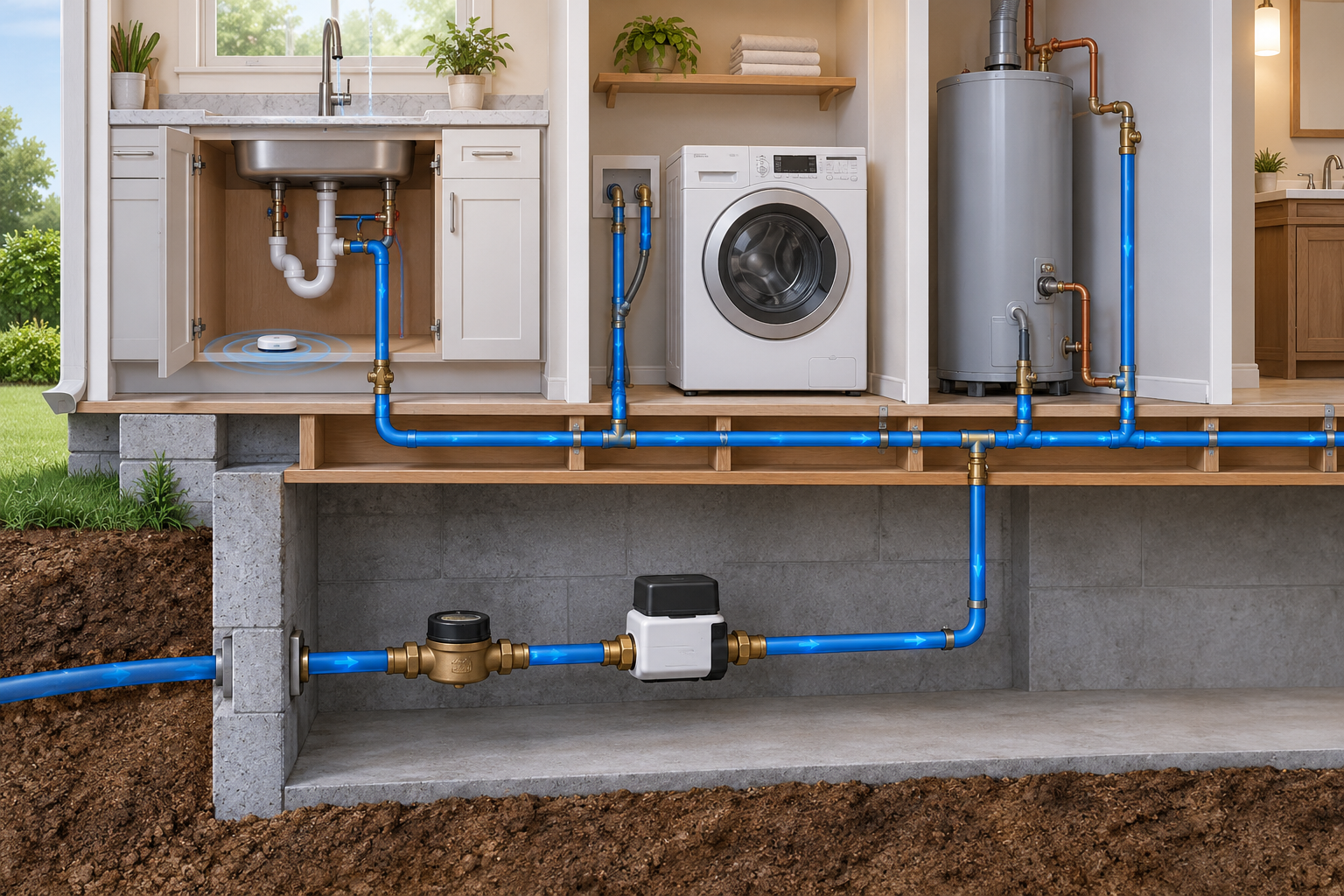
Leak-protection equipment ranges from a dampness sensor under one fixture to a flow-monitoring system installed in the main line, with or without an automatic shutoff. These are different purchases. The cost and value depend on what the system can detect, whether it can stop water, where it is installed, how it is powered and connected, and what the homeowner will do when an alert arrives.
Four system types
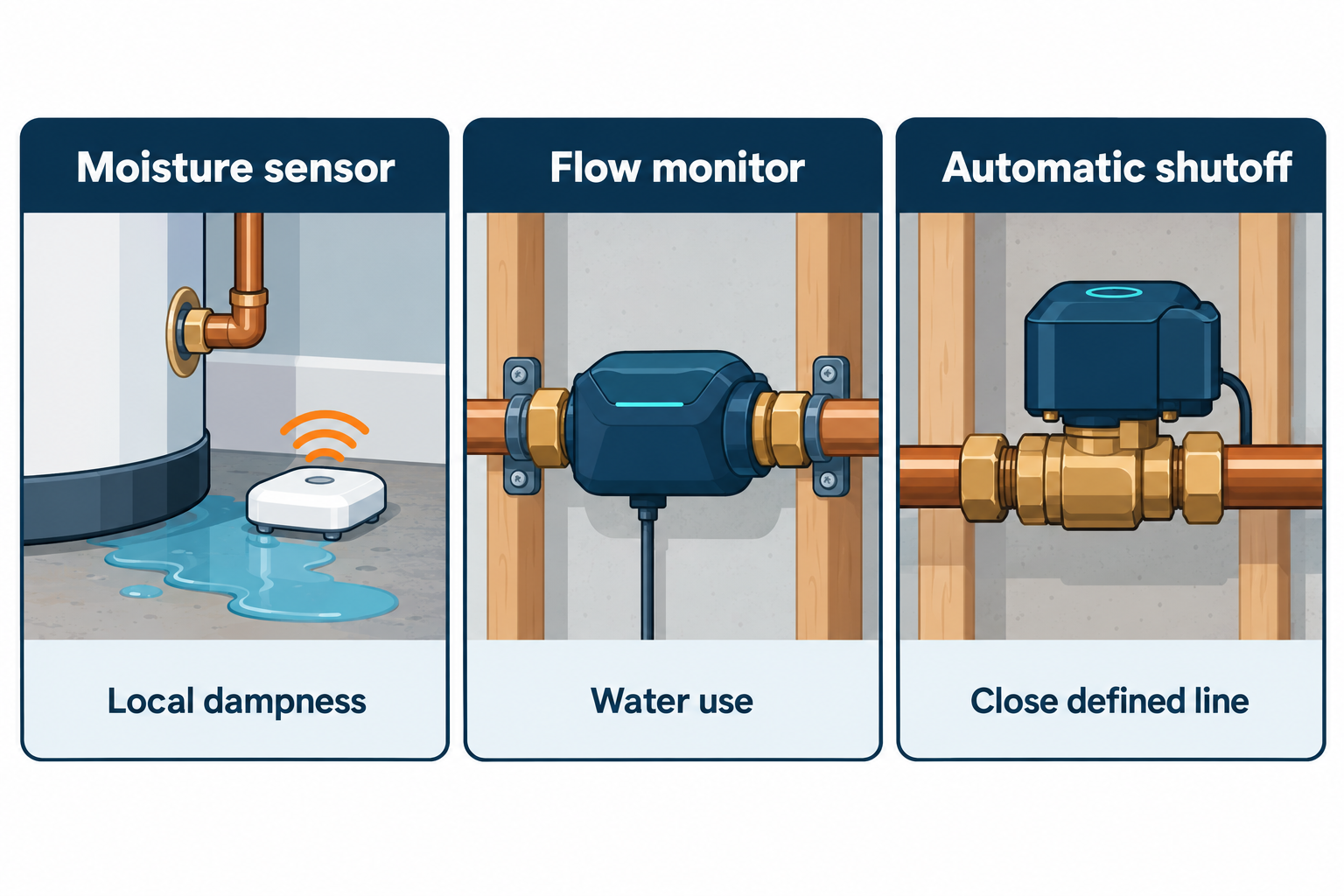
EPA WaterSense distinguishes common technology classes:
- Moisture sensor: detects unexpected dampness at a selected location. It may send an alert or activate a local shutoff, depending on the product.
- Flow monitor: measures flow or pressure and looks for irregular use at a point of entry or selected line. It may detect a leak without water reaching a sensor.
- Alert-only device: notifies the homeowner but does not itself stop the water.
- In-line automatic shutoff: is installed within the water piping and can close the line when the product’s logic identifies a qualifying event.
An in-line installation is more invasive and is likely to need a plumber. A sensor may be easier to place but protects only the location and conditions it can observe. A whole-home label does not guarantee whole-home detection of every small, intermittent, or hidden leak.
What the installed cost contains
Separate equipment from labor, main-line cutting and reconnection, valve compatibility, power, Wi-Fi or network setup, sensors, programming, testing, and any subscription or monitoring fee. The installation location can require access, a new outlet, weather or freeze protection, or coordination with a pressure regulator, backflow device, fire-sprinkler system, or shared-property arrangement.
Available market research does not establish a universal installed-price range. Retail prices are not installed prices, and marketing claims are not proof of compatibility or insurance savings. Ask the installer to identify the pipe size and material, pressure limits, valve position, manual override, outage behavior, and maintenance requirement.
Damage prevention versus financial payback
The economic objective is often reducing the duration or severity of a water loss, not generating a guaranteed payback from water savings. Expected value depends on the chance of a leak, how quickly someone responds, the property’s exposure, equipment reliability, installation price, and insurance terms. Do not use an unsupported ROI percentage or assume an insurer will provide a discount. Ask the insurer directly about current, property-specific eligibility.
A homeowner can make that comparison without inventing a failure probability. Name the event being addressed, how long water could run before someone notices, the rooms or finishes exposed, whether the device can detect that pattern, whether it can close the relevant line, and who will respond. Then compare the installed and recurring costs with the household’s own deductible, documented coverage, and plausible repair exposure. This is a scenario check, not an actuarial prediction: it shows whether the purchased function matches the loss the owner cares about.
Scenarios
Targeted protection: A washing machine, water heater, or remote fixture is the concern. Moisture sensing may be proportionate if the homeowner can respond to alerts.
Whole-home alerting: The homeowner wants flow visibility and irregular-use notification. This can provide useful information but does not necessarily shut water off.
Automatic protection: The homeowner wants a main valve to close under defined conditions. Confirm false-alert handling, manual override, power and connectivity behavior, and whether a missed event remains possible.
| Loss scenario | What to verify before paying for protection |
|---|---|
| A supply hose leaks while the home is empty | Whether a sensor is placed at that appliance, or the flow system can recognize the event and close the correct line |
| A slow concealed leak occurs behind a wall | Whether the product can detect low or intermittent flow; a main-line monitor may alert without locating the leak |
| Water appears beneath one sink while someone is home | Whether a local sensor is enough and who will receive and act on the alert |
| A seasonal home is unattended | Whether power, network, shutoff operation, and a reachable responder remain dependable |
The table is a selection aid, not a product-performance guarantee. Ask for the model’s documented detection limits and test the installed configuration under the manufacturer’s procedure. If the desired outcome is only notification, do not pay for a shutoff feature that the household will not maintain; if automatic isolation is the objective, verify which branches it actually closes.
Maintenance and boundaries
Sensors need placement checks and battery or power maintenance. Flow systems may require calibration, app access, or a subscription. Automatic valves should remain reachable and tested according to the manufacturer. Broader networking, hubs, and automation belong to a smart-home scope; the plumbing decision here is the water-side equipment and installation.
This equipment does not replace a functioning manual main shutoff, routine leak checks, or source repair. It also does not dry walls, repair a burst pipe, or pay for restoration after a loss.
Compare the installed and recurring price
Ask bidders to separate the device, plumber’s labor, main-line cutting and reconnection, valve or electrical changes, access, testing, and finish restoration. List subscriptions, batteries, sensor replacement, calibration, and service visits as recurring costs instead of burying them in the equipment price. Identify whether the proposal is alert-only or includes a valve, which line it closes, and which compatibility assumptions remain to be checked. Confirm any insurance credit directly with the insurer before counting it in the financial comparison.
Use the later coverage map and loss scenarios to decide whether bids deliver the same outcome. A sensor at one fixture is not the same project as a monitored main-line valve, and a product label alone does not establish its detection limits.
Match the system to the loss you want to limit
For a washing machine, remote water heater, or one cabinet, a moisture sensor may be proportionate if someone can respond to its alert. A flow monitor can identify unusual use without water reaching a sensor, but may not identify the leak location. An automatic valve can stop flow when its product logic qualifies an event; its thresholds, manual override, and false-alert behavior are model-specific.
A vacant or seasonal home may place more value on remote alerts and shutoff, but only when power, connectivity, valve operation, and a reachable responder are reliable. Ask how the device treats irrigation, long draws, or small continuous flow. A homeowner who disables frequent alerts loses the intended protection, while an automatic close during normal use can create disruption. Compare the system’s actual response with the failure pattern, not its feature count.
Map what the system can see and isolate
Ask which incoming line, branches, fixtures, appliances, outdoor connections, and concealed zones the system can observe or close. A main-line monitor may detect a change in whole-house flow without locating it. A cabinet sensor may identify water there while leaving an unrelated branch unprotected. A whole-home label does not guarantee detection of every small, intermittent, or hidden leak.
For separate units, additions, wells, irrigation, fire protection, or shared plumbing, draw the boundary before choosing a device. Confirm pipe size and material, valve position, access, and whether the installation can safely be serviced. Keep any fire-sprinkler or product-compatibility question specific to the equipment and local design; the category evidence does not establish universal compatibility.
Test, maintain, and respond
At handoff, have the installer test the sensor, valve, manual override, alert path, and any backup or bypass using the manufacturer’s procedure. Record the device model, normal-use assumptions, notification recipients, account owner, subscription terms, and maintenance schedule. EPA recommends checking an installed leak-detection or flow-monitoring system annually to confirm it still operates; use the product instructions for the actual test and service steps.
Decide who will respond to an alert, who can reach the property, how water is restored after a close, and what happens if the home is rented or seasonal. If several people use the system, name the account owner and a backup contact, keep the credentials and manual accessible, and explain how a false shutoff is reversed. Include subscription renewals, batteries, sensor replacement, and service visits in the annual ownership budget; an unmaintained connected feature should not be counted as functioning protection. Keep the manual main shutoff accessible. If power, internet, batteries, a subscription, or a cloud account fails, know which functions remain. The device does not dry a wall, repair a pipe, or pay for restoration, and no insurer discount or damage reduction should be assumed without written confirmation.