
The cost of a leaking water heater depends first on where the water originates. A connection, drain, valve, or relief-related leak may be repairable. Water escaping from the tank or equipment body can indicate a replacement decision. Because an active leak can damage the property, emergency isolation and damage control may be more urgent than deciding which new model to buy.
Identify the leak category
Water around the base does not prove that the tank itself has failed. A plumber may inspect the top connections, temperature/pressure-related components, drain, seams, pan, nearby piping, and condensate or discharge path as applicable. The diagnosis should state whether the equipment body is leaking or whether water is arriving from a repairable connection.
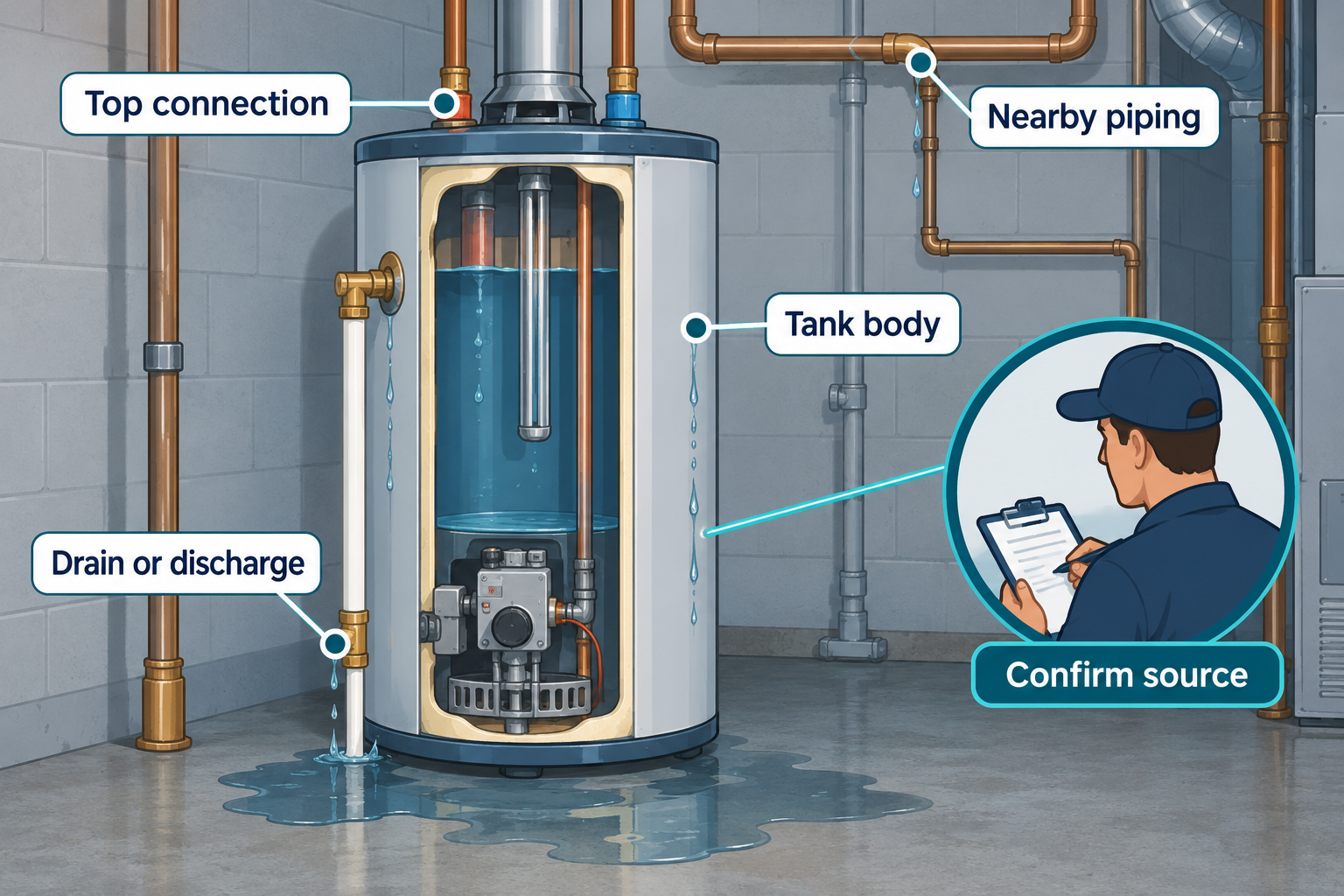
Use qualified service and current manufacturer/local guidance when water is near energized equipment or fuel-burning components, or when pressure-relief and hot-water hazards are involved. This article does not provide a universal shutdown sequence because equipment and site conditions vary.
Repair versus replacement
A connection or valve repair can be proportionate when the tank is sound, the fault is confirmed, parts are available, and the installation remains suitable. A leaking tank body generally changes the decision toward replacement because repairing the reservoir may not restore reliable containment; the exact diagnosis and manufacturer guidance control.
HomeGuide reports specialist repair-cost observations, while HomeStars reports broad Canadian installation and repair ranges with different scopes. These sources do not establish a guaranteed repair price or a unified US/Canadian range. Ask for diagnosis, emergency labor, parts, removal, replacement equipment, and installation as separate lines.
Damage-risk economics
The plumbing fix and property recovery are separate. A pan, floor drain, automatic shutoff, leak sensor, or accessible manual valve may reduce response time or contain some events, but none guarantees that a failure will not cause damage. Drying, demolition, disposal, mold assessment, flooring, drywall, painting, contents, and insurance documentation belong to a restoration or finish scope when consequential.
An emergency replacement quote should identify whether it is a safe temporary measure, a permanent installed unit, or both. Do not let a fast equipment swap omit removal, access, testing, venting, electrical, condensate, expansion, or other required installation conditions.
Cost drivers
- leak location and diagnosis;
- emergency versus planned scheduling;
- repair component or complete replacement;
- tank capacity, fuel, and technology;
- removal, delivery, access, and disposal;
- venting, electrical, condensate, drain, pan, expansion, or tempering scope where applicable;
- permits and inspection; and
- separate drying and finish restoration.
Scenarios
Repairable connection: Water is traced to a fitting, valve, or drain connection and the tank is sound. Price the repair, testing, and any access.
Uncertain base leak: Water is at the base but the source is not confirmed. Buy diagnosis and controlled stabilization before choosing a replacement based on appearance alone.
Tank/body failure: The reservoir or body is confirmed to be failing. Compare an urgent replacement with a planned technology choice, using a like-for-like installed quote as the benchmark.
Damage event: Water has entered finishes or contents. Coordinate source correction with drying and recovery, and do not treat a plumber’s cleanup as complete restoration.
Quote questions
- Where exactly is water coming from, and what inspection confirms it?
- Is the tank/body sound, or is replacement being recommended because of a confirmed failure?
- What does the emergency price include, and what is temporary?
- Are removal, delivery, access, installation, testing, permits, and cleanup included?
- Are pan, drain, expansion, tempering, venting, electrical, or condensate conditions addressed?
- Which water-damage and finish-restoration costs are outside the plumbing quote?
The right decision protects the property first, then compares repair and replacement using the complete installed scope. A low equipment number is not a leak-response plan.
A controlled emergency sequence
Ask the responding professional to distinguish immediate isolation, temporary containment, diagnosis, permanent repair, and restoration. If the water source is not confirmed, a replacement recommendation may be an educated risk decision rather than a diagnosis. That can be appropriate in an emergency, but the uncertainty and return conditions should be stated.
If replacement is required, keep a like-for-like installed option as a benchmark before selecting tankless or heat-pump equipment. A technology change may need different venting, electrical supply, space, condensate, or controls and may not be the safest emergency scope. A planned follow-up can compare those choices after the property is stable.
Damage containment is not damage recovery
A pan, accessible shutoff, moisture sensor, or automatic valve can be part of a future risk-reduction decision. None replaces drying and reconstruction after a covered loss. Ask who documents moisture, removes damaged material, handles contents, and repairs finishes. If insurance is involved, coordinate scope and photographs without allowing an insurer or plumber’s preliminary estimate to stand in for a complete repair plan.
Preserve evidence without delaying protection
Photograph the model plate, leak location, pan, surrounding floor, and visible corrosion when it is safe. Ask the contractor to note the confirmed source, what was isolated, what was repaired or removed, and the final leak test. This record supports warranty and insurance conversations and makes clear whether the emergency work was stabilization or a permanent installation.
Do not delay necessary isolation to build a perfect record. Water near energized equipment, hot surfaces, fuel, or pressure-relief components deserves qualified service. Once the source is controlled, compare the repairable connection, like-for-like replacement, and technology-change options with restoration and access included.
Separate the source from the damage
Water at the base of a heater does not prove that the tank itself has failed. The source may be a drain valve, relief discharge, temperature connection, flex line, shutoff, condensate route, pan, or a leak that travelled from above. Ask the technician to identify the observed source, the evidence, and the components that were not visible. A replacement recommendation should explain why repair is not a reasonable option rather than relying on the presence of water alone.
If the tank is removed, preserve the model plate and photograph the connections when safe. This helps establish whether the failed item was the vessel, an attached part, or the installation around it. It also prevents the emergency removal from erasing useful information before a warranty, insurer, or later contractor reviews the condition.
Make emergency and permanent work distinct
An emergency visit may isolate the heater, contain a discharge, or make the home safe while a permanent decision is pending. Ask whether the invoice includes a temporary measure, a credit toward replacement, or a limitation on warranty. A temporary connection should not be treated as a completed replacement, and a same-day replacement should not include unrelated upgrades without a clear reason.
For a planned replacement, compare the existing storage option with technology changes only after venting, fuel, electrical, condensate, clearance, delivery, and disposal are priced. If a repair is selected, record the part replaced, test performed, and any remaining risk. If replacement is selected, include removal, delivery, installation, commissioning, access, finish work, and old-unit disposal.
Check the room after the leak is controlled
A heater leak can affect flooring, cabinets, drywall, insulation, contents, and electrical or fuel equipment. Plumbing source correction and drying or reconstruction may belong to different contractors. Ask who protects the area, who documents moisture, and who restores opened finishes. Do not assume a new heater invoice includes every consequence of the leak.
At handoff, confirm the relief path, shutoff, drain or pan arrangement, operating instructions, model and warranty information, and the result of the leak test. The completed record should say what was corrected and what was referred for separate restoration.
Compare the room condition with the equipment choice
If the heater sits in a finished room, attic, closet, garage, or occupied area, include protection, access, drying, and restoration in the decision. A replacement may stop the source while leaving a wet subfloor, damaged cabinet, stained wall, or affected insulation. Ask whether those materials are being evaluated by the plumber or referred to another contractor. Source correction and reconstruction should be coordinated without pretending they are the same trade.
For a recurring leak, identify whether the pattern points to pressure, temperature, corrosion, movement, a connection, or a location problem. One failed fitting may justify a focused repair; repeated failures or a deteriorated vessel may justify replacement or a broader assessment. The evidence should determine the scope. A general promise that a new heater solves every nearby leak is not a diagnosis.
Keep the emergency invoice, permanent work, and follow-up observation distinct. At completion, note the date of the test, the condition of the surrounding area, and what remains open. This record helps a future owner see whether the installation was a temporary stabilization, a completed replacement, or a plumbing repair that still required restoration.
Use the closeout record to prevent scope confusion
The closeout should identify the failed source, isolation point, component or heater removed, new work, test, and finish boundary. If moisture or contents were referred elsewhere, name that handoff without assigning the restoration result to the plumbing contractor. If an old connection, pan, drain, or relief arrangement was reused, record it.
For a homeowner comparing bids after an emergency, ask each contractor to state what is confirmed and what remains an allowance. A like-for-like replacement can be compared with a repair or technology change only when removal, delivery, access, infrastructure, commissioning, and restoration are visible. The right scope is complete for the actual leak, not merely quick at the point of sale.