
A flooring estimate is meaningful only after the water source is controlled and the affected assembly has been assessed. The visible finish, cushion or underlayment, adhesive, subfloor, and framing can respond differently. A dry-looking surface alone does not show whether the layers below are sound.
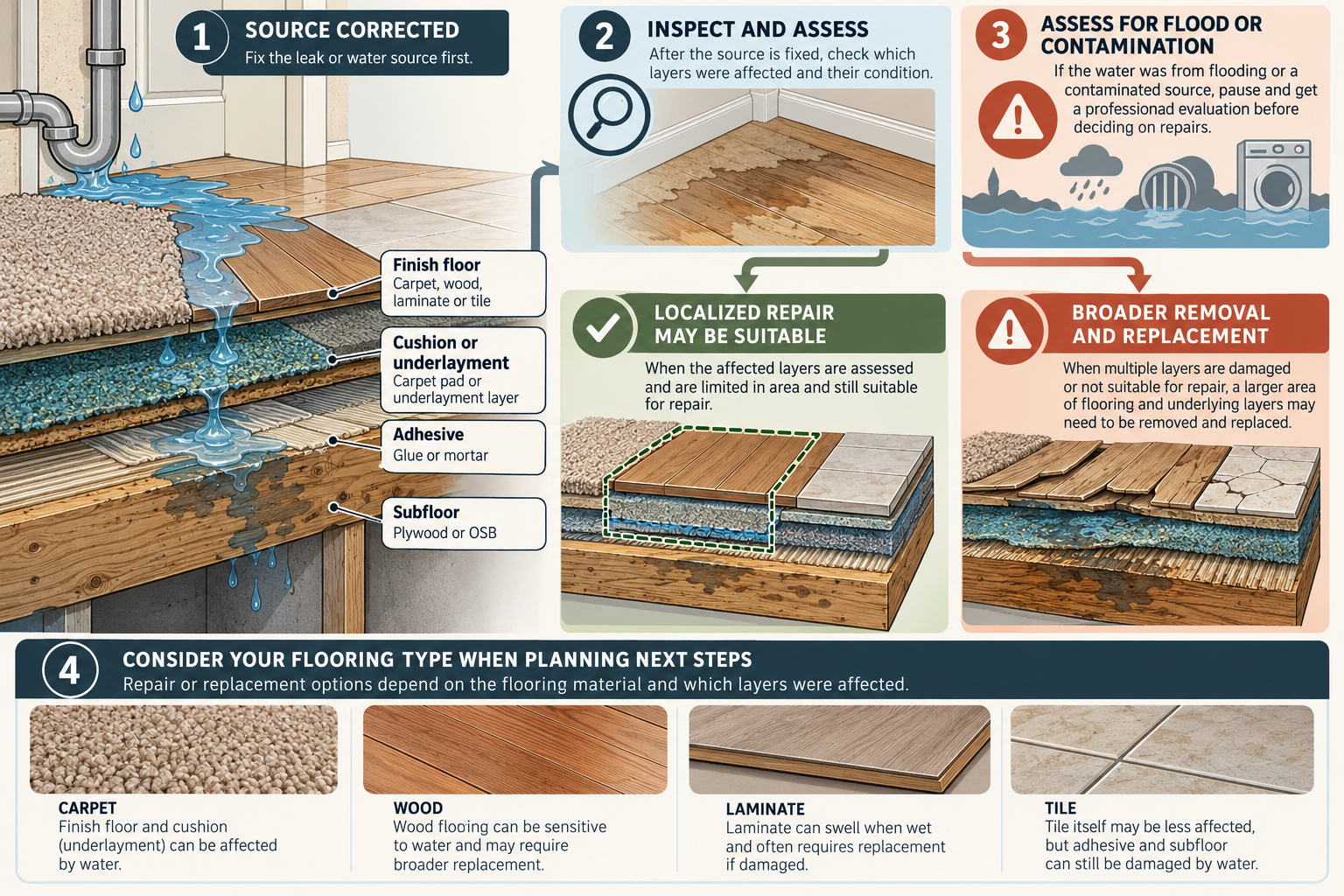
Establish what happened before choosing a repair
Confirm that the leak, overflow, or other source has stopped. Then identify what water reached the floor, how far it spread, how long materials stayed wet, and which layers may have been affected. A small clean-water plumbing leak is a different decision from floodwater or sewage exposure.
If water is still entering, a finish replacement quote is premature. Source correction, contaminated-water handling, mold remediation, structural repair, and insurance-driven reconstruction may require separate qualified work before an ordinary flooring project can proceed.
Flood-soaked flooring has a distinct removal boundary
For Canadian flood cleanup, Health Canada says flooring soaked by flood water should be removed and discarded. This direction is specific to flood-soaked flooring; it is not a rule for every corrected clean-water leak, and the page does not establish requirements for every other jurisdiction or product.
Do not use the ordinary localized-repair options below to justify retaining flooring soaked by flood water in the situation covered by that guidance. Sewage-contaminated water calls for additional precautions and local public-health or qualified professional input. Health Canada also cautions that drying within 48 hours makes mold growth less likely; that is risk-reduction guidance, not a universal material-drying deadline or proof that a particular floor is ready to rebuild.
How flooring materials change the decision
Carpet and cushion: The carpet face, backing, cushion, tack strips, and subfloor may be affected differently. A surface that looks clean does not establish that the cushion or base is dry or uncontaminated. A replacement quote may need to separate carpet, cushion, removal, disposal, seams, furniture handling, and substrate preparation.
Wood: Solid or engineered boards may swell, cup, stain, lose finish, or move at joints. The pattern and extent of damage matter, but sanding or replacing one board cannot solve a wet or moving base. Matching species, width, finish, age, and sunlight exposure can also make a technically small repair visible.
Laminate and resilient flooring: Laminate can swell or delaminate after water reaches the core or edges. Resilient flooring may remain bonded while moisture affects the adhesive or substrate below. Product instructions and the condition of the installed assembly matter; a water-resistant product label does not prove that a wet installation can remain.
Tile and stone: The visible tile may survive while grout, setting materials, underlayment, or the subfloor needs assessment. Loose or cracked tile can reflect movement or a problem below the finish. A replacement decision should account for the layers that need access, not only the tile that looks damaged.
The area that needs inspection may be larger than the area where the finish changed color. Water can travel beneath a floor or collect at edges, cabinets, walls, and low points. A contractor should explain which areas are being checked and whether removal is needed for access. That does not mean every wet floor needs complete demolition; it means the quote should distinguish what was observed from what remains concealed.
Compare localized repair with broader replacement
A localized repair is most plausible after a limited, clean-water event when the source is corrected, the affected layers are dry and sound, the material can be matched, and the repair can be completed without hiding damage below. A small patch can still be costly when there is a minimum service charge, difficult access, or a need to blend the work across a larger area.
The repair boundary should follow both the damage and the way the floor is built. A board or tile may be replaceable by itself, while a carpet repair can depend on whether a matching remnant exists and whether a seam can be placed inconspicuously. A repair that stops in the middle of an uninterrupted room may save material but leave a visible transition. Ask the installer to explain where the work would stop and what the finished edge will look like.
Partial replacement may make sense when damage crosses several boards or tiles but stops at a natural seam, doorway, or other practical boundary. Replacing a continuous room or area may be more coherent when the finish is discontinued, the damaged material cannot be matched, many transitions would remain, or the floor must be opened to address a broader substrate problem.
Do not use a universal age, moisture, or percentage-of-floor threshold. The choice depends on the water source, exposure, finish and substrate condition, contamination, material availability, room layout, and the appearance the homeowner expects.
What drives the project cost
The finish itself may be only one part of the estimate. Ask whether the price includes assessment, moving and protecting furniture, removing and disposing of material, cleaning, drying or dehumidification, inspecting the underlayment and subfloor, replacing damaged base layers, installing new finish, transitions, trim, and cleanup.
Separate any unresolved source repair, structural work, mold remediation, contaminated-material handling, or insurance reconstruction from the finish quote. Those scopes can dominate the total and require different qualifications. If opening the floor may reveal additional damage, ask how the contractor will document it and price a change in scope before proceeding.
Finish and substrate costs can move in opposite directions. A relatively inexpensive surface can still require substantial labor if removal is difficult, disposal is costly, or the base needs correction. A premium replacement material can add material cost while reducing some preparation or matching work in a particular room. Compare the same layers, access, disposal assumptions, and final boundary rather than the material allowance alone.
Three useful comparison scenarios
A limited clean-water repair might involve a corrected source, a small affected area, a dry sound base, available matching material, and straightforward access. Compare the repair price with the minimum charge and the cost of blending.
A larger ordinary leak repair may require finish removal, inspection of cushion or substrate, drying assessment, replacement material, transitions, and furniture handling. The estimate should state which hidden layers are included and what condition must be met before new flooring is installed.
A flood or sewage event is not an ordinary localized-repair scenario. Follow the applicable flood-cleanup and contamination guidance, use qualified help for site-specific decisions, and price finish rebuilding after removal, cleanup, drying, and any necessary remediation have been addressed.
Questions to ask before approving work
Request a written scope that identifies the source-correction assumption, affected flooring and layers, water-quality assumptions, removal and disposal, inspection of the subfloor, replacement material, transitions, furniture handling, and cleanup. Ask what evidence the contractor will use to decide that the substrate is ready for new flooring, without treating an unspecified meter reading as a universal pass point.
For a proposed repair, ask why the material can remain and how the contractor will address matching and the layers below it. For replacement, ask where the work stops and whether a doorway, seam, or room boundary creates a more practical edge. Keep the finish bid separate from unresolved moisture, contamination, structural, or restoration decisions.
If a contractor recommends retaining part of the floor, ask which unaffected areas will remain, how the repair will connect to them, and whether the same product or a close match is available. If broad removal is proposed, ask whether it is needed to reach damaged layers, to achieve a consistent appearance, or both. Those are different reasons with different cost consequences. For each bid, note whether it assumes clean water, a dry base, completed source repair, and no concealed damage; otherwise, the totals are not comparing the same project.
The useful comparison is not simply patch versus replace. It is the cost of each complete, appropriately scoped path after the water source and the condition of the floor assembly are understood.