
Refinishing stain-grade trim is a labor-dominated restoration project. It may include cleaning, preparation, stripping where appropriate, sanding, color matching, repairs, clear finish, and careful protection of adjacent surfaces.
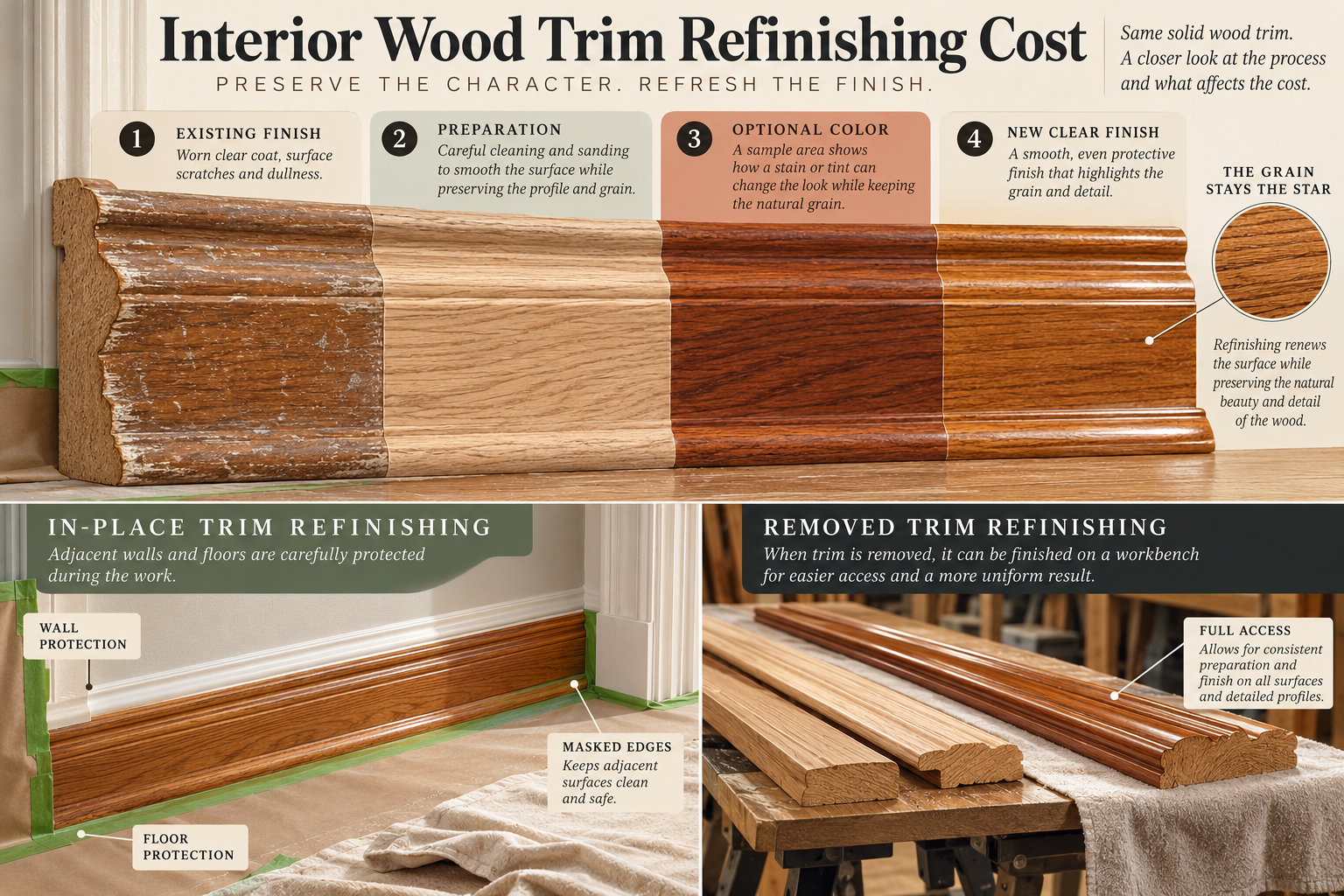
What changes the scope
Profile detail, linear footage, in-place versus removed work, existing coating, damage, corners, access, matching, number of finish coats, ventilation, furniture, and cleanup affect the estimate. Removing trim can improve access but adds labeling, storage, reinstallation, and possible damage to walls and floors.
Available market data does not establish a reliable U.S. or Canadian national refinishing range. Treat a specialist bid as a project-specific estimate and ask it to distinguish refinishing from repainting or replacement.
Safety and indoor air
Sanding or stripping older painted trim may require lead-safety assessment; U.S. and Canadian guidance differ and material content cannot be inferred from appearance. Health Canada identifies paints, glues, varnishes, and some composite materials as possible VOC sources and recommends ventilation and lower-emission products where possible. This does not establish a universal reoccupation time for a particular product.
Compare options
Ask for repaint, refinish, and replacement scopes with the same appearance goal. Confirm preparation, color matching, clear finish, product compatibility, protection, ventilation assumptions, furniture, and cleanup. Highly ornate or historically significant millwork may need a different specialist scope.
What refinishing includes
Interior wood-trim refinishing can include cleaning, preparation, stripping where appropriate, sanding, repairs, stain or color matching, clear finish, detail work, and reinstallation. Baseboards, crown, casings, paneling, and built-up profiles have different access and labor requirements. Refinishing in place may reduce removal but increase masking and detail work; removing the trim may improve access but adds labeling, transport, and restoration.
The budget should begin with the intended appearance. The homeowner may want to preserve visible grain, change a color, restore a worn clear coat, or make mismatched trim more uniform. Painting over stain-grade trim is a different decision from restoring it. Ask for a sample or test area when color and sheen matter.
Preparation and profile labor
Detail profiles collect old coatings and require more careful sanding or stripping. Corners, returns, nail holes, joints, doors, windows, and baseboards can make a small linear-foot project labor-intensive. In-place work requires floor and wall protection and careful separation from adjacent paint. Removed work may require replacement of damaged pieces or caulking and touch-up after reinstallation.
Existing finish compatibility matters. Do not assume a new coating can be applied directly to every old finish. Ask the contractor to state the preparation, primer, stain, and clear-finish system and to identify any product-specific limitations. Avoid making a generic promise about adhesion or cure time.
Refinish, repaint, or replace
Refinishing may fit when the trim is sound, the profile is worth preserving, and the homeowner values a wood appearance. Repainting may be less labor-intensive when the desired result is an opaque color and the surface can be prepared safely. Replacement may be more sensible when pieces are damaged, the profile is unavailable, or the existing finish requires excessive labor.
Compare the complete paths. Refinish may include stripping, sanding, color matching, clear coats, protection, and occupancy disruption. Paint may include cleaning, sanding, primer, caulking, and coats. Replacement adds material, removal, disposal, attachment, wall repair, corners, and finishing.
Safety, ventilation, and legacy finishes
Sanding or stripping older painted trim can disturb lead-containing coatings, and some legacy materials may raise asbestos questions. U.S. and Canadian guidance differs; content cannot be inferred from appearance. Obtain qualified local advice before disturbing a suspected coating.
Health Canada identifies paints, glues, varnishes, and some composite materials as possible VOC sources and recommends ventilation and lower-emission choices where possible. This does not establish a universal reoccupation time for a particular product. Follow the selected product and contractor’s current instructions.
Cost scenarios
A simple project has sound straight trim, a clear finish, limited profiles, and in-place access. A typical project includes preparation, profile detail, stain or clear finish, furniture and floor protection, and touch-up. A complex project includes ornate millwork, removal and reinstallation, color matching, high access, old coatings, or historically significant material.
Reliable national prices are weak for this specialty service. Ask for measured linear footage, profile details, preparation assumptions, and finish samples rather than relying on a generic rate.
Quote checklist
Request the trim type, length, profiles, in-place or removed work, preparation, stripping, sanding, repairs, stain or paint, clear coats, color matching, furniture, protection, ventilation, cleanup, and historic or hazardous-material exclusions. The right budget accounts for the labor needed to make the original trim worth keeping.
Define refinishing
Refinishing can mean cleaning and recoating an intact finish, deglossing and repainting, stripping to bare wood, repairing damaged sections, staining, or applying new clear coats. These are not equivalent scopes. State whether the goal is to preserve the existing color, change it, expose natural wood, or match adjacent trim.
Profiles, length, corners, returns, built-ins, stair details, and the number of separate pieces affect hand labor. A long run of simple baseboard is a different project from ornate casing that must be protected and blended in place.
In-place versus removed work
Working in place may reduce removal and reinstallation but increases masking, access, and the risk of affecting floors, walls, and furniture. Removing trim can improve preparation and finish control, but it adds labeling, storage, wall repair, disposal, and reinstallation. Compare both approaches with the same final appearance and protection assumptions.
Legacy coatings and condition
Old paint, varnish, caulk, and stain can affect adhesion and the method. Their age and composition cannot be confirmed from appearance alone. Where a suspect legacy coating or historic material is possible, obtain the applicable local assessment; ordinary stripping or sanding pricing is not hazardous-material abatement or preservation approval.
Compare alternatives
When trim is split, missing, swollen, or extensively patched, compare refinishing with replacement or selective new millwork. Include repairs, preparation, stain or paint, clear coats, color matching, protection, ventilation, access, and cleanup in both paths. A complete quote should explain why preserving the existing profile is worth the labor.