
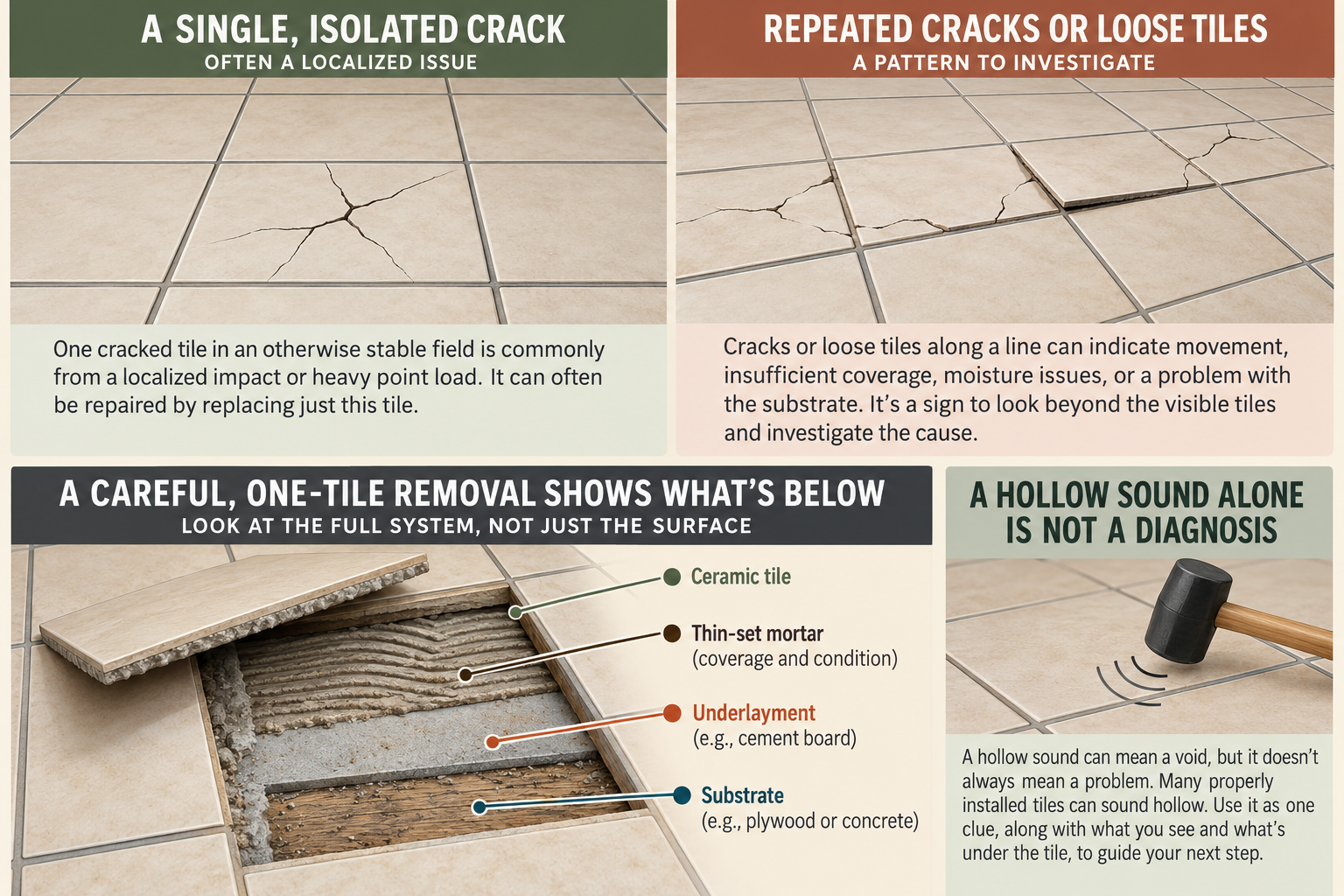
Cracked, loose, or hollow-sounding tile can have several causes. A replacement tile may solve a localized break, but it may not solve movement, poor coverage, moisture deterioration, delamination, or a damaged substrate.
Why a diagnosis affects the price
The estimate changes with the number of tiles, access to matching material, grout and setting-material removal, substrate condition, furniture, surrounding damage, and the need to investigate below the finish. A small repair may be dominated by travel, setup, and matching time.
TCNA explains that a hollow sound does not by itself prove imminent failure. It lists movement, poor thinset coverage, moisture, delamination, excessive deflection, and other conditions as possible contributors. It also notes that an epoxy injection may work in a small area but is impractical over a large one and may not correct the cause.
Cost boundaries
Available sources do not establish a reliable national U.S. or Canadian price. Ask for a scope that distinguishes inspection from repair, tile and grout replacement, substrate work, and structural or moisture-source correction. A finish-only allowance should not be presented as a diagnosis-free solution.
Before approving the repair
Ask how the replacement tile will be matched, how the cause will be assessed, what area may be opened, and what happens if the substrate is moving or wet. If deflection, failed framing, active moisture, or a larger tile-system failure is suspected, route that part of the project to the appropriate professional.
Start with the failure pattern
An isolated cracked tile can be a localized impact or material problem. Several cracked tiles, recurring grout cracks, loose tiles, hollow areas, or a tented pattern can indicate movement, poor coverage, moisture, delamination, deflection, or a damaged substrate. The visible defect is not enough to select a repair.
TCNA material explains that a hollow sound alone does not prove imminent failure and that a repair method must fit the actual condition. The budget should therefore separate inspection, tile and grout removal, substrate work, and the finish repair. A fixed price for replacing one tile may be appropriate only when the surrounding system has already been assessed.
Localized repair scenarios
Isolated replacement may fit when a matching tile exists, the base is sound, access is straightforward, and surrounding tiles are not moving. Labor can still include careful grout removal, setting-material removal, protection, curing, and color matching.
A small-area opening may be needed when the tile is loose, the setting layer has failed, or the base is questionable. The repair may expand if adjacent pieces or the substrate are damaged.
A larger investigation is more appropriate when failures repeat, movement is widespread, moisture is present, or the floor flexes. Replacing visible pieces without correcting the cause can create a short-lived repair and an unclear warranty.
Matching and demolition
Tile changes through wear, cleaning, light, and grout color. A discontinued product may be impossible to match exactly. Ask whether the contractor will use spare tile, source a close match, salvage from an inconspicuous area, or recommend a larger replacement for visual continuity.
Demolition may damage neighboring pieces if the setting material is strong or the base is weak. Confirm the size of the opening and the method for protecting adjacent tile, cabinets, trim, and furniture. A “one-tile” price that excludes matching, cleanup, or surrounding protection is not comparable with a complete service quote.
When repair is not enough
Repeated cracking can reflect movement or an installation-system problem. A wet substrate can require source correction or drying. Deflection or damaged framing can cross into structural work. A contaminated or hazardous condition can require a separate assessment. Keep those scopes outside an ordinary tile-replacement allowance.
Do not infer safety or structural condition from an intact-looking tile. At the same time, do not assume that every hollow sound requires full replacement. The appropriate level of work is the smallest scope that is supported by the observed pattern and the condition beneath it.
Repair versus larger replacement
Broader replacement may make more economic sense when matching material is unavailable, failures are spread across a continuous area, access requires removing many tiles, or the substrate correction is already extensive. Compare removal, disposal, substrate preparation, new tile, setting materials, grout, transitions, and restoration against the localized repair.
Questions for the contractor
Ask for the observed failure pattern, proposed cause assessment, matching plan, number of tiles, grout and setting-material removal, substrate opening, moisture or movement assumptions, furniture, disposal, and concealed-condition allowance. The best quote makes clear whether it is a cosmetic replacement, a functional repair, or the first stage of a larger tile-system investigation.
Local repair or a larger opening?
A single broken tile and a repeating field of loose tiles are different repair budgets. One isolated break may be replaceable if matching material remains and the surrounding installation is stable. Several failures near a doorway, along a crack, or across a broad area can make the installer investigate movement or coverage before replacing individual pieces. The pattern matters more than the count alone.
Ask how the proposed repair will establish whether adjacent tiles are stable. A contractor may tap or inspect the area, but a hollow sound by itself does not identify a cause or prove that every tile must be replaced. The quote should distinguish observations from the suspected explanation, then state what limited opening or further assessment would answer the unresolved question. If the substrate is damaged or moving, a surface-only patch can fail again.
Matching and access affect value
Keep spare tile, grout information, and product details when available. Without matching stock, a sound repair may remain visible because nearby tile has aged or the original product is discontinued. Ask whether the goal is functional stability, a close visual match, or both. A sample comparison and written expectation can avoid disagreement after installation.
Compare the repair with broader replacement only when both bids end at a clear, usable floor. Include demolition, disposal, base preparation, new tile, grout, transitions, furniture handling, and room downtime. A small replacement may be costly per tile because protection, setup, cleanup, and minimum labor remain. A broader scope may be more coherent when the failures are widespread, but should be supported by the observed condition rather than assumed from one crack.