
Subfloor work is the layer of repair beneath the finish. It may be a localized panel repair, a larger replacement, or preparation that is often mislabeled as leveling or underlayment. Clarifying the term prevents a finish quote from being compared with a structural quote.
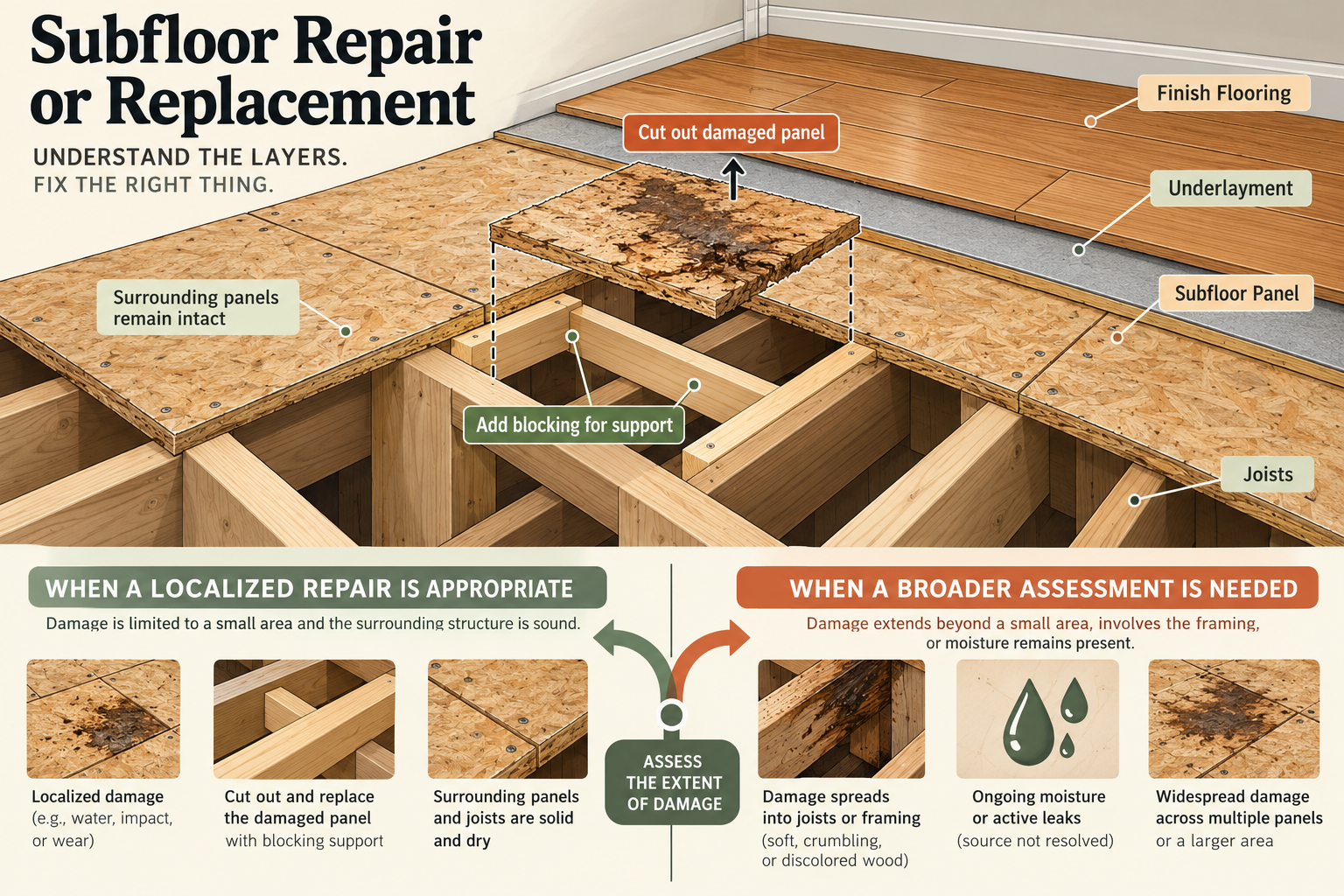
Repair versus replacement
Localized work may be reasonable when damage is limited, the surrounding panels are sound, the source of moisture is corrected, and the new finish can transition cleanly. Broader removal and replacement may be more economical when panels are extensively damaged, delaminated, contaminated, or incompatible with the proposed flooring system.
U.S. market observations report about $3–$10 per square foot for subfloor replacement in one pricing context and a $1,500–$5,000 example for a 500-square-foot project. These are not a national range; access, material, labor, and hidden conditions can dominate.
The conditions that change the quote
Ask about access from above or below, furniture and finish removal, panel thickness, fastening, moisture, insulation, joist condition, floor height, underlayment, and disposal. Work from above can require removing more finished flooring. Work from below can be limited by a basement, crawl space, utilities, or insulation.
Moisture damage should not be treated as a dry carpentry allowance until the water source is corrected and the affected assembly is assessed. A surface that looks dry may still have hidden damage or contamination.
Know the structural boundary
Rotten or undersized framing, significant deflection, settlement, or damaged joists can turn a finish project into structural work. The flooring contractor may identify the concern, but the repair scope belongs with the appropriate structural or foundation professional. The replacement finish can be priced after that decision is clear.
Quote questions
Ask for the exact area, material and thickness, removal method, fastening and underlayment scope, access assumptions, moisture findings, disposal, and a unit or allowance for concealed damage. Also ask how the finished floor height will affect doors and transitions.
What counts as subfloor work
The subfloor is the structural or semi-structural panel or layer immediately below many finish systems. In practice, contractors sometimes use “subfloor repair” to mean a surface patch, underlayment replacement, leveling, or a joist repair. Those scopes are not interchangeable. Ask which layer is being removed, which material is being installed, and what condition the new finish requires afterward.
A localized panel repair may be enough when damage is limited and the surrounding material is sound. A wider replacement may be more sensible when moisture, delamination, rot, contamination, or repeated fastening failure affects a continuous area. If the subfloor has to be opened to inspect a leak or movement, the finish restoration should be priced separately from the cause investigation.
Why homeowners discover this cost late
Subfloor condition is often hidden by carpet, resilient flooring, tile, wood, or multiple underlayment layers. A room can look acceptable until the finish is removed. Common triggers include a past or active leak, pet or appliance damage, long-term moisture, failed seams, fastener loss, previous patching, or a floor system that was installed over an unsuitable base.
The new finish also changes the requirement. Tile and stone are sensitive to movement and substrate quality. Laminate and resilient products need appropriate flatness and moisture conditions. Carpet may hide some visual irregularity but still needs a sound base for attachment and seams. Wood requires attention to moisture, attachment, and floor movement.
Repair or replacement scenarios
Localized repair can be efficient when the damaged panel can be cut out without disturbing a large finished area, the cause is corrected, and the patch can be supported and fastened properly. The cost may still include access, furniture, removal, disposal, and transition work.
Partial-area replacement may make more sense when damage crosses seams, several panels have failed, or a new finish needs a consistent base. It can reduce repeated small repairs but may require more finish removal.
Broad replacement becomes more likely when damage is widespread, the substrate is contaminated or delaminated, the floor height is inconsistent, or the proposed finish requires a different base. A broad replacement quote should state whether it includes underlayment, insulation, vapor or moisture work, and finish restoration.
Structural expansion occurs when inspection finds damaged joists, beams, settlement, significant deflection, or a persistent source of movement. The subfloor may be part of the access path, but the structural repair is a different decision and should be assessed by the appropriate professional.
Access changes the budget
Work from above usually requires removing enough finished flooring to reach and restore the panel. That can make a technically small repair expensive when matching material is discontinued or when the finish runs continuously through a room. Work from below may reduce finish restoration but can be limited by a finished ceiling, insulation, utilities, crawl-space access, or working height.
Ask whether the bid assumes an empty room, a clear work path, and access to the underside. Include disposal, protection, dust control, and restoration of baseboards or transitions. If the repair is near an appliance, cabinet, stair, or doorway, ask what has to be moved or disconnected.
Moisture and hidden conditions
Do not price wet or stained subfloor as ordinary carpentry until the water source is corrected. A surface can appear dry while the assembly, insulation, or framing remains affected. Contaminated water, mold, or hazardous material may require a separate assessment and should not be folded into an improvised finish quote.
Use a clear change-order process. The contractor should describe how additional panels, joist work, moisture findings, or disposal will be measured and approved. A low base price with an unlimited concealed-condition allowance is difficult to compare.
Quote questions
Ask for the panel material, thickness, area, access route, removal method, fasteners, support, underlayment, moisture assumptions, floor-height effect, disposal, and finish restoration. Confirm whether leveling, structural work, insulation, and source correction are excluded. A useful bid tells you what will be ready for the new floor and what decisions remain open after demolition.
Read the quote by layer
Separate the finish, underlayment, subfloor, framing, and moisture source. A finish contractor may quote a thin underlayment patch as “subfloor repair,” while another contractor may quote panel replacement. A third may identify joist damage that makes the project structural. These are different scopes even when they occur in the same room.
Ask for a cross-section in words: what is being removed, what remains, what material is being installed, how it is supported, and what finish will go on top. This simple description often exposes why two bids differ.
Flooring height and future access
New panel thickness, underlayment, leveling, and finish can alter the final height. Changes may affect doors, stairs, thresholds, cabinets, appliances, baseboards, and adjacent floors. If the repair is in a hallway or open plan, the transition should be planned before work begins.
Consider future access too. A localized repair under a fixed cabinet or appliance may be hard to repeat. If a moisture source or plumbing route remains possible, record the repair and product information so later work does not begin from guesswork.
When a staged quote is safer
If the existing finish remains, ask for a limited investigation or a demolition allowance followed by a revised price. If the substrate is already exposed, request measurements and photographs. A staged quote can separate known panel replacement from unknown joist, insulation, moisture, or contamination work.
This is especially useful after a leak. Correct the source, assess the assembly, then decide whether localized repair, broader replacement, or restoration is appropriate. Do not let a low finish allowance conceal a condition that needs another professional.
Pre-approval questions
Confirm panel type and thickness, access, supports, fasteners, moisture condition, insulation, framing exclusions, removal and disposal, leveling, underlayment, finished height, transitions, furniture, protection, and change-order method. Ask who signs off on concealed damage and whether the replacement finish is included.
The right subfloor budget does not promise a final number before the base is visible. It makes the known work measurable and the unknown work governable.
How to read a subfloor allowance
Ask whether “subfloor” means the structural sheet below the finish, an underlayment layer, a surface patch, or a combination of those scopes. Contractors sometimes use the terms loosely, but the layers have different purposes and different replacement consequences. A surface patch may prepare a localized depression; replacing a damaged panel can restore a load-bearing layer; neither is the same as repairing a joist or correcting a persistent moisture source.
The quote should identify the assumed panel material and thickness, the area included, how the panel is supported, and whether fasteners, adhesive, blocking, insulation, or access work are included. If the finish is tile, ask how the proposed base meets the selected tile system. If the finish is a floating product, ask how the repair affects flatness, height, and expansion space. The cheapest subfloor line can create a later flooring problem if it leaves a ridge, soft spot, or incompatible height.
Repair, replace, or stage the work
A localized repair may fit when damage is confined, the surrounding base is sound, access is reasonable, and the replacement finish can bridge the repaired area as intended. Broader replacement may be more efficient when several panels are damaged, the edge support is poor, or demolition has already opened a continuous area. Staging can make sense when the visible finish must be removed before the extent of damage is known.
Staging should still be specific. A useful first stage states what will be opened, documented, protected, and left exposed. The second stage states the unit price or fixed scope for panel repair, leveling, disposal, and preparation. The final stage states whether the finish installation is included. This gives the homeowner a decision point before an uncertain condition becomes an open-ended change order.
What the finished height changes
Subfloor work can affect door undercuts, thresholds, stairs, baseboards, appliances, and the transition to adjacent rooms. Adding a panel, underlayment, or leveling layer may raise the finished surface; removing layers may lower it. Ask the installer to compare the proposed height at doorways and transitions rather than discussing the subfloor in isolation.
Moisture deserves its own line of inquiry. A stained or softened panel may be a consequence of a corrected event, or it may point to an active leak, condensation, or below-grade condition. Finish replacement should follow source correction. If the source, framing, insulation, or contamination is still uncertain, keep those investigations outside the ordinary finish allowance.
A practical bid comparison
Give each bidder the same drawings or measured areas and ask for separate lines for removal, panel repair, replacement, fasteners, supports, leveling, underlayment, disposal, and the new finish. Ask what evidence would trigger additional work and how that work will be priced. A good bid does not need to predict every concealed condition; it needs to make the decision path visible.