
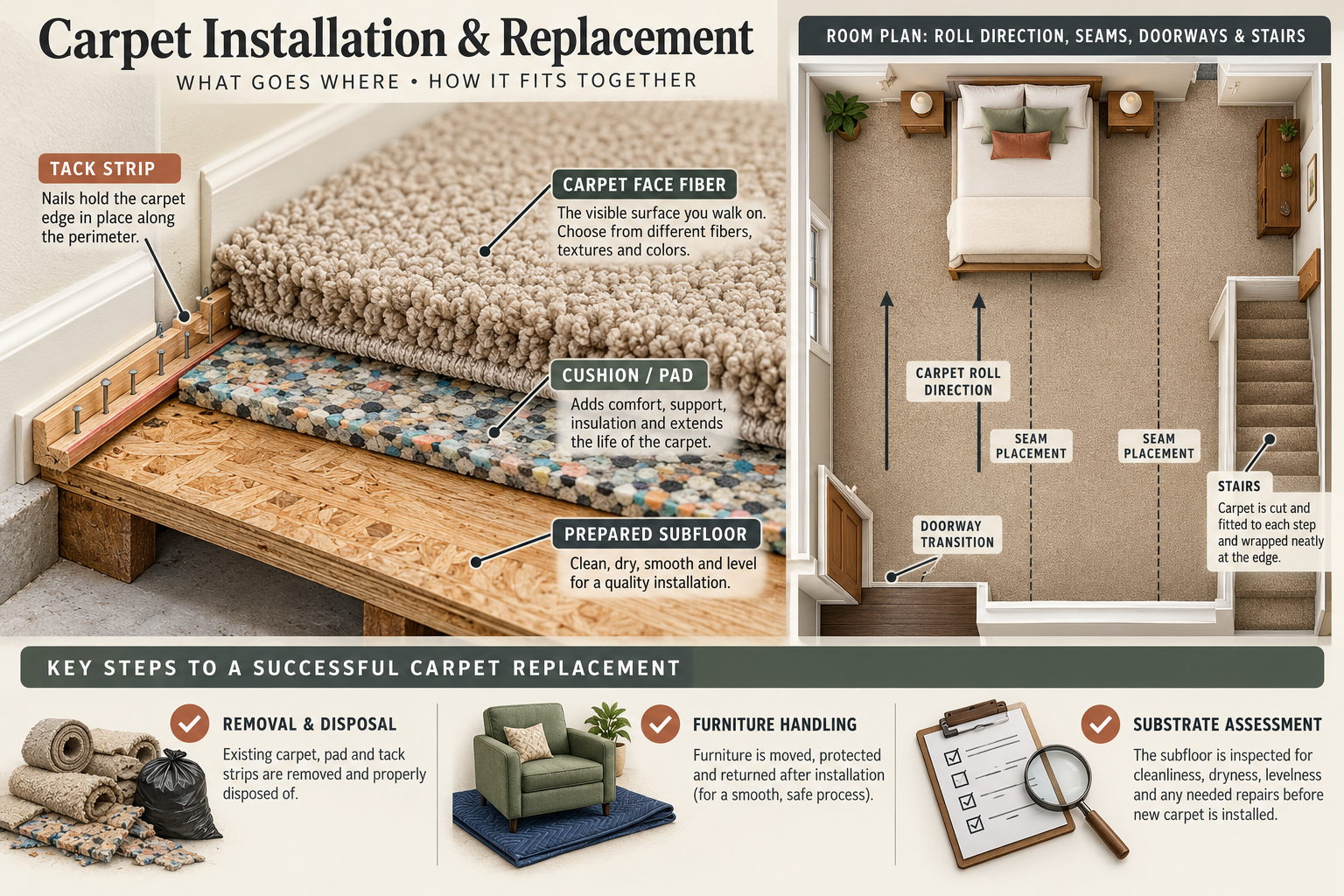
Carpet installation cost includes more than the face fiber. Cushion, seams, substrate preparation, room measurements, furniture, old-carpet removal, disposal, stairs, and final transitions all affect the project.
A Canadian example and its limits
A Canadian flooring guide reports about $1,958 for a 550-square-foot carpet installation example. It also reports approximately $2.61 per square foot for commonly purchased carpet and up to $4.58 per square foot with installation. These are source-specific Canadian planning observations, not a complete national range; the guide does not define every inclusion, and the figures should not be treated as a U.S. equivalent or a guaranteed quote.
A Toronto carpet provider’s 2026 guide separately gives a CAD $4–$10 per-square-foot installed planning range. It says material, underpad, removal, disposal, furniture moving, and subfloor work may be included or quoted separately. This is one local provider’s planning range, not a survey; request the same itemized scope before comparing it with another bid.
Some assistance programs have narrow household and project requirements. Alberta’s SHARP grant lists carpet-to-hard-surface replacement as a potentially eligible essential repair, subject to applicant and property rules and program approval. It is not a carpet price, routine discount, or offer in other jurisdictions; confirm the current terms separately rather than subtracting a possible benefit from the installation quote.
What professional installation involves
CRI 105 treats planning, seam placement, substrate preparation, moisture conditions, cushion, and manufacturer instructions as installation-quality concerns. A wood substrate should be structurally sound, flat, dry, and securely anchored. A carpet quote should say who moves furniture and removes or disposes of the existing carpet and cushion.
Cost drivers
Pattern direction, seams near doorways or strong light, closets, stairs, irregular rooms, pad grade, floor repairs, moisture testing, furniture handling, and access can change labor. Carpet over an existing resilient floor is conditional: CRI 105 does not recommend overlaying floating, perimeter-bonded, or cushion-backed sheet goods.
Before you approve
Ask for the carpet and cushion specifications, seam plan, substrate assumptions, removal and disposal, furniture responsibility, stairs, tack strips, thresholds, taxes, and cleanup. On concrete, confirm any moisture or alkalinity testing required by the installation system. Compare the complete installation plan, not carpet price alone.
Carpet cost has two material decisions
The face fiber is visible, but the cushion or pad affects comfort, wear, seam behavior, and the installation specification. Ask for the exact carpet construction and cushion grade rather than accepting a single “carpet allowance.” A less expensive carpet with appropriate cushion may be a better fit than a premium carpet installed over an unsuitable base, but the products should be compared on the intended traffic and use.
CRI 105 treats planning, substrate condition, seams, cushion, moisture conditions for specified systems, and manufacturer instructions as installation concerns. These requirements do not create one universal price, but they explain why a carpet quote can change after the room is measured and the base is inspected.
Removal, layout, and seams
Replacement usually includes some combination of old-carpet removal, tack-strip decisions, cushion removal, hauling, disposal, furniture handling, and floor preparation. Stairs, closets, irregular rooms, doorways, and strong natural light can affect seam placement and the amount of material needed. A seam may be technically acceptable but still visible under certain lighting or with a patterned product.
Ask for a seam plan and the expected result. Confirm whether the contractor moves beds, appliances, bookcases, or packed furniture. A quote that assumes an empty room should say so. If the homeowner is responsible for moving items, include the time and temporary storage in the project budget.
Substrate and overlay decisions
Carpet can be installed over some existing surfaces only under defined conditions. CRI 105 excludes several floating, perimeter-bonded, and cushion-backed resilient systems from the general overlay path. The exact product, adhesive, moisture condition, and substrate must be assessed.
On concrete, ask whether moisture or alkalinity testing is required for the installation system and who pays for it. On wood, confirm that the surface is sound, flat enough, and securely anchored. A soft, damp, or contaminated base is not solved by adding cushion.
Cost scenarios
A simple installation has an open room, standard carpet and cushion, ready substrate, simple seams, and no stairs. A typical replacement includes removal, disposal, furniture, tack strips, thresholds, minor preparation, and several rooms. A complex installation includes stairs, patterns, difficult access, direct-glue or specialty conditions, extensive subfloor work, or a room that cannot be emptied.
Canadian market observations include a 550-square-foot installation example and broad material-and-labor observations, but they do not establish a complete national rate. Use the source as a planning signal with its assumptions. Do not merge it with U.S. observations or convert currencies mechanically.
Repair and replacement planning
Carpet can sometimes be patched or restretched, so a replacement quote should be compared with the condition of the existing material. If the backing, cushion, or subfloor has failed, a new carpet installation may require more than a surface change. Keep spare carpet, product details, and dye-lot information when possible; these can improve future repair options.
Quote checklist
Request carpet and cushion specifications, measured area, waste, seam plan, stairs, tack strips, thresholds, old-floor removal, disposal, substrate work, moisture testing, furniture, protection, taxes, and cleanup. Ask what is excluded and how concealed damage is priced.
The best carpet budget tells you what the homeowner is buying, what base it depends on, how the room will be prepared, and what appearance or installation limits remain uncertain.
Start with the measured installation
Carpet is priced from more than floor area. The installer must plan roll direction, seams, pattern repeat, waste, closets, stairs, doorways, and the relationship between rooms. Ask whether the estimate uses a measured takeoff or a rounded room size. A small difference in material waste may matter less than a seam plan that avoids a highly visible or heavily trafficked location.
State the desired result before comparing bids. A basic solid color, a patterned broadloom, and a direct-glue installation do not have the same labor or material assumptions. CRI 105 treats planning, substrate condition, seams, cushion, moisture conditions for specified systems, and manufacturer instructions as installation-quality concerns. Those requirements explain scope; they do not create one universal price.
Decide what happens to the old system
Replacement may include carpet, cushion, tack strips, thresholds, removal, hauling, disposal, and preparation. Ask whether the existing tack strips remain, are repaired, or are replaced. Confirm who moves beds, bookcases, appliances, and packed furniture. If the homeowner must empty the rooms, include storage and the time needed to do it.
On concrete, ask whether moisture or alkalinity testing applies to the chosen installation system and who performs it. On wood, ask how flatness, dryness, and secure attachment are assessed. A new cushion does not correct a soft, damp, contaminated, or moving base.
Plan for repair and future ownership
Before replacing carpet, compare the condition of the existing carpet, cushion, seams, and substrate with a repair or restretching option. Replacement may be sensible when the backing or cushion has failed, matching material is unavailable, or damage is widespread. Keep spare carpet and product information for future patches when practical; color and dye-lot differences become more visible as the original ages.
For the final bid, request measured area, product and cushion, seam layout, stairs, removal, disposal, substrate work, furniture, protection, transitions, tax, and cleanup. Also ask what appearance is expected at seams and what condition would require a revised scope. That is more useful than comparing carpet prices detached from the installation system.