
Hardwood repair ranges from a small finish touch-up to board replacement and broader refinishing. The visible defect does not determine the full scope by itself.
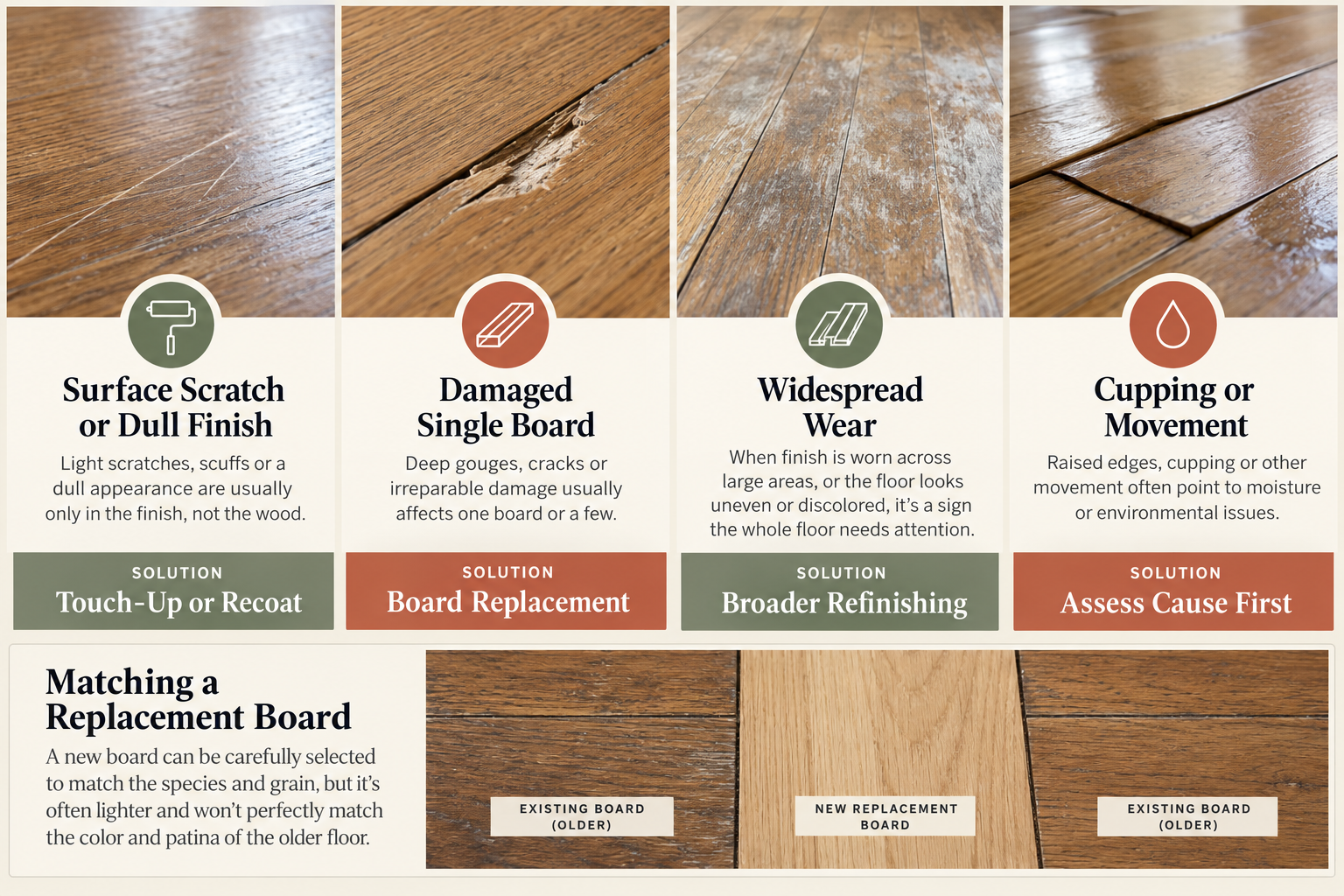
Match the repair to the damage
Surface scratches or dull finish may suit a maintenance recoat. Deeper scratches, stains, gaps, impact damage, or damaged boards may require localized repair, board replacement, blending, or a larger finish area. Cupping, movement, moisture, or subfloor problems must be addressed before cosmetic repair.
Cost changes with solid or engineered construction, board availability, finish age, color matching, the size of the repair, transitions, furniture, access, and whether the repair can be blended into the surrounding floor. A small job may still carry a minimum service charge.
Why there is no simple rate
Available market data does not establish a reliable U.S. or Canadian national repair range. Ask for the exact intervention and whether the price includes diagnosis, replacement material, removal, preparation, stain or finish matching, curing, and cleanup. A localized repair may be less expensive than full refinishing but may be more visible; a larger refinishing scope may produce a more uniform appearance without solving a structural or moisture cause.
Angi’s 2026 U.S. hardwood-repair guide reports a $1,078 project average and a typical range of $483–$1,707, based on 10,984 Angi Pro projects. This is one platform’s broad planning signal; the underlying jobs and repair scopes are not a substitute for an estimate describing this floor’s damage, access, and finish work.
NWFA guidance treats floor construction, remaining wear layer, condition, and existing finish as relevant to repair and refinishing decisions. Do not assume that every engineered board can be sanded like solid hardwood.
Before authorizing work
Confirm what success means: invisible repair, functional stabilization, improved appearance, or a uniform new finish. Ask for a matching plan and for exclusions such as active moisture, subfloor work, furniture moving, or replacement of discontinued material.
Match the repair to the damage
Localized hardwood damage can include surface scratches, dents, finish wear, isolated staining, gaps, loose boards, cupping, or a damaged board. These conditions do not share one repair. A surface treatment may address appearance, while a board replacement addresses damaged material. Gaps or movement may point to moisture, seasonal change, attachment, or a substrate condition that a cosmetic repair will not solve.
The first budget question is therefore whether the repair can remain local. If the finish is sound around a shallow scratch, localized preparation and blending may be reasonable. If the board is broken, swollen, deeply stained, or loose, replacement may be considered. If the problem repeats across a room, full refinishing or substrate work may be more coherent than a series of small patches.
Why matching is often the largest uncertainty
An old floor may have changed color through light, wear, cleaning, and previous finishing. The replacement board may differ in grain, width, profile, finish, or availability. A contractor can install a technically correct board and still be unable to make the repair invisible. State the desired result before comparing prices: functional repair, a visually blended repair, or a uniform refinish of a larger area.
Keep spare boards, product details, and installation records when available. If material is discontinued, the contractor may need to salvage from a closet or another inconspicuous area and restore that area with a less visible material. That can change the labor and the final appearance.
Access and finish consequences
Board replacement can require reaching fasteners or adhesive, removing adjacent boards, protecting nearby finishes, and rebuilding the finish at the repair. A localized repair may still require sanding or coating beyond the damaged board to blend the sheen and color. On site-finished floors, the repair may be easier to integrate than on a factory-finished product, but the result depends on age and finish differences.
Furniture, rugs, baseboards, doorways, and continuous runs affect the practical scope. Ask whether the contractor will move furniture, remove trim, open a larger area for access, and restore the finish. A quote that prices only the replacement board is not a complete repair budget.
Water, pets, and recurring movement
Pet or water damage can affect the finish, wood, subfloor, and adjacent material. Correct the source and assess the assembly before treating the visible board as an isolated defect. Cupping, crowning, or recurring gaps may reflect moisture or movement; sanding may improve the appearance temporarily while leaving the cause in place.
Likewise, a loose or squeaking board may be a finish-level problem or part of a broader subfloor issue. Ask what evidence would cause the repair to expand. If joists, settlement, rot, pests, or persistent moisture are involved, keep the appropriate structural, foundation, or source-correction scope separate from finish repair.
When a localized repair stops making sense
Consider a broader intervention when matching material is unavailable, the damaged area is part of a continuous visual field, many boards need replacement, the finish is worn throughout, or access requires removing a large section. Full refinishing may address appearance but cannot make a structurally unstable or moisture-damaged floor sound. Replacement may offer a cleaner result but adds removal, disposal, substrate, transitions, and installation costs.
Quote checklist
Ask the contractor to identify the damage, cause assumptions, matching material, access route, number of boards, finish blending, furniture and trim, moisture or subfloor exclusions, and the expected appearance. Ask for photographs or a test area when matching is important. The most honest quote describes what can be repaired confidently and what remains dependent on opening the floor.
Small repair, large appearance field
A localized repair is judged against the surrounding floor, not in isolation. A new board can differ in color and grain. A fresh finish can differ in sheen. A filled gap can change as seasonal movement continues. Ask whether the contractor will blend only the repair, finish a larger area, or recommend full refinishing for a uniform result.
If the owner plans to sell, rent, or remodel soon, a functional repair may be sufficient. If the goal is an invisible repair in a prominent room, matching and access deserve more budget. State that preference before the contractor prices the work.
What to document
Record the floor construction, product if known, location, damage pattern, recent moisture or pet events, prior repairs, and any spare material. Photos taken in consistent light can help compare a patch before and after, but they do not replace a site assessment. Product information and repair records can reduce future uncertainty.
Stop points
Ask what would cause the contractor to stop the repair: wet material, movement, missing support, a larger damaged area, unavailable matching material, or a suspected legacy coating. A defined stop point prevents a small fixed price from becoming an unapproved larger intervention.
Final quote questions
Confirm damage and cause assumptions, access, number of boards, finish blending, furniture, trim, removal, disposal, moisture and subfloor exclusions, and the expected appearance. Compare localized repair with a broader refinish or replacement only after adding all access and restoration work. The best hardwood-repair budget makes both the technical result and the aesthetic result explicit.
Separate the visible repair from the finish match
Replacing a damaged board, filling a small defect, blending a finish, and refinishing a larger area are different scopes. A board may be accessible but still difficult to match because the species, profile, color, sheen, and age are not identical. Conversely, a surface scratch may be too shallow to justify board replacement but may remain visible after a local treatment.
Ask the contractor to describe the expected appearance from normal standing distance and under the room’s actual lighting. “Match” can mean functional continuity, a close visual blend, or an attempt to make the repair disappear. Those are different expectations and may carry different labor. Keep a spare board or a record of the original product when possible.
Access can dominate a small repair
A repair beside a wall, cabinet, stair, threshold, or fixed appliance may require more disassembly and restoration than the damaged area suggests. The contractor may need to reach a sound joint, preserve surrounding boards, or blend finish beyond the replaced piece. Furniture, protection, disposal, and a minimum service charge can make a small repair economically different from a large open-area job.
Compare a localized repair with a recoat, broader refinishing, or continuous-area replacement only after including those related tasks. A broader scope may provide a better visual result, but it should not be recommended merely because the local repair is inconvenient. Ask what condition justifies expanding the area.
Do not repair the finish over an active cause
Pet damage, water, recurring movement, pests, or a weak subfloor can affect more than the visible board. Active moisture should be corrected before finish work. Structural movement and pest treatment are separate investigations, while this category can own finish restoration after the cause is addressed. A new coat can improve appearance without proving the base is stable.
A repair decision worksheet
Record the defect, likely cause, accessible repair area, material availability, finish expectation, furniture and trim work, disposal, and the condition that would change the recommendation. Then ask for a local repair price and a broader alternative on the same assumptions. This keeps a technically possible repair from becoming an expensive sequence of return visits without making full replacement the default.