
A small damaged spot can create a larger finish decision. The choice is not governed by a universal percentage or age threshold; it depends on whether the material, installation system, and appearance can be restored responsibly.
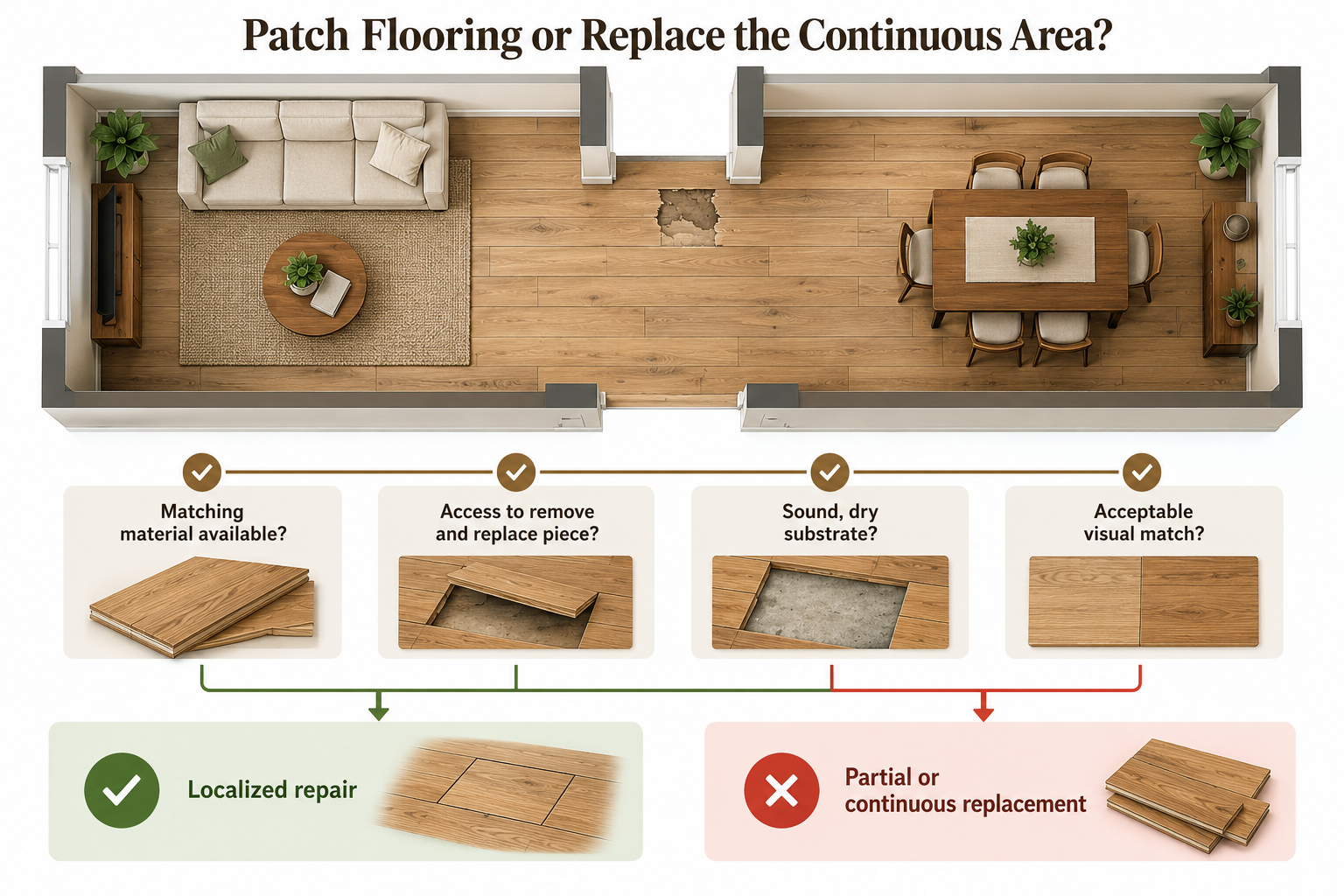
When a patch may fit
Localized repair is more plausible when spare or matching material exists, the damage is isolated, the substrate and surrounding floor are sound, and the repair can be reached without damaging adjacent areas. Carpet patch visibility, hardwood blending, tile color variation, and floating-floor access all affect the result.
When broader replacement may fit
Replace a larger continuous area when material is discontinued, color has changed, damage crosses transitions, the installation system cannot be opened locally, or the underlying cause affects more than the visible spot. A larger scope can also make mobilization and finish matching more practical, but it is not automatically cheaper.
Available sources do not establish universal service minimums or repair thresholds. Ask for a site-specific comparison rather than relying on a square-foot rule.
What to keep in the budget
Compare diagnosis, removal, matching material, access, substrate work, transitions, disposal, furniture, and cleanup. Ask whether the proposed repair is intended to be invisible, functional, or simply less noticeable.
Preserve future options
If the flooring manufacturer permits it, retaining spare material can improve future matching. Store it in a way that protects it from damage and record the product information. This is a planning choice, not a guarantee that future material will match.
Why a small defect can create a large decision
Replacing one board, plank, tile, or carpet section may sound simple, but the damaged piece is part of a visual and installation system. The repair may require reaching under adjacent pieces, matching aged color, restoring a seam, correcting a substrate, or mobilizing a specialist for a minimum charge. The alternative is not always “replace the whole room”; it may be a partial continuous area, a transition, or a planned repair at the next larger project.
Start by defining the intended result: functional repair, a less noticeable patch, a blended repair, or a uniform continuous finish. A homeowner who expects an invisible repair needs a different budget and material strategy from one who only needs the surface stabilized.
Matching by finish family
Hardwood may require a replacement board, blending, localized finishing, or broader refinishing. Aged color, species, profile, and prior coatings make invisible matching uncertain.
Laminate and resilient planks can be replaceable when the locking direction and access allow it, but discontinued patterns and cabinets can limit the repair. Record the product and keep spare pieces.
Tile depends on matching, grout color, substrate movement, and adjacent condition. A new tile may differ in size, thickness, shade, or finish even when the name is similar.
Carpet depends on spare material, pile direction, dye or age, cushion, and seam visibility. A patch can be functional without being invisible.
Access and continuous runs
The damaged piece may not be the first piece the installer must remove. Floating floors can require disassembly from an edge or an approved repair method. Hardwood and tile may require opening a larger area. Carpet may require restretching, seam work, or furniture handling. A continuous hallway or open-plan floor can make a local mismatch more visible and increase the area worth replacing.
Ask whether baseboards, transitions, doors, cabinets, and appliances limit access. The quote should say whether removal and restoration are included. If the repair is delayed, protect the damaged area from water and traffic without assuming that temporary protection fixes the underlying condition.
Fixed objects can be a product-specific access constraint. Lions Floor’s 2026 WPC guide does not allow permanent cabinets or islands to be installed on top of the floating floor it covers and specifies breaks or expansion space around fixed objects. This is not a universal vinyl rule; check the exact product manual before comparing patch and replacement scopes. For accessible-ready Canadian new construction, CAN-ASC-2.8:2025 describes a future replacement design path that may limit finish work to flooring, baseboards, and kick plates. It does not impose a retrofit or establish a cost or safety outcome for an existing home.
When broader replacement is economical
Partial or continuous-area replacement can make sense when matching material is unavailable, damage crosses seams, the material is worn throughout, the substrate must be opened anyway, or the minimum repair charge approaches the cost of a better-defined larger scope. Broader replacement may also provide a more consistent appearance at a doorway or room boundary.
Do not use a fixed percentage or age rule. A small area can be expensive in a difficult material, while a larger open area can be straightforward. Condition, access, material availability, and the homeowner’s appearance threshold matter more than area alone.
Cause and substrate check
Water, movement, pets, impact, installation failure, or pest damage can affect more than the visible piece. Correct a moisture source, assess a moving substrate, and separate structural or remediation work before choosing the finish scope. Replacing the surface without addressing the cause may simply create another repair.
Quote checklist
Compare localized, partial, and continuous-area scopes using the same assumptions. Ask for diagnosis, matching material, access, removal, substrate work, transitions, furniture, disposal, finish blending, and the expected appearance. Keep spare material and product details when practical. The best decision preserves reader value and future options without paying for a larger replacement that the condition does not justify.
Evaluate the material family
A patch is easier to defend when the flooring has a clear repair boundary, spare or matching material exists, and the surrounding finish has not changed substantially through wear, light, or moisture. Wood, laminate, resilient flooring, carpet, and tile each show repairs differently. A technically sound patch can remain visible when pattern, dye lot, grain, sheen, or age does not match.
Ask whether the material can be removed without damaging adjacent pieces and whether the replacement method requires access to a larger continuous area. Include seams, cuts, transitions, baseboards, cabinets, furniture, and cleanup rather than measuring only the damaged spot.
Access and continuous areas
Replacement of one piece may require removing a row, opening a threshold, moving furniture, or disturbing an adjoining room. Conversely, a broad replacement may be unnecessary when a localized repair can be made cleanly. Request a diagram or defined boundary so “room replacement” and “partial replacement” describe actual scopes rather than different assumptions.
The substrate is part of the decision. If the base is wet, uneven, moving, or damaged, a new finish can fail in the same place. Price subfloor, underlayment, leveling, moisture, and source correction separately when they are not already resolved.
Find the reason before enlarging the scope
Water, impact, wear, installation failure, pet damage, movement, and an unsuitable product lead to different recommendations. Replacing a visible area without correcting an active cause can turn a small repair into repeated spending. A contractor should state what is observed, what is inferred, and what condition would justify opening farther.
Compare the complete alternatives
For a patch, compare diagnosis, matching material, removal, substrate preparation, installation, blending, transitions, furniture, and disposal. For room replacement, add demolition, waste, new material, broader preparation, trim, and restoration of adjacent spaces. Choose the smallest scope that addresses the cause and delivers an acceptable appearance, with a clear boundary for concealed conditions.