
Ceiling repair cost depends on what failed: paint or texture, drywall, plaster, backing, or the source above. A ceiling stain, crack, hole, sag, or loose area should be scoped by condition rather than by appearance alone.
Common cost drivers
Material, damage size, ceiling height, access, furniture protection, texture matching, patch blending, primer, paint, drying time, and cleanup all affect the estimate. A high or vaulted ceiling can add access and protection even when the damaged area is small.
Angi U.S. observations report professional ceiling repair around $150–$4,420 and a broad $150–$4,500 range, with separate material examples. The same source uses mixed project and unit bases, so these are planning observations rather than a single comparable rate. Canadian sources do not establish a matching national range.
Fix the cause first
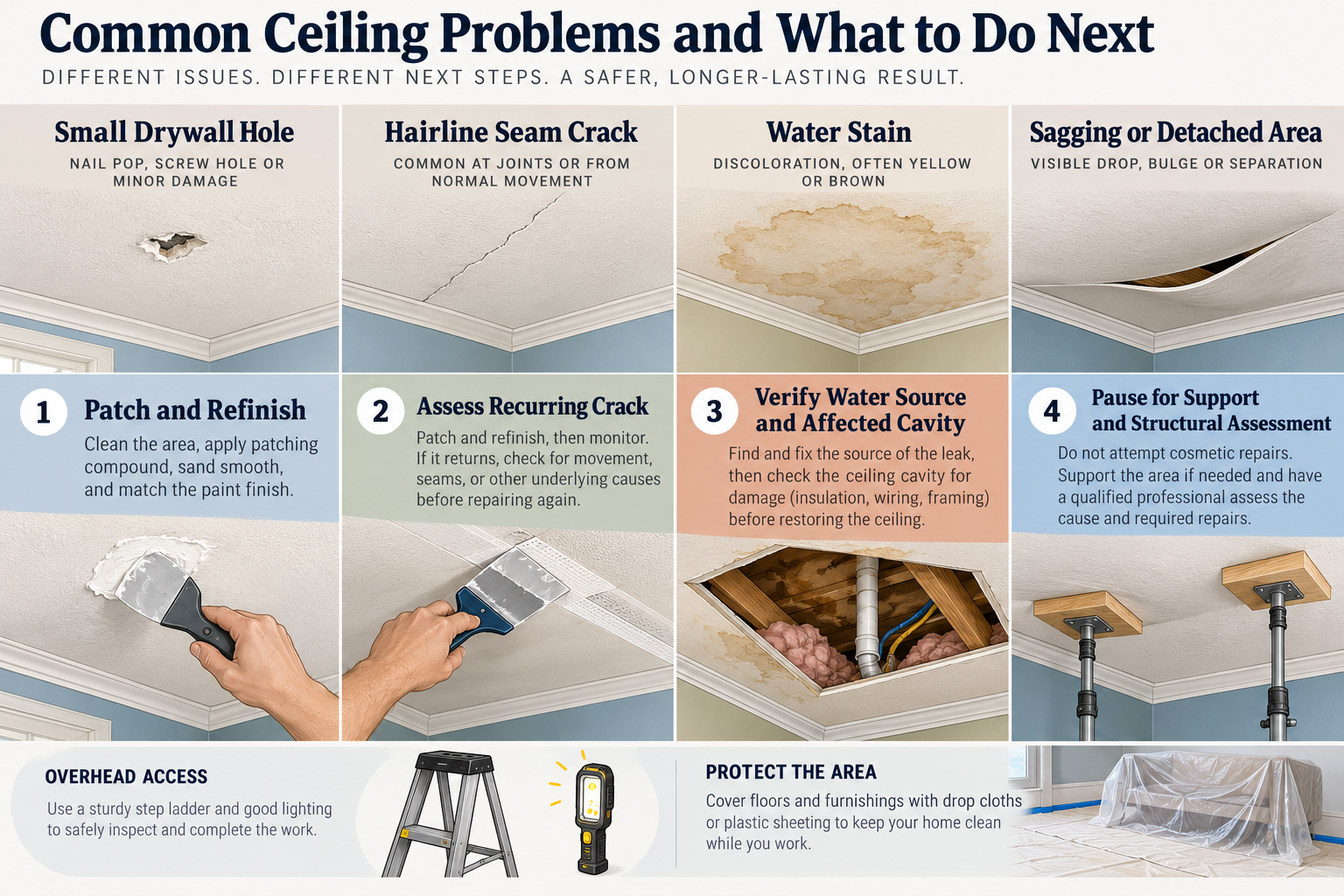
Water damage requires correction of the source and assessment of drying, contamination, and concealed damage before the finish is restored. Structural movement, sagging, or detachment may require a professional assessment. Painting over a stain does not establish that the ceiling is dry or that the cause is gone.
Compare the scope
Ask whether the quote covers opening and removal, substrate or framing assessment, drywall or plaster repair, texture matching, primer, paint, access, protection, and cleanup. If legacy material, mold, or structural work dominates, separate that scope from ordinary ceiling finishing.
Identify the ceiling problem first
A ceiling repair may address a small hole, a joint crack, a stain, loose texture, a sagging finish, detached plaster, or broad water damage. The same visible symptom can lead to different work. A small patch in sound drywall is not priced like a detached plaster ceiling or a ceiling that must be opened to find hidden moisture.
Ask what the contractor believes is visible and what remains uncertain. A sag, crack pattern, or recurring stain may require assessment before finish restoration. A paint coat can improve appearance, but it does not establish that the ceiling is dry, attached, or structurally sound.
Drywall, plaster, and texture
Drywall repair may involve board, joint treatment, texture, primer, and paint. Plaster repair may require stabilization, lath assessment, specialized matching, and more hand finishing. Texture matching depends on the existing pattern, light, and the desired final result. A smooth finish under side lighting has a different preparation standard from a forgiving textured surface.
Material choice, ceiling height, access, furniture, fixtures, vents, and room protection can make a small ceiling repair labor-intensive. Ask whether light fixtures, fans, insulation, or trim are being moved by the finish contractor or another trade.
Water and structural boundaries
After water damage, correct the source and assess drying, contamination, hidden cavities, insulation, and framing before rebuilding the finish. EPA guidance supports source and moisture control but does not establish a universal drying or replacement threshold. Mold remediation, contaminated water, structural repair, and source correction are separate scopes.
Likewise, a ceiling that sags or moves may have a finish-detachment issue or a more consequential underlying condition. The finish budget should not promise to correct framing or structural movement unless that work is explicitly designed and owned by the appropriate professional.
Cost scenarios
A simple repair has an accessible localized defect, sound material, easy texture match, and no furniture or cause issue. A typical repair includes opening or patching, finish blending, primer, paint, protection, and cleanup. A complex repair includes high access, plaster, widespread damage, hidden moisture, insulation, recurring movement, texture removal, or full-ceiling replacement.
The available U.S. ceiling observations range from about $150 to $4,420 or a broad $150–$4,500 context, but the source mixes project sizes and measurement bases. Material-specific figures are also source-specific. Canadian observations do not establish a matching national range. Use these as planning signals only and request a local scope-based estimate.
Quote checklist
Ask for material, defect, access, opening and removal, substrate or framing assessment, drying assumptions, texture, primer, paint, fixtures, furniture, protection, disposal, and concealed-condition terms. Separate the finish restoration from source repair, remediation, and structural work.
The right ceiling budget explains what is being restored and what must be known before the final finish can be trusted.
Start with material and cause
Plaster, drywall, acoustic tile, textured coatings, and a suspended ceiling each repair differently. A stain, seam crack, sagging panel, impact opening, and loose section are different starting conditions. The estimate should identify the observed material and state whether the work is a finish repair, a board or tile replacement, or an investigation of the support above it.
Ceiling symptoms can also reflect a leak, condensation, movement, damaged framing, or a failed fastener. New compound or paint is not a source correction. Ask what has been verified, what remains an assumption, and what finding would expand the scope.
How access and finish affect price
Ceilings require setup even when the damaged area is small. Protection, ladders or other access equipment, fixtures, furniture, dust control, drying time, sanding, texture matching, and repainting can outweigh the material cost. A spot repair may remain visible under a different sheen or in strong light, so agree on whether the target is a localized blend or a ceiling-wide finish.
Texture removal, skim coating, and a full smooth repaint are separate choices. Include the same finish target when comparing bids; a patch that stops before primer and paint is not equivalent to a completed restoration.
Water and structural boundaries
For a water-marked ceiling, confirm that the source has been corrected and that the affected material is suitable for repair. Wet insulation, cavity moisture, mold concerns, damaged framing, and electrical or fixture issues require their own assessment. A finish contractor’s ceiling price should not be read as a remediation, structural, or hazard-abatement price.
Repair versus replacement quote
Compare localized repair, a larger board or plaster section, and full-ceiling replacement when the damage is widespread or the finish cannot blend. Request lines for opening and disposal, material, backing, texture, primer, paint, access, protection, fixtures, and cleanup. The best scope restores the visible ceiling while clearly stating what must be solved above it first.