
Drywall repair may mean filling a small hole, rebuilding a corner, correcting a failed seam, replacing a board section, or restoring a ceiling. The visible defect is only one part of the price. Access, preparation, finish matching, paint, and the cause of the damage can matter as much as the patch itself.
Price observations are not one comparable rate
In its U.S. guide updated September 24, 2026, Angi reports an average drywall-repair cost of $612 and a typical range of $296–$929, based on 36,945 verified Angi Pro projects. Treat this as an Angi-reported planning signal, not a local quote or a guaranteed national price. The page does not sufficiently define the sample period, geographic weighting, or inclusions to normalize the figure for a particular repair.
The reported project total is best used as a broad point of comparison when discussing an ordinary repair with similar assumptions. It does not tell you whether a particular bid includes moving furniture, replacing a board section, matching texture, repainting a full wall, or fixing the condition behind the surface. Compare those scope details before deciding that a quote is high or low relative to the published figure.
The average and typical range also do not describe the cost of every repair type. A small hole, a ceiling opening, a long seam, and a water-damaged section require different work. Angi lists its hourly, area-based, ceiling, and water-damage observations separately, which is another reason to keep each measure attached to its own scope. Do not multiply one measure into another or add unlike figures together to create a home-specific estimate.
Angi also presents hourly, square-foot, ceiling, and water-damage observations separately. They describe different measures and project types; do not combine or convert them into one rate. Its water-damage figure is not a flood-remediation estimate.
Canadian project observations use different scopes and are not directly comparable with Angi’s U.S. project sample. A Metro Vancouver repair provider’s 2026 guide lists CAD $100–$200 for a single patch under 6 inches, CAD $200–$450 for a 6-inch-to-2-foot hole or crack, and CAD $150–$600 for a typical repair job. Its CAD $1,000–$1,600 drywall-and-paint package includes painting a whole room corner to corner, so it is not a drywall-only comparison. The provider gives no job count or calculation method; treat the examples as local context, not a rate for another market or defect.
What changes the cost
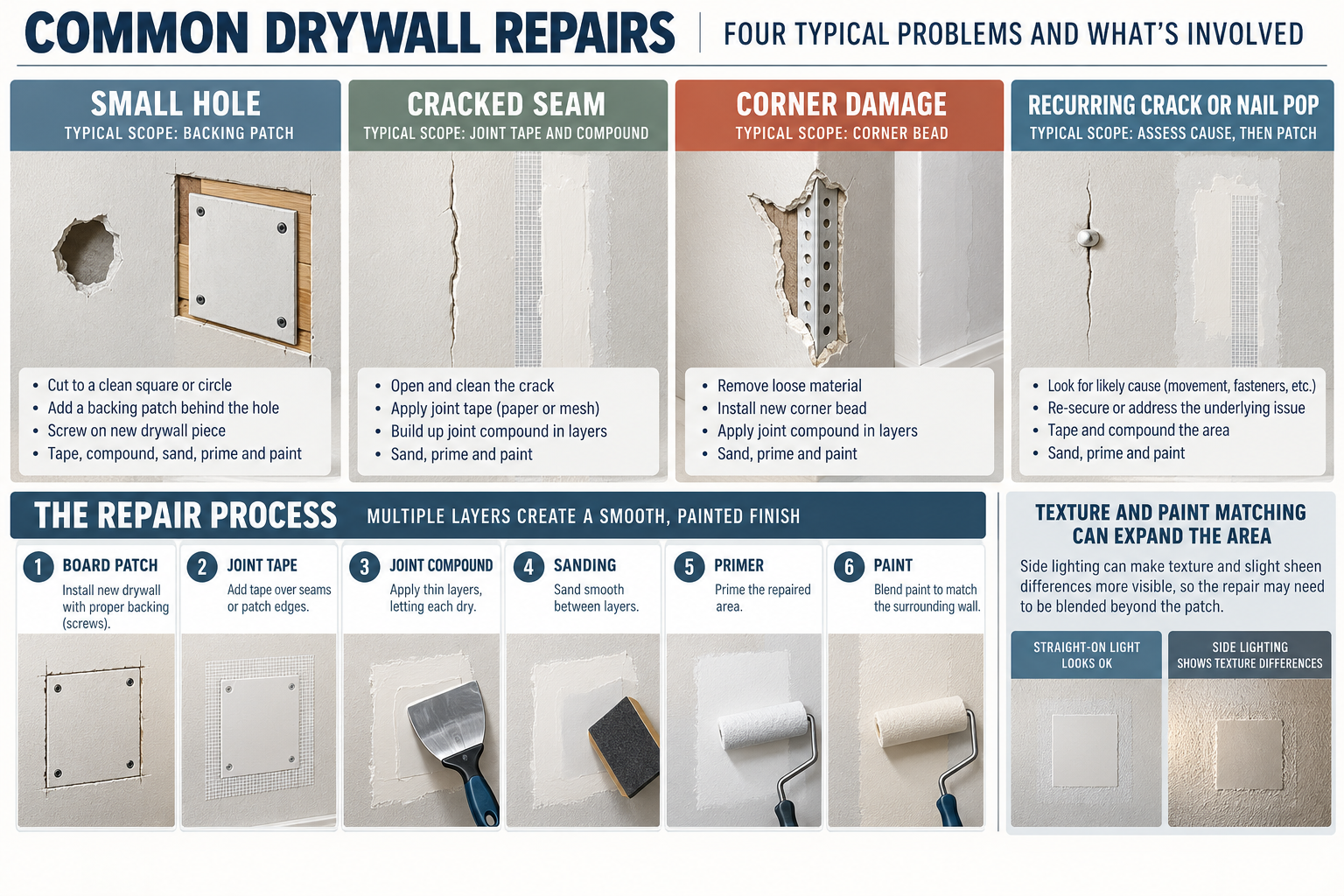
The repair method depends on the damage. A small hole may need backing, a patch, joint compound, sanding, primer, and paint. A larger opening can require a board section and more extensive joint treatment. A corner, seam, or nail pop may need a localized finish repair, while repeated failure can indicate a cause that must be addressed before patching.
Access affects the price. A high ceiling, stairs, awkward corner, furnished room, or area around fixtures can require extra setup and protection. Multiple small defects may be less expensive in one visit than separate service calls, but a contractor may still have a minimum charge.
Match the repair to the surrounding finish
The result should be priced against the wall or ceiling around it. Gypsum Association GA-214-2021 describes finish levels in relation to panel type, location, lighting, surface smoothness, and the final decoration. A patch on a textured, low-sheen wall may blend more easily than work under strong side lighting or a smooth glossy finish.
Texture matching, primer, paint, and return visits can be a meaningful part of the total. New compound and paper may absorb paint differently from the surrounding surface. Spot painting can leave a visible boundary, so ask whether the quote ends at the patch, covers a wall corner to corner, or includes a larger ceiling area.
Cracks, seams, and recurring damage
A crack or nail pop can be a local finish problem, but a repeated or widening defect deserves more context. Moisture, movement, a failed joint, inadequate backing, or another assembly condition may cause the repair to return. A cosmetic patch does not correct an active leak or a structural problem.
Ask the contractor to describe the observed defect and the proposed repair before comparing bids. If an opening reveals wet material, damaged insulation, wiring, plumbing, framing, pests, or a suspected legacy coating, pause and establish who is responsible for that separate assessment or repair.
Compare complete repair paths
A simple repair might be one accessible hole in sound board with a finish that can be matched. Confirm whether the minimum service charge, primer, paint, and cleanup are included.
A typical repair may involve several patches, a seam or corner, texture matching, furniture protection, and more than one visit for compound, sanding, and paint. Ask whether the estimate includes the final visual finish or only the board and joint work.
A complex repair may involve overhead access, larger board replacement, repeat cracking, water damage, extensive texture, or a broader wall or ceiling repaint. Where damage is widespread or board is soft or delaminated, compare a larger replacement scope with repeated local patches.
The least expensive first visit is not always the lowest-cost finished repair. A patch may need a second or third visit for compound, sanding, primer, and paint. A contractor may also charge a minimum for a small job, while grouping several defects can spread setup and travel across more work. Ask whether the estimate is a fixed project price or an hourly or area allowance and what condition would change it.
If several defects are in one room, provide photos and dimensions for each and ask whether they can be handled in one mobilization. The estimate should still say how many areas are included and what happens if opening one defect reveals a broader issue. For a single tiny defect, compare the minimum visit charge with the value of waiting to combine it with other needed work; avoid delaying when the defect signals active water or movement that needs attention.
Make the quote specific
Ask for the defect type and dimensions, access, backing or board replacement, joint and corner treatment, texture, sanding, primer, paint, furniture and protection, number of visits, cleanup, and change-order terms. Confirm whether the quoted result is functional, cosmetic, or intended to match a larger area.
If the visible crack or stain may have an unresolved cause, have that condition assessed before approving a finish-only patch. Separate ordinary drywall work from moisture-source correction, structural repair, mold remediation, and hazardous-material work. A clear scope makes the contractor’s price easier to compare and reduces the chance that a low patch allowance leaves the finished room incomplete.
For competing estimates, compare the same repair boundary and final appearance rather than only the quoted unit. One contractor may include a board patch and joint finish; another may include surface protection, texture, primer, paint, and cleanup. Record who supplies materials, how many visits are expected, how adjacent finishes will be protected, and whether a larger blend is included. Those details make the price signal useful without treating an online average as a quote for the home.
For cracks or seams, also compare what cause the contractor assumes and whether the repair is limited to the surface. For a hole, ask whether the edges are stable and whether backing or a larger board section is needed. For ceiling work, include access and protection; for a textured wall, state how close a match is expected. A quote becomes much more useful when the homeowner can see both the proposed repair and the point where additional work would require a new decision.