
Plaster repair can involve a surface patch, loose-plaster stabilization, crack treatment, lath or backing repair, finish matching, or replacement with another system. Those scopes should not be priced as ordinary drywall patching.
What changes the price
Condition, thickness, ornament, texture, access, wall or ceiling location, paint layers, crack pattern, lath condition, furniture, dust protection, and the desired visual match all affect labor. Small repairs can be labor-intensive because the surrounding finish must be protected and blended.
Canadian homeowner-reported project observations range from $100 to $40,000 for plastering across mixed scopes. That spread is evidence of project variation, not a national rate. No reliable U.S. or Canadian plaster-repair range was established.
Investigate the cause
Recurring cracks, sagging, active moisture, movement, or damaged backing may require an assessment beyond finish repair. Water and structural work should be separated from the plaster restoration line item.
Older plaster and painted surfaces can raise lead or asbestos concerns. Health Canada advises professional testing and qualified handling when suspected asbestos-containing materials may be disturbed. Do not infer material content from age or appearance.
Compare bids
Ask for stabilization, patch or replacement area, finish match, sanding, primer and paint, access, protection, and cleanup. If preserving historically significant ornament or original work is the dominant decision, use the historic-home scope rather than treating it as ordinary patching.
Common plaster repair scopes
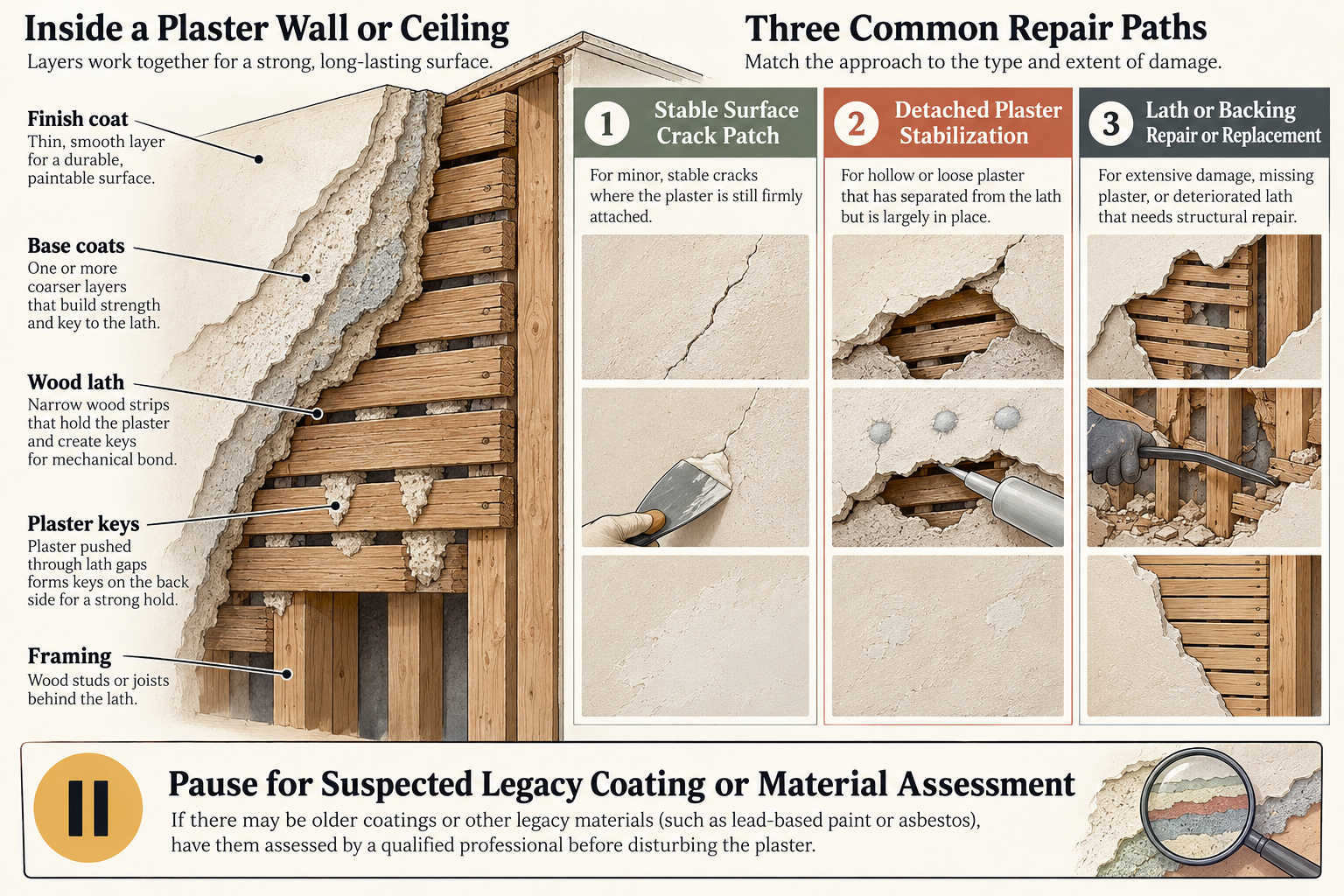
Plaster repair can mean filling a stable crack, patching a hole, reattaching a loose area, rebuilding a section, repairing the lath or substrate, or restoring a ceiling after water damage. These scopes require different labor. A surface crack may need preparation and a compatible finish; detached plaster may require stabilization before it can be patched; a damaged lath or wet cavity can expand the work behind the visible surface.
The quote should say whether the work is cosmetic, intended to restore attachment, or dependent on a separate substrate or moisture repair. Plaster can look intact while being loose. A new surface coat is not a substitute for correcting movement, water entry, or a failing base.
Why plaster differs from drywall
Plaster is a layered finish with its own thickness, texture, hardness, and relationship to lath or masonry. A repair must meet the surrounding surface and often needs more hand finishing than a drywall patch. The material and technique also affect drying, sanding, color, and the visibility of the repair.
Ceilings can add access, protection, and overhead labor. Walls with ornate profiles, multiple coats, or difficult corners take more time than a clear flat area. If electrical or plumbing access is needed, keep that work separate from the plaster finish unless the quote clearly includes it.
Matching the existing finish
The homeowner should define what “matched” means. A repair can be structurally sound while remaining visible under side lighting or a new paint sheen. Existing plaster may have changed through paint, repairs, settlement, cleaning, and age. Sample work can help establish an expectation before the full area is priced.
Paint and primer may be a separate stage. A localized patch can require painting from corner to corner for a consistent result. Ask whether sanding, dust control, furniture protection, trim, and cleanup are included.
Cost scenarios
A simple project has a stable localized defect, accessible surface, limited finish matching, and no active moisture or movement. A typical repair includes stabilization, broader patching, surface preparation, primer, paint, and occupied-room protection. A complex project includes detached ceiling areas, damaged lath, repeated cracks, hidden moisture, high or awkward access, extensive matching, or a decision between repair and replacement.
Reliable national plaster rates are weaker than broad drywall observations. Do not use a drywall price as a guaranteed plaster equivalent. Ask for a local estimate that identifies the condition and finish standard.
Safety and historic boundaries
Older painted plaster may create lead concerns, and some legacy materials may raise asbestos questions. Do not infer content from age or appearance. U.S. and Canadian guidance differs, and testing or qualified handling may be required before disturbance.
If ornamental or historically significant plaster preservation is the central decision, use the historic-home scope. Ordinary repair remains here when preservation is incidental and the homeowner mainly needs a practical finish decision.
Quote checklist
Request the defect type, stabilization, lath or substrate assumption, repair area, finish match, ceiling access, sanding, primer, paint, protection, furniture, cleanup, and treatment of recurring cracks or moisture. Compare complete repair scopes, not a patch price detached from the condition below it.
Match the intervention to the plaster condition
A hairline finish crack, loose plaster, a missing section, detached keys, damaged lath, and a water-softened area require different scopes. The visible opening may be smaller than the work needed to stabilize its edges. Ask whether the proposal is cosmetic, a stabilized repair, or an opening that includes lath, backing, or substrate work.
Plaster can be sound around a defect or can be separating from the support beyond what is visible. Tapping, probing, or opening the area is an assessment decision for the contractor. The cost should not imply that a surface patch proves the surrounding assembly is stable.
Wall and ceiling access
Ceiling repairs, high walls, stairwells, furniture-filled rooms, and ornate trim require more protection and setup than an open wall. Matching an existing texture or decorative finish may require multiple passes and a wider blending area. Include sanding, dust control, primer, paint, fixtures, and cleanup when comparing a finished result.
Appearance and historic boundary
Older plaster may have a character that a new smooth patch will not reproduce. If preservation matters, state whether the goal is an invisible blend, a sympathetic repair, or a deliberately renewed surface. Trim, moldings, and adjacent paint can determine how far the work must extend.
Questions about lead-containing coatings, asbestos-containing materials, or historic requirements are location- and material-specific. Do not treat ordinary plaster pricing as hazard abatement or preservation approval. Obtain the appropriate local assessment when the age or condition makes it relevant.
Compare repair and replacement
When damage is widespread or access to the supporting system is poor, compare stabilized plaster repair with removal and a new finish assembly. Include demolition, disposal, framing or backing, board or plaster, finish level, trim, insulation, paint, protection, and cleanup in both alternatives. A lower patch price is not a better value if the repair cannot address the condition that caused the failure.