
Smoothing a textured ceiling can mean removing the texture, covering it with a prepared finish, skim coating, or repairing and repainting the existing surface. These approaches have different labor, dust, access, and finish-quality implications.
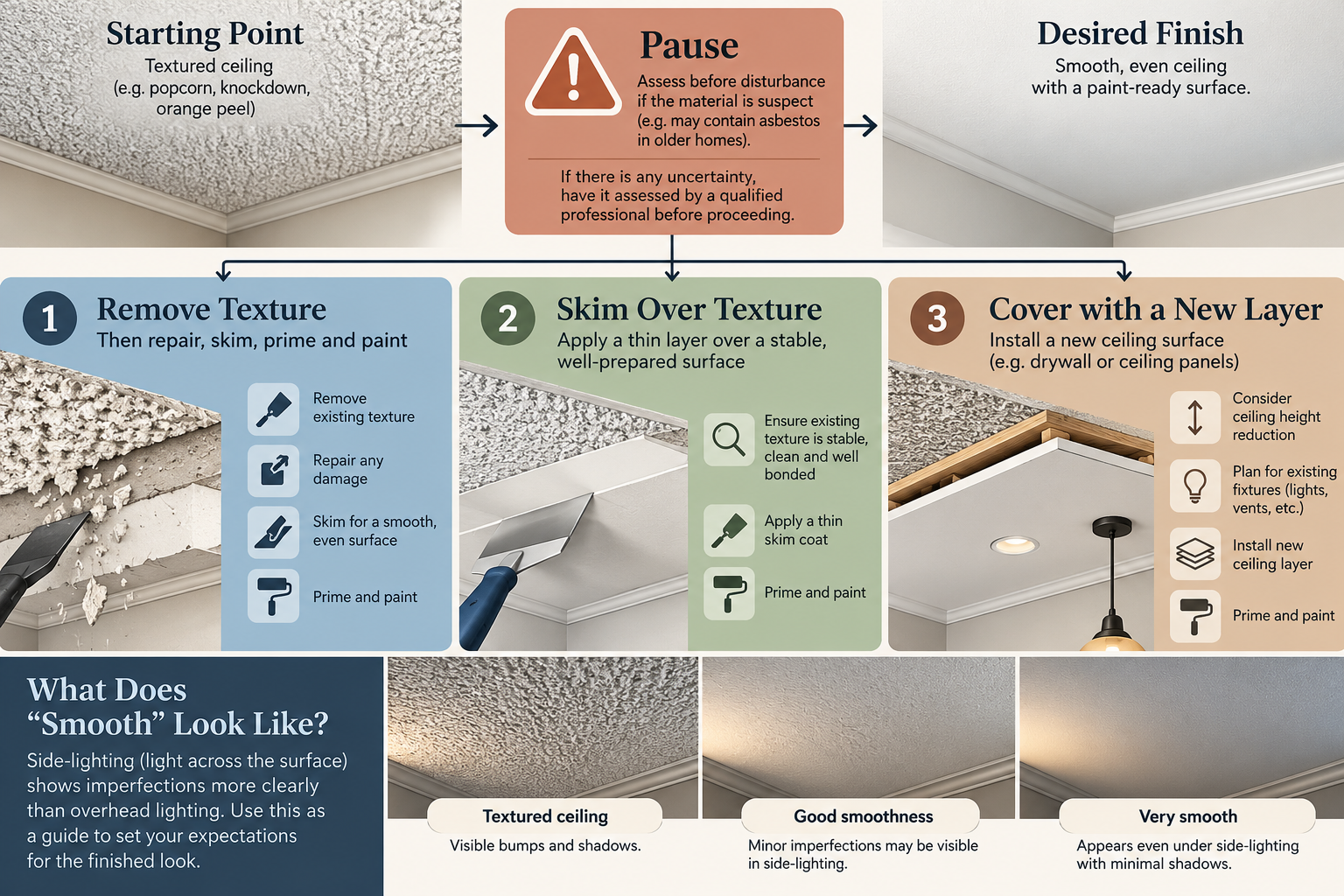
Removal versus smoothing
Removal may expose paper damage, uneven joints, stains, or earlier coatings that need repair. Skim coating can provide a uniform surface over a properly prepared base but does not correct movement, moisture, or damaged backing. The desired final smoothness and the effect of critical lighting should be part of the scope.
GA-214 links gypsum finish level to decoration, location, and lighting. That makes “smooth” a result to define, not merely a product name. Available sources do not establish a reliable U.S. or Canadian national price for this work. One GTA contractor’s 2026 example puts standard-height popcorn removal and a smooth refinish at about $6–$10 per square foot when protection, preparation, repairs, skim coating, sanding, primer, paint, and cleanup are included. Projects below about 250 square feet may use a minimum price. The guide uses $ without a currency code and gives no independent sample; it is one local full-scope example, not a rate for scraping, skim coating alone, or every ceiling texture.
Safety boundary
Older texture or coatings may require asbestos or lead assessment before disturbance. Canadian and U.S. guidance has different scopes and local requirements. Do not disturb a suspected material on appearance alone, and do not represent ordinary smoothing as hazardous-material abatement.
Quote questions
Ask for removal or cover method, testing assumptions, surface repairs, sanding and dust control, access, primer, paint, protection, disposal, and cleanup. Compare bids that promise the same finish standard and include the same preparation.
Removal and smoothing are different paths
Mechanical removal may expose the underlying board and reveal paper damage, weak joints, stains, or earlier repairs. Skim coating or covering can avoid some removal but still requires adhesion, preparation, and a surface suitable for the new finish. A contractor’s recommendation should explain why the proposed path fits the texture, substrate, and desired appearance.
The phrase “smooth ceiling” also needs definition. A homeowner may want a visually improved low-sheen surface, a uniform finish under ordinary light, or a high-finish surface under strong side lighting. These expectations change the number of preparation passes, sanding, primer, and paint work.
What makes ceilings labor-intensive
Ceilings require overhead work, room protection, fixture and vent coordination, access equipment, dust control, and careful blending at walls and corners. Texture adhesion, ceiling height, room size, existing damage, and furniture can matter more than the raw area. A small room with difficult access may cost more per square foot than a large empty room.
If the texture hides cracks, stains, or movement, smoothing does not remove the cause. Correct moisture and assess recurring movement before the surface is rebuilt. A new finish should not be used to establish that the cavity or substrate is dry.
Legacy-material boundary
Older textures or coatings may require asbestos or lead assessment before disturbance. U.S. and Canadian guidance differ, and a particular material cannot be identified from appearance or age. Obtain qualified local advice before scraping, sanding, or demolishing a suspected surface. Keep testing, abatement, containment, and regulated disposal separate from ordinary finish work.
Cost scenarios
A simple project has a sound ceiling, accessible height, defined smoothness, and limited fixture or furniture work. A typical project includes removal or skim coating, surface repair, sanding, primer, paint, protection, and cleanup. A complex project includes high access, old texture, extensive repairs, stains, water damage, plaster, or a safety assessment.
Available evidence does not establish a reliable national U.S. or Canadian smoothing range. Broad market observations may help identify cost drivers but should not be merged into a false average. Compare local bids that promise the same final surface.
Quote checklist
Ask for the proposed method, existing texture and substrate condition, repairs, number of coats, sanding and dust control, primer, paint, fixtures, access, furniture, protection, disposal, cleanup, and the condition that would cause the work to expand. The complete budget is the cost of the desired finish on a prepared ceiling, not the price of scraping alone.
Define what “smooth” means
A smooth-looking ceiling can mean removing loose texture, scraping high points and skim coating, installing a new surface, or applying a new uniform texture. These approaches have different preparation, dust, access, and finish implications. Agree on the viewing distance, lighting, sheen, and whether minor variation is acceptable before comparing a price.
Texture may be hiding seams, fasteners, stains, or board movement. Removing it can expose those conditions rather than eliminate them. Ask how many preparation passes are assumed and what happens when the substrate is not ready for the selected finish.
Removal versus skim coating
Removal may be appropriate when the coating is loose, incompatible, or the desired result requires a reset, but it can create more debris and surface repair. Skim coating over a stable surface may reduce disturbance, but it adds material and does not correct a moving or moisture-damaged base. A full replacement can be a separate comparison when the substrate is broadly unsound.
Legacy coating boundary
The age and composition of a ceiling coating cannot be established from appearance alone. Where a suspect legacy coating is possible, use the applicable local testing, work-practice, and disposal process before disturbance. Do not treat a texture-removal estimate as hazard assessment or abatement.
Final finish and access
Ceiling height, fixtures, furniture, protection, sanding, primer, paint, and cleanup can be a substantial part of the job. Request separate lines for removal or covering, repairs, skim coating, finish coating, access, and disposal. The most useful quote prices the completed ceiling and gives a clear boundary for water, structural, electrical, or material findings.
Choose a finish standard before choosing a method
Bring the contractor to the room and agree on the finished appearance under the lighting the ceiling normally receives. Strong side light can reveal joints and surface variation that are hard to see from directly below. Describe whether the goal is to remove loose texture, reduce its visual prominence, or produce a uniformly smooth surface. The amount of preparation and the risk of visible imperfections differ among those outcomes.
Ask for the proposed process in order: protection, disturbance or covering, repairs, skim work, sanding, primer, finish coats, and cleanup. Identify how fixtures, vents, crown, wall edges, and furniture are handled. If the ceiling is occupied by lighting or other equipment, clarify who removes and reinstalls it and whether electrical work is excluded.
Compare alternatives by total work
Removal can reduce an unwanted texture but reveal defects that require additional board or plaster repair. Skim coating can avoid some disturbance while adding material and finishing labor. Covering may produce a new surface but can affect room height, fixtures, and trim. Ask the contractor to price the appropriate alternatives with the same finish expectation and explain what condition favors each path.
A test area may help show how the existing coating responds, but it does not establish the composition of suspect material or guarantee that concealed conditions are absent. If assessment is needed, treat it as a separate decision before ordinary disturbance. Then compare the actual finish scope, including access, dust protection, repairs, paint, and disposal, rather than a scraping price alone.